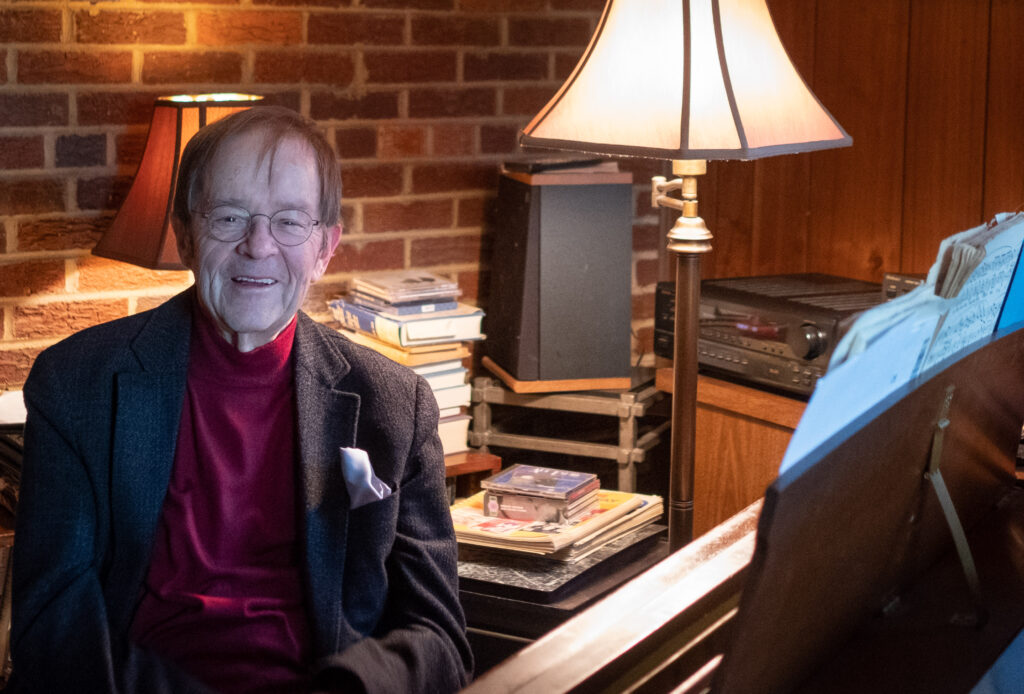
John Eaton, a jazz pianist who helped draw renewed attention to the Great American Songbook, championing the work of Hoagy Carmichael, George Gershwin, Fats Waller and other composers while gaining a reputation as one of Washington’s most versatile and inventive musicians, died May 24 at his home in Chevy Chase, Maryland. He was 91.
His death was confirmed by his daughter, Beth Kelley.
Mr. Eaton learned the piano by ear at age 6, got a classical training from composer Alexander Lipsky and developed an elegant, graceful style while performing at D.C. piano bars and leading the house band at Blues Alley. As jazz greats passed through the city, he joined them at the piano, performing with musicians including “Wild Bill” Davison, Roy Eldridge, Clark Terry, Benny Carter and Zoot Sims.
Across a more than six-decade playing career, Mr. Eaton recorded albums for the Chiaroscuro jazz label, took requests from first lady Nancy Reagan at the White House, delighted audiences at the Barns at Wolf Trap and maintained a long-running association with the Smithsonian Institution, delivering song-filled lectures on American music that were broadcast around the country.
To jazz critic Nat Hentoff, Mr. Eaton was “a complete pianist … a bemused master of just about the whole spectrum of jazz language.” Buffalo News music critic Herman Trotter, who attended many of Mr. Eaton’s summertime concerts at the Chautauqua Institution in western New York, praised his “mind-boggling harmonic inventiveness, easy rhythmic freedom, and absolute fidelity to the composer’s spirit.”
Mr. Eaton was especially known for his ability to inject new life into jazz and pop standards, reinterpreting touchstone like Cole Porter’s “Night and Day” or Duke Ellington’s “In a Sentimental Mood.”
“He’ll pick a song,” jazz pianist Marian McPartland told The Washington Post in 1985, “and twist and turn it, and hold it up to the light, and then polish it a little as if it were crystal.”
Playing at Billy Martin’s Carriage House or the Fairfax hotel on Embassy Row, he might slip a bit of Bach into “Ain’t Misbehavin’” or create an impromptu medley out of the standards “Laura” and “Sweet Georgia Brown.” His repertoire included the ragtime songs of Scott Joplin as well as the bebop of Bud Powell, along with occasional Beatles tunes that served as a launchpad for improvisations.
“It’s not a question of traditional versus modern,” he told jazz journalist W. Royal Stokes. “It’s a matter of doing what you’re comfortable with, and if you do what you’re comfortable with, it always sounds fresh. You never run out of ideas.”
The grandson of a Washington business journalist and a Cornell University president, Mr. Eaton was a self-described “ex-member of the establishment.” He studied at Maryland private schools, earned an English degree from Yale and was doing graduate work at Georgetown University, preparing for a teaching career, when he dropped out around 1960, ditching the academy for his “first love,” jazz.
“It wasn’t hard to get a job then,” he told the New York Times, remembering early dates at the Mayfair club. “There was a lot of musical activity in Washington. Charlie Byrd, the guitarist, was just getting started with his club, and the economy and popular taste were in my favor.”
Before long, Mr. Eaton found a niche as a kind of musical preservationist, promoting songs that had fallen out of fashion with the rise of the folk and rock scenes.
“We always think of classical music — the European variety of Mozart and Beethoven and so on — as a high art form. But this — Gershwin and Ellington, especially, and all the rest of them, too — they are America’s classical composers,” he said in a 2013 interview with the Georgetowner newspaper. Their music, he added, was “as fresh and great as any music ever written.”
Mr. Eaton began working with the Smithsonian in the late 1970s, performing concerts that he came to describe as “a mixture of stand-up comedy, lecture and playing.” Over the next decade, he took his show on the road, performing at college campuses and concert halls while interspersing songs with droll interludes about the stride style of jazz, the development of bebop or the idiosyncratic stylings of pianist Thelonious Monk.
Onstage and in interviews, Mr. Eaton was blunt in his assessments of contemporary music. “So much of what you hear is wall-to-wall junk,” he told The Post in 1985, singling out composer Andrew Lloyd Webber as “a total charlatan who writes synthetic music he borrowed from everyone else.”
Mr. Eaton also showed a softer side while delivering a steady patter in between songs, honed from years of playing to packed houses as well as the occasional near-empty room. “We have time for about two more numbers,” he once told a crowd of perhaps a dozen people, performing at Washington’s Embassy Row Hotel a few days before Christmas. “And then, I think, the hotel is going into receivership.”
The younger of two sons, John Livingston Eaton was born in Washington on May 29, 1934. His father, Harry, was a vice president of the Whaley-Eaton newsletter, one of the country’s first widely circulated business newsletters. Mr. Eaton’s grandfather Henry had co-founded the publication in 1918.
After work, Harry would come home, play the George and Ira Gershwin song “Oh, Lady Be Good!” on the piano, and make himself a martini. “He taught me a lot of the songs just by playing them,” Mr. Eaton told The Post.
When Mr. Eaton was 16, his father died of a heart condition. His mother, Margaret Farrand Eaton, married retired Navy Rear Adm. Charles Conard the next year.
Mr. Eaton attended the private Landon and Saint James schools and graduated from Yale University in 1956. After a stint in the Army, he underwent a musical apprenticeship at the Bayou, then a Georgetown haven for Dixieland jazz, where he played in a group led by cornetist and bassist “Wild Bill” Whelan.
Crucially, he also began to take lessons from Lipsky, whom Mr. Eaton continued to study under for 25 years. “He took me on as a semiliterate jazz pianist,” Mr. Eaton recalled, “and he taught me to play the piano.”
Mr. Eaton settled in the American University Park neighborhood of Northwest Washington and supplemented his income by taking on piano students.
“When I was younger and bolder,” he explained to the Times, “I had a chance to go on the road, but my family was young, and the money wasn’t good. Then I got comfortable. I was making a decent living, and people in Washington knew what I did. There was an economic stability there. I needed a reason to leave. If I were more aggressive, I might have left before this. I wanted to leave, but I didn’t want to.”
His marriage to Carolyn Berry, with whom he had two children, ended in divorce. Mr. Eaton was later married to Audrey “Penny” Karr, a creative director at Time-Life Books and co-owner of a consignment shop, Sequels. She died in 2013.
In addition to his daughter, survivors include a son, John “Bo” Eaton; six grandchildren; and two great-grandchildren.
Mr. Eaton said that in his piano playing and stage patter, he was inspired by stride pianists like James P. Johnson and Willie “the Lion” Smith, who mesmerized listeners with their expressive styles and larger-than-life personalities.
“They realized that music, to be anything, has got to be communicated to the audience,” he said in an interview for Stokes’s 2000 book “Living the Jazz Life.” “Otherwise, what’s the use of it?”
The post John Eaton, renowned jazz pianist and advocate for American music, dies at 91 appeared first on Washington Post.