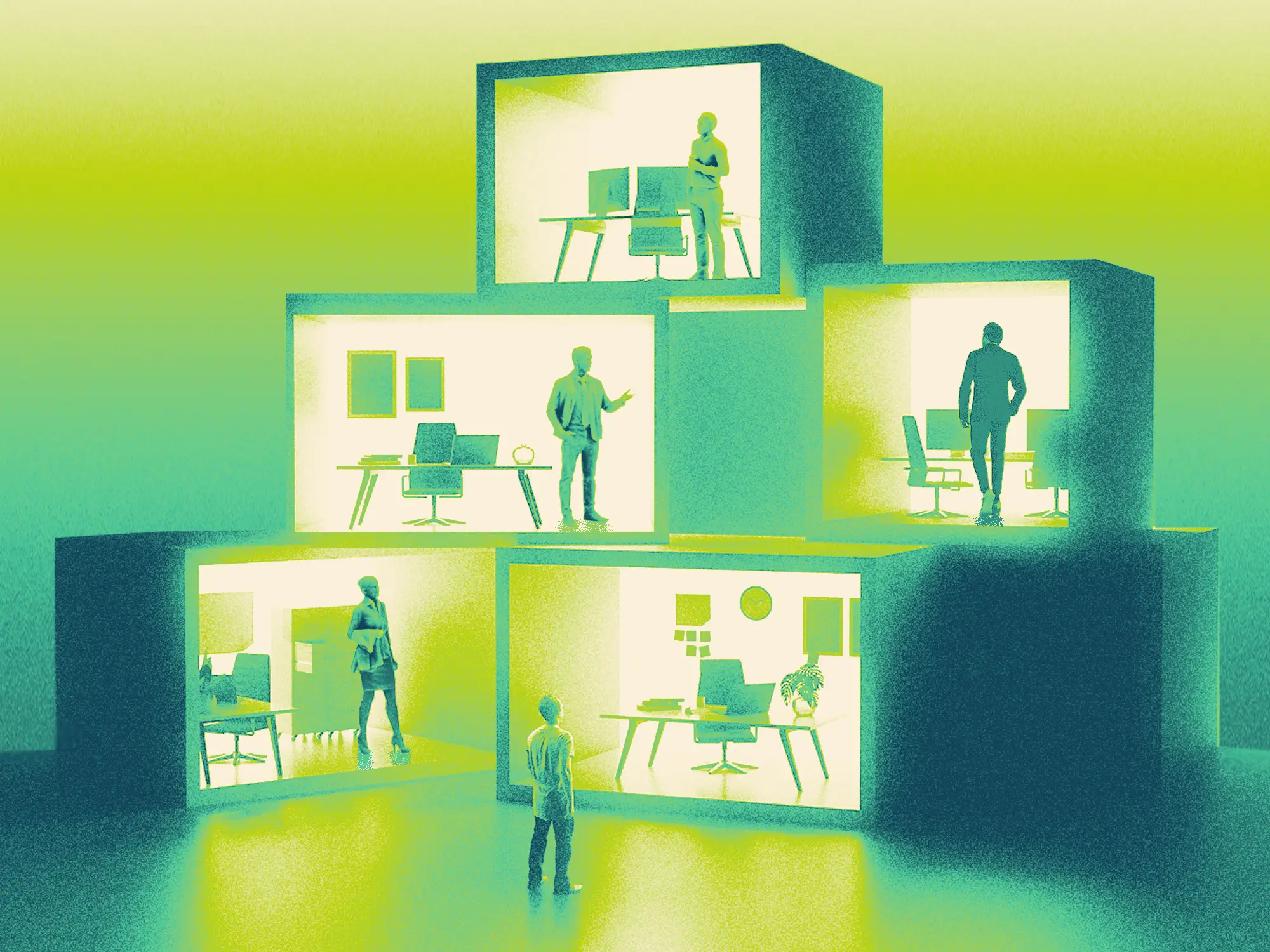
Work was never supposed to be your entire social life.
But for many people, it’s become the last meaningful part of one.
Now, AI is threatening to take that away. The office is becoming less social, less human, and less alive.
That’s because the AI revolution won’t just shrink companies’ workforces, it will also weaken the relationships between the employees still working inside them, BI’s Aki Ito writes.
For all the indignities of modern work — the Slack pings, meetings that should’ve been emails, “just circling back” for the fifth time — offices quietly served another purpose: They brought us together.
We found mentors and confidants. Work spouses and — in some cases — actual spouses. We vented after meetings. Learned how to disagree. Built friendships in the gaps between spreadsheets and status updates.
But now some of us are on our own. And some researchers think the consequences could be much bigger than awkwardly quiet offices.
Studies are beginning to show that heavy AI users report lower trust in colleagues, weaker team coordination, higher burnout, and greater feelings of isolation.
Which raises an uncomfortable question: What happens to workplaces when nobody really needs each other anymore?
Because the risk doesn’t stop at the office door. Some Americans were already writhing in the throes of a loneliness epidemic, which the US surgeon general compared to the health impact of smoking 12 cigarettes a day. And if work is one of the last remaining places where people regularly interact with others beyond their close circle, its gradual erosion could reshape how connected we feel in everyday life.
But it might not be too late to change that trajectory.
Some companies are already experimenting with ways to use AI to strengthen relationships rather than replace them, while deliberately rebuilding the social interactions work used to generate accidentally.
Because becoming more productive and more alone at the same time was never the trade we thought we were making.
Read the original article on Business Insider
The post Why your colleagues have stopped talking appeared first on Business Insider.