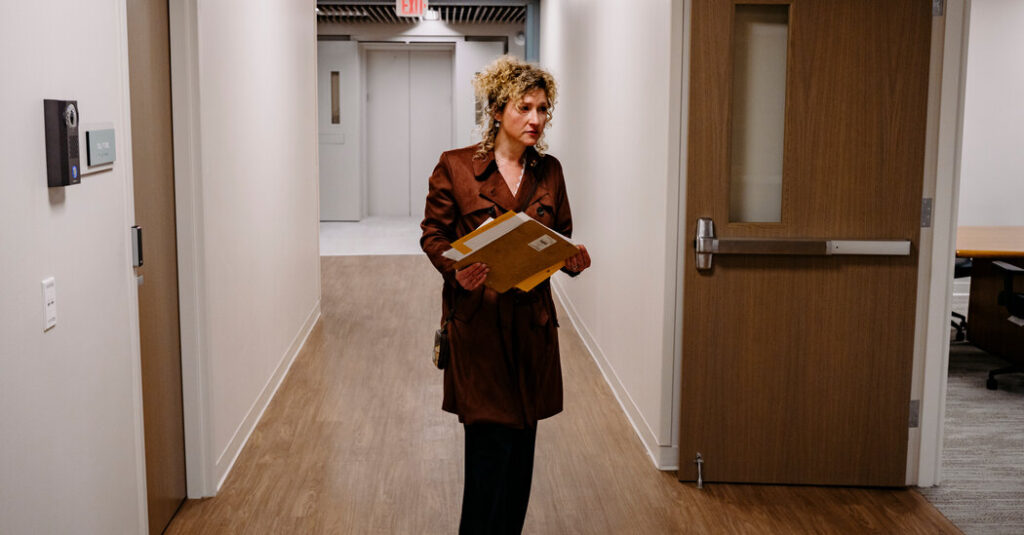
At the top of a gravel road, inside a small aluminum-clad building, Kassi Solberg arrived at another town council meeting in Broadview, Mont., causing trouble.
This time, the mayor threatened to call the sheriff.
Ms. Solberg was at it again, demanding information about a Houston company’s plan to build a behemoth 5,000-acre A.I. data center campus near her rural property. The development, part of a nationwide boom in facilities that can power artificial intelligence, would be the size of about 3,800 football fields.
Her face grew red when Broadview’s mayor gruffly turned down her request to host a public forum about the data center. Because the property was outside the town limits, “it doesn’t affect us,” he said.
“It affects your residents!” Ms. Solberg said, leaning forward in her chair, frustrated that the council members didn’t share her unease that the project could destroy the area’s traditions of farming and ranching that have endured for generations.
One of only two members of the public at the meeting last month, she asked: Has anyone on the town council signed a nondisclosure agreement with the developer that would keep them silent about the project?
The mayor said the council wasn’t obliged to answer the public’s questions at the town meetings, according to what the town’s lawyer had told him.
One council member leaped from her chair to confront Ms. Solberg, nearly nose to nose, demanding that she leave. Another council member, the mayor’s sister, said the group had no power over whether the data center would come to Broadview.
“You can’t stop it,” she said.
Still, Ms. Solberg, 43, is trying to stop it, or at least slow it down, until some questions are answered. She is stepping into an increasingly common role for residents in rural communities throughout the United States where data centers are planned: the fledgling gadfly taking on Big Tech, racing against the clock to rouse concerns among neighbors over construction projects so large they have no precedent.
Developers and the tech companies behind the quick and quiet proliferation of data centers often respond with little transparency, asking communities to simply trust them while sharing no official plans.
“I think they count on us being dumb country people and us not pushing back,” Ms. Solberg said. “But by the time you figure out what these companies are planning to do, they’ve got the data centers built already.”
The Kassi Solbergs of the country might not have the financial might, political power or legal arsenal needed to beat back the multibillion-dollar projects catalyzed by the world’s most powerful companies. But they do have a fierce loyalty to their way of life and their land.
Can a stay-at-home mother of six thwart one of the biggest developments in her state’s history?
On one side of Ms. Solberg’s 21-acre property, the jagged teeth of the snowcapped Crazy Mountains rise from the horizon. Everywhere else is an endless jigsaw of green and tan fields and farms, home to antelope, deer and prairie dogs. Coyotes howl at night, but the loudest sound on most days is the wind whooshing through the grass, the white noise of the Great Plains.
“It’s very peaceful here, and we just want to live simply,” Ms. Solberg said with a sigh last month, as she pitched hay to her horses while meadowlarks sang in the distance. “That’s exactly what we were looking for. But will we be able to live like this anymore?”
Ms. Solberg and her family moved here in November from Idaho for her husband’s job, bringing their menagerie: 12 chickens; 12 ducks; 2 horses; 3 cats; 4 dogs, including one 140-pound Anatolian shepherd who greets every visitor at the car door; and their milk cow, Lily.
Their 8-year-old daughter, Zoe, was their only child who made the trip. Their older children were already out of the house.
They sought solitude and freedom in Montana, and found it outside Broadview, a town of about 140 people, with one restaurant, one gas station and no stop lights along a lonely two-lane highway that leads to Billings, the state’s most populated city, 30 miles away.
Ms. Solberg home-schools Zoe in the dining room while the scent of homemade sourdough bread rises from the oven. On Tuesdays, they head to a children’s Bible club in Lavina, the next town over, 14 miles away. Wednesdays are for 4-H Club and ballet.
Ms. Solberg had dreams of her five other children moving onto the property with their own families someday. Then, on Jan. 4, she saw a video on the town’s Facebook page. A local activist whose daughter attends the town’s only school, was inviting people to meetings about A.I. data centers.
“These A.I. centers are like something we’ve never seen before,” the woman said on the video.
Ms. Solberg turned to her husband, Brendan. They wondered, what’s a data center?
Questions were racing through Ms. Solberg’s head later that month as she sat among more than 100 people in an auditorium at Rocky Mountain College in Billings, where the local activist, Cari Olson, and several environmental experts spoke about the recent wave of data center activity in Montana.
At least three large data centers and many smaller ones have been proposed for the state, lured by tax breaks, vast open land and Gov. Greg Gianforte, who has tried to make Montana a hub for A.I. So many people came to the meeting that some were stuck in the hallway, trying to listen in.
“People are very upset,” Anne Hedges, executive director of the Montana Environmental Information Center, a nonprofit that hosted the gathering and others around the state, later said. “We are seeing a response that, in my 32 years, I’ve never seen.”
An M.C. introduced the speakers. “I have assurances from all of them that they did not use ChatGPT to write their presentations,” she said, getting a laugh before the tone shifted.
Ms. Solberg took notes: A data center is a warehouse-size building that holds a sea of computer servers that run day and night, collecting, processing and storing data for the internet. Giant ones are needed to run A.I. models that teach computers to think like humans. The chief executive of Quantica Infrastructure, the developer of the Broadview project, has said on a podcast that the campus could have 12 to 16 buildings, 200,000 to 300,000 square feet each.
Data centers need a lot of water — in some cases, more water than a small city needs — because the servers create intense heat and require continuous cooling. This could be disastrous for Broadview, Ms. Solberg thought, because water is precious there. Many residents struggle with low water flow; they don’t do laundry and shower at the same time.
She also learned that data centers require a massive amount of electricity. NorthWestern Energy, Montana’s largest power provider, signed a letter of intent to provide up to 1,000 megawatts to Quantica’s Broadview data center — enough to power every home in the state on an average day, and then some.
A document appeared on the video monitor, showing the letter of intent from NorthWestern regarding Quantica’s project. Ms. Hedges said that about the only thing not redacted “is the language that says, ‘This is confidential.’”
The companies said discretion was necessary to protect business strategies. Ms. Solberg said she couldn’t help but be suspicious.
A few seats away from her were Charlie Baker, the chief financial officer of Quantica, and Jess Peterson, a lobbyist and management consultant who is the local face of Big Sky Digital Infrastructure, the arm of Quantica that is developing the Broadview project.
Ms. Solberg noticed the company’s logo on one of their jackets and sneaked glances at them. The two men listened to the presentations, but never spoke.
A Broadview town council member’s garage was renovated recently. Now it’s the local headquarters for Big Sky Digital Infrastructure, which holds weekly office hours to give community members a chance to talk to company representatives about the data center.
I attended an office-hours session last month, to interview Mr. Peterson. Inside, a white board featured a welcome sign drawn by Mr. Peterson’s two daughters in middle-school cursive. Another sign said, “Go Pirates,” for the town’s school.
Mr. Peterson said Quantica had gone out of its way to have “complete transparency” about its project, which he said would be “a data center done right.”
He acknowledged that some residents might be concerned about information they had learned from environmental groups objecting to the data center’s potential use of water and electricity. But the public just has to trust that Quantica will do right by them, he said — they are partners in this.
Everyone will know more, he told me, when Quantica signs a contract with a tech company to use the facility. That announcement could come by the end of the year.
Besides, Mr. Peterson said, much of the apprehension over the data center comes from people who are afraid of A.I. more broadly, as if “Big Brother is going to take over,” he said.
Those people, he added, “have no role in this conversation.”
What Mr. Peterson could tell me now, he said, was that the project would have minimal impact on the land and the people who live nearby. And residents wouldn’t have to pay a thing for it. He offered no guarantees, but said the project would bring its own power — at least some of it from solar and natural gas.
Despite what opponents have been saying, and despite the information gleaned from data centers around the world, Mr. Peterson said the Broadview site would need “not that terribly much” water.
It will bring jobs, he said. Thousands of temporary workers could descend on Broadview for the construction. The number of permanent jobs would be 30, 40, 100 — he doesn’t know for sure. But he described them as good-paying jobs that would not require specialized training or a college education. Jobs like janitors, maintenance workers or security guards.
He likened it to “being a miner, but not having to grab a drill.” Generations of families could stay in Broadview because people would not have to move to make a living, as many are doing now. They could say, “Oh my gosh, I could push a broom and come home to my home in Lavina that I love — and my kids can do that?”
For anyone who doesn’t like the idea of living next to a data center, he added, “there’s probably a county up the road that doesn’t have one.”
He said the eventual deal would include a “community benefits package,” which could help Broadview pay for things like its problematic wastewater lagoon. The Montana Department of Environmental Quality issued the town a violation in March for longstanding issues at the site, demanding compliance. Remediation could cost millions.
The mayor has said the town had no official business with Quantica, but Mr. Peterson said town officials did ask the company for financial help with its lagoon, recalling them saying: “It’s a big cost for the community. We’re in a big deficit now.”
Of course the company would help, Mr. Peterson said. He said he had been checking with the town council to see how its requests for loans and grants were going, and that a town councilwoman visited him every week to chat.
Quantica also has been putting money toward school functions, like concessions at sporting events, and town causes, including the emergency squad.
Last fall, it bought a hog that had been raised by a member of Broadview’s 4-H Club, and turned it into pork for the school’s lunches. “Nothing is more rewarding than bringing homegrown Montana pork to the kids right here in Broadview!” the company said in a social media post.
In Wrangler jeans and a hoodie under a jean jacket, Ms. Solberg stood in front of the Yellowstone County commissioners at one of their weekly meetings in March, voice shaky and notes in hand, as she presented a case to pause the development of the data center.
“We would like some guardrails on this project out in Broadview,” she said, asking for the county to pass an interim zoning ordinance so it could have time to study the project’s impact. “We’d like transparency, accountability and protections.”
As Ms. Solberg read her exhaustive research about the effects of data centers on things like water, air temperature and electricity, the commissioners grew antsy. “How much longer?” one said.
She had some allies. Rick Eaton, a knife maker who raises horses, was one of more than a dozen people at the hearing in favor of Ms. Solberg’s zoning request. “She has been carrying a heavy load, especially being right there near where the data center will be,” he said later.
Twenty years ago, Mr. Eaton and his wife, Marie, moved to an 1,100-acre ranch northeast of Broadview from the fast-paced world of the West Coast.
“We live here for a reason, and that’s to get away from these big businesses, big government and technology, so it’s frustrating that they tracked us down and showed up at our doorstep anyway,” he said. His main worries are that the data center will cause his wells to go dry and make his electric bills unaffordable.
Tim Wipf is the president of the Mountain View Hutterite colony outside town, where his group of German-speaking Anabaptists lives on a communal farm. He begged the commissioners to protect residents. If the data center affects the aquifer, what will the 140 people in his colony do? Their lives and businesses are tied to the land.
They have 160 dairy cows and 19,000 chickens (they sell the eggs to Walmart), and they ship 1,800 pigs a week to other states. The farm needs a lot of clean water.
“These people do think we are stupid,” he said. “But where do people think their eggs and milk comes from? People like us.”
The county denied Ms. Solberg’s request.
Every day, Ms. Solberg sits at her desk that looks out onto miles of prairie and reads about people across the country who have succeeded in hindering data centers.
They’re storming into town hall meetings. Recalling politicians who don’t endorse moratoriums. Lobbying for state legislation.
She has been desperately trying to get that kind of traction in Broadview. There have been no breakthroughs — yet. “I hope I will be able to make a difference,” she said. “But, you know, I’m just not sure.”
The Montana Legislature meets only once every two years, and is not set to convene again until January. The data center construction might be well on its way before state lawmakers offer help, she said.
Her fellow Broadview-area residents aren’t exactly galvanizing behind her efforts. Residents who meet most mornings at the Homestead Inn, the only restaurant for miles, say they don’t know what all the fuss is about.
Sipping coffee and snacking on homemade glazed potato doughnuts called spudnuts last month, the group decided that people should not be protesting a project that might not happen. Other projects for that land have come and gone, they said.
“Why do they keep bothering us?” said Roger Swartz, the mayor, whose brother, Duane, owns the restaurant. “They’re just too much. It’s all too much.”
Yet Ms. Solberg continues to show up at every town council and county commissioners meeting. “I’m still here,” she told the town council at its last session.
The Yellowstone County commissioners suggested that Ms. Solberg pursue a special zoning ordinance that citizens can initiate to protect the health, safety and welfare of county residents.
“Is that a red herring?” she asked them, adding that their apparent apathy has been deflating. She wondered out loud if they were sending her on a wild-goose chase.
The citizen-led zoning permit requires approval from at least 60 percent of the landowners whose properties border the data center land, and Ms. Solberg and her husband have been trying to get those ranchers and farmers to sign petitions in support of it. But that has been a challenge. This time of year, ranchers are busy branding and castrating their calves. A few have declined because they’ve leased their land to Quantica.
Ms. Solberg invites the landowners, 20 of them, to a weekly video call to discuss the zoning regulations she must formulate to create a special district. Only one family has shown up.
With just days left to file the paperwork with the county, she drove six hours round trip to save an hours-old calf whose mother was sent to slaughter. She then stayed up past midnight to try to draft the regulations — a daunting assignment for someone with no legal background.
She has felt growing pressure. Last week, Quantica announced a new plan to generate not just 1,100 megawatts of power for the Broadview campus — but more than 7,000 megawatts. That’s more power than is generated by the Grand Coulee Dam, the largest power plant in the country.
If Quantica uses all of that power in Broadview, the site would be one of the biggest data center campuses in the world.
“There’s a monster coming,” Ms. Solberg said. “I’m just trying to warn everyone about it.”
Juliet Macur is a national reporter at The Times, based in Washington, D.C., who often writes about America through the lens of sports.
The post The Homesteading Mother of 6 Taking On Big Tech appeared first on New York Times.