Ekaterina Mittsel ran through her 6-year-old daughter’s schedule as she waited at the school pickup line in Thailand’s tropical heat. Mondays are for choir practice, Tuesdays and Thursdays for gymnastics. Wednesdays and Saturdays are for Russian lessons — just in case the family ever decides to return home.
The Mittsels are among the hundreds of thousands of Russians who left the country after the 2022 invasion of Ukraine, and one of an estimated 30,000 Russian émigrés living on Phuket, a resort island in southern Thailand. Many of them see it as calmer than Bali, cheaper than Dubai and friendlier than Europe.
“We joke that we meet our friends here more often than we did in Moscow,” Mrs. Mittsel, 36, said during an interview at the family’s hillside bungalow, which has a view of Phuket’s southern coast.
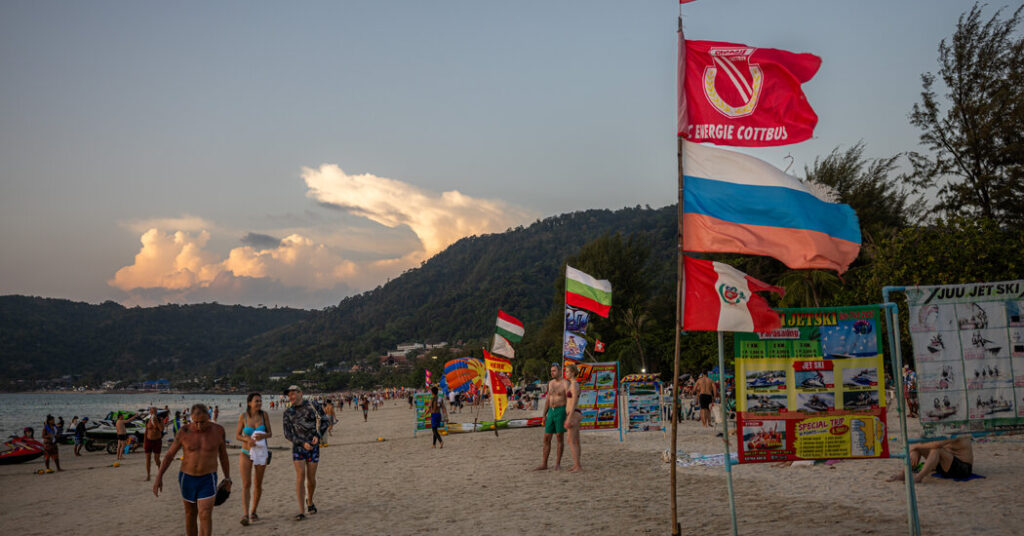
Signs of Russian influence are everywhere on the island, a popular destination for Russians even before the war: Russian saunas that thrive despite the tropical weather, Russian grocery stores that sell ingredients from home and daily flights to Phuket by the Russian state airline Aeroflot. Beachside restaurants offer cold borscht, and some Russian pop stars and rappers have added the island to their international tours.
But as Phuket’s Russian community has grown, so has local resentment over Russians amassing properties, opening businesses and — critics say — abusing the country’s visa policy to work illegally. (The Thai foreign ministry declined to directly answer questions about allegations of visa fraud on the island.)
The resentment has contributed to an air of impermanence that hangs over Phuket’s Russian community. Russians who have residence visas, including the Mittsels, said in interviews that they don’t see the island as a forever home. And Russians on shorter-term stays face pressure from a government crackdown on tourist visas.
On Tuesday, the Thai government halved its tourist visa exemption period from 60 days to 30 days. That could affect many of the roughly 15,000 Russians that the Russian consulate in Phuket says live on the island without long-term visas. Some are young men who left Russia to flee conscription.
Evgenii, a 39-year-old engineer who asked that his surname not be published for fear of reprisal, said he had left Russia in 2022 and moved around Europe before settling in Phuket. He worked at a real estate agency for about six months, but had to resign to leave the country temporarily to reset his visa exemption, which was expiring.
“I’m good at it,” he said, referring to his real estate work. “But I’m always thinking about hopping the border.”
Some of the young Russians who remain in Phuket attend an Orthodox church service on Sundays, staying afterward for a lunch of rice and clam soup. One man there said he was training in one of the island’s Muay Thai gyms through a 90-day visa that the government offers for amateur fighters.
As their visa exemptions expire, many Russians pay $150 to be driven across the border and back to restart the clock on their stays — a hefty recurring fee for young men scraping by on irregular work. Evgenii said he was going to Vietnam to consider his options for staying in Thailand.
“I’ll either return to Phuket with a visa, or pick up my things and move on,” he said.
Thaneth Tantipiriyakit, the president of a provincial tourism association that serves businesses in Phuket, said it had received complaints about the visa-free policy from Thai people in Phuket.
“Whenever there’s a foreigner behaving badly, they blame the free visa,” he said, adding that Russians became a conspicuous target partly because they are the largest group of tourists on the island. Similar resentment has sprung up in Bali, the Indonesian island that had once welcomed Russians and Ukrainians who fled the war.
In Phuket, some local residents also blame Russians for rising property prices that have made housing unaffordable for many Thai people.
The center of Russian society in Phuket, Bang Tao, is nicknamed Thai Rublyovka, after Moscow’s most exclusive neighborhood. Four years ago it was empty beachside land. Now it has resorts, commercial strips, gated villas and luxury condominiums.
Russian buyers accounted for more than half of property sales in Phuket in the first year of the war in Ukraine, according to Thailand’s Real Estate Information Center, a government research agency. The price of land on the island rose by at least 20 percent that year, the agency said.
Maksim Shatilov, who is from St. Petersburg and owns a real estate brokerage in Phuket that serves Russian families, has seen his business boom in the past four years.
“After the war started, there weren’t many places where you could feel free to be a Russian,” he said.
Russian money was on display on a recent evening at Come Leo Come, a Russian-style supper club in Bang Tao that is owned by a Ukrainian businessman. Guests pulled up in sports cars, and high heels were the unspoken dress code for women.
In the dimly lit and velvet-walled dining room, Russian-speaking waiters offered shots of premium tequila and vodka as well as platters of sashimi and caviar, while Thai staff worked in the back of the house. Dancers brandished champagne sparklers as two saxophonists played on top of the bar.
Despite making his fortune in Phuket, Mr. Shatilov, 31, said it was not his forever home. But he and his wife, Alona Myronenko, cannot return to Russia, in part because she is a Ukrainian citizen.
“Now the place I really want to travel to is Moscow,” he said, “but I don’t feel safe.”
Mrs. Mittsel said her family also feels the pull of home.
They left Russia in 2022 because her husband, a software engineer at an American technology company, could not be paid locally when U.S. sanctions blocked several Russian banks from the SWIFT payment system.
After they settled on Phuket — the setting for the latest season of “The White Lotus” — they were joined by other Russian friends seeking stability for their young families.
At the end of each school year, the Mittsels consider moving back to Russia instead of renewing their visas. They visit home every summer to see their parents, but their daughter longs to skate on ice and play in the snow. Last year, Mrs. Mittsel brought her to a winter carnival at a mall in Bangkok, the Thai capital, to enjoy the fake snow.
So far, they have decided to stay, out of concern that she would struggle to adjust to Russian schools.
Mrs. Mittsel said she misses Moscow’s opera, ballet and music scene. But she doesn’t miss clubbing. That’s why she and her husband rarely make the long drive from their home on the island’s southern peak to Bang Tao’s exclusive clubs.
“I don’t have those kinds of outfits,” she said. “I left them in Russia, like, on purpose.”
Francesca Regalado is a Times reporter covering breaking news.
The post Russians Are Thriving on This Thai Island, but the Scene Feels Fleeting appeared first on New York Times.