SEOUL — As China shows greater willingness to strong-arm its neighbors and President Donald Trump injects waves of unpredictability into global affairs, Japan and South Korea are banding together as smaller nations redraw the geostrategic balance in Asia despite their complicated history.
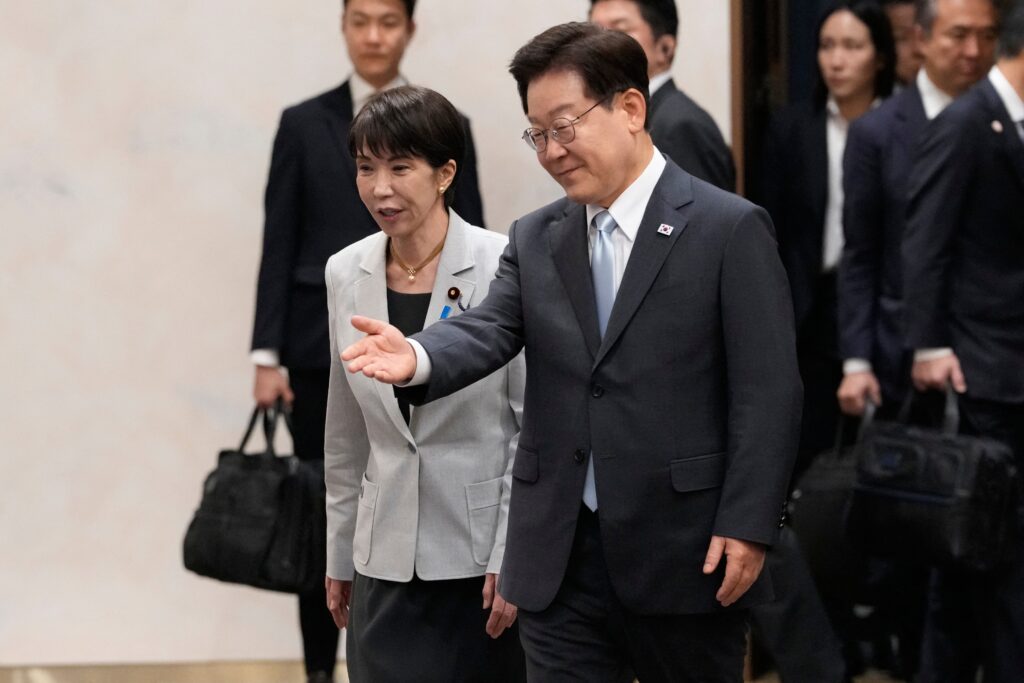
The growing urgency felt by nations around the world to insulate themselves from the big powers was evident as South Korean President Lee Jae Myung hosted Japanese Prime Minister Sanae Takaichi for a two-day summit last week in Lee’s home city of Andong, including a banquet and a traditional fireworks show.
The visit, with a heavy dose of bonhomie, was intended as reciprocation for a meeting in January in Takaichi’s hometown.
In Asia, as in Europe, Trump’s seeming ambivalence about the value of allies has created a sense of urgency among countries whose security long relied on close ties with the United States but that also face the added complication of heavy economic dependence on China. The U.S.-Israel war in Iran has added further uncertainties, prompting nations in the region to turn to each other.
Japan is at the center of the effort to reinforce the U.S.-led security order in the Asia-Pacific. Takaichi in recent weeks has been promoting a diplomatic strategy that positions Tokyo as a leader from the Pacific to the Indian oceans with an implicit goal of containing China.
This Japanese effort has become even more important with the U.S. focused on the Middle East, experts said. Japan sees itself as the stable actor making sure that the balance of deterrence in the region doesn’t collapse, even — or especially — when the U.S. is distracted.
“The Iran war has triggered another geopolitical shift,” said Kunihiko Miyake, research director at the Tokyo-based Canon Institute for Global Studies and a former Japanese diplomat. “And in order to respond to that shift, Japan doesn’t have time to just hang around Washington chatting idly.”
Indeed, Takaichi has been hitting the road.
In Vietnam and Australia earlier this month, and last week in South Korea, Takaichi rolled out plans to bring the countries together for roughly $10 billion in emergency responses to the fuel shortages and supply chain disruptions caused by the Iran war, and promoting new steps to make the oil-dependent region more energy-resilient in the long term.
Japan has also struck defense deals with the Philippines and with NATO countries, especially in light of Russia’s war with Ukraine, which some in Tokyo fear could embolden Beijing to attack Taiwan.
Takaichi is promoting her version of Japan’s diplomatic strategy for a “Free and Open Indo-Pacific,” which was coined by her mentor and predecessor, Shinzo Abe. Takaichi, a security hawk who took office last fall, is now building on Abe’s efforts by increasing military, energy and critical minerals agreements with Asia-Pacific nations facing threats from China.
Unlike efforts by Canadian Prime Minister Mark Carney to rally middle powers against U.S. economic coercion and the U.S.-led international order, the strategy in this region is more nuanced: Middle powers are drawing closer, while each seeks ways to stabilize their own security relationship with the U.S.
“The Carney vision of middle powers counterbalancing the U.S. and diversifying away does not work for Japan or Korea or Australia because the China menace, the China shadow, is just so large,” said Michael Green, a senior director for Asian affairs at the National Security Council under President George W. Bush.
“As unnerving as Donald Trump’s tariff and alliance policy has been, there’s no alternatives to the U.S.,” Green said. “And the China problem is much bigger.”
A visit to Beijing by Russian President Vladimir Putin last week — right after Trump’s own summit there — only reinforced China’s growing influence and dominance.
China and Russia
For China, Putin’s visit was an opportunity for leader Xi Jinping to flex his diplomatic muscle.
“Hosting back-to-back visits by Trump and Putin is a great showcase of Beijing’s growing diplomatic leverage and unique role in engaging rival powers,” said Wan Qingsong, deputy dean of the Institute of Russian and Eurasian Studies at the Shanghai-based East China Normal University.
While Putin and Xi failed to reach a final agreement on a major new gas pipeline proposed by Russia, they touted their “unyielding” bond and signed a wide-ranging package of deals on trade, education, technology and more. Xi hailed that relations were at “their highest level in history.”
The visit underscored that Russia is China’s preferred partner, despite Trump’s efforts to net big wins in Beijing and paint the U.S. and China as equal partners in managing the global order, analysts said.
Since 2022, China has stepped up efforts to reshape major-power relations, deepening its strategic partnership with Russia, managing competition with the U.S. through pragmatic engagement, and positioning nations in Asia and Africa against what China call a U.S.-led hegemony.
Xi and Putin discussed plans to deepen cooperation to “steer the reform of the global governance system in the right direction,” the Chinese Foreign Ministry said — a reference to the U.S., according to analysts.
Putin’s trip was “reassurance that China-Russian relations — already at a very high level — are not a contingency or cozying up under Western pressure” even as Beijing and Washington seek stability in their often-volatile relationship, said Zhao Long, a senior fellow at the state-affiliated Shanghai Institutes for International Studies.
The close timing of Trump’s and Putin’s visits may have been a “technical coincidence,” Zhao said, but China was also trying to send a strategic message that it “doesn’t have to choose between the U.S. and Russia,”
“China will not weaken its relationship with Russia just because the China-U.S. relations are experiencing a temporary easing,” Zhao said. “Nor will it seek confrontation with the U.S. for the sake of deepening coordination with Russia.”
Japan and South Korea
China was among the main agenda items during Takaichi’s trip to South Korea last week, where she met with Lee in Andong, in the southeast.
Takaichi and Lee agreed to work together on stabilizing the supply chain and energy volatility resulting from the Iran war. In a moment of levity, Takaichi and Lee swapped eyeglasses and posed for a photo. Before their dinner, Lee announced the meal was prepared without red chili powder. (Korean food is far spicier than Japanese cuisine.)
The two leaders are unlikely pals. Takaichi, a conservative nationalist, has long defended Japan’s wartime past. Lee is a liberal with a long track record of criticizing Japan over lingering animosities stemming from the Japanese occupation of Korea.
Yet they have taken pragmatic steps to keep each other close as they face a volatile U.S. administration.
Seoul is also an important piece of the deterrence strategy for Tokyo, which wants to counter China’s economic dominance and shore up support from South Korea while Japan-China relations are at a low point.
Beijing has been wary of Takaichi because of her hawkish China policy and overt support for Taiwan, an island democracy that the Communist Party never ruled but claims as its own. A joint statement issued after the Putin-Xi summit condemned Japan’s “remilitarization” attempts, “nuclear ambitions” and “far-right provocations.” (Russia and Japan have a long-standing territorial dispute over the Kuril Islands, or Northern Territories.)
South Korea is walking a delicate path. China is its biggest trading partner, and Seoul needs Beijing’s help in dealing with North Korea. Seoul also wants to avoid taking sides in the Japan-China diplomatic spat.
Thorny historical tension over Japan’s occupation have long hindered the ability of Tokyo and Seoul to cooperate at a deeper level. While South Koreans’ view of Japan is growing more positive, particularly among younger generations, the rapprochement is fragile.
“Relations have improved tremendously,” said Miyake, of the Canon Institute. “But I still think there will be many twists and turns ahead. I do not expect relations to improve in a straight line.”
Tanaka reported from Tokyo.
The post Fearing China and an erratic U.S., Japan draws nearer to South Korea appeared first on Washington Post.