American military forces conducted what U.S. Central Command said were “self-defense strikes” in southern Iran on Monday “to protect our troops from threats posed by Iranian forces.”
The targets included missile launch sites and Iranian boats trying to place mines, Capt. Tim Hawkins, a Central Command spokesman, said in a statement.
“U.S. Central Command continues to defend our forces while using restraint during the ongoing cease-fire,” said Captain Hawkins, who declined to say which ships came under fire, where they were located or precisely where the other U.S. strikes took place.
A senior U.S. military official said Iranian surface-to-air missiles threatened some of the nearly two dozen U.S. Navy warships — including two aircraft carriers and their escort vessels — in the Gulf of Oman and Arabian Sea enforcing a blockade against vessels trying to enter or leave Iranian ports. The official added that the U.S. strikes hit near Bandar Abbas, a major port and Iranian navy base.
American and Iranian forces have had other skirmishes since a cease-fire took effect about six weeks ago. But the strikes on Monday came as Iranian negotiators arrived in Qatar for talks on ending the war, and they threatened to upend a fragile potential agreement that President Trump has said could reopen the Strait of Hormuz and relieve the greatest energy disruption in modern times.
That Iranian missile batteries were reportedly zeroing in on U.S. Navy ships came as no surprise, despite repeated assertions from Mr. Trump, Defense Secretary Pete Hegseth and other military leaders that the 38-day American-Israeli military campaign had vastly degraded or destroyed much of Iran’s combat power.
U.S. intelligence agencies have told policymakers in confidential assessments from early this month that Iran has regained access to most of its missile sites, launchers and underground facilities. While the United States has sunk most of Iran’s conventional navy, Iran’s Islamic Revolutionary Guards Corps still retains hundreds of small speedboats that can be used to lay mines in the strait.
Most alarming to some senior officials is evidence that Iran has restored operational access to 30 of the 33 missile sites it maintains along the Strait of Hormuz, which could threaten American warships and oil tankers transiting the narrow waterway.
People briefed on the assessments said they show — to varying degrees, depending on the level of damage incurred at the different sites — that the Iranians can use mobile launchers that are inside the sites to move missiles to other locations. In some cases, Iran can launch missiles directly from launchpads that are part of the facilities.
Senior U.S. military officials have also privately raised alarm about critically low American stockpiles of long-range missiles and other heavy ordnance — the very weapons needed to destroy Iran’s hardened underground missile sites. Instead of pursuing full destruction, the Pentagon opted for lighter munitions intended to seal off the entrances to those sites, the officials said, and the Iranians have been more adept at digging them out than the Pentagon anticipated.
Iran still fields about 70 percent of its mobile launchers across the country and has retained roughly 70 percent of its prewar missile stockpile, according to the assessments. That stockpile encompasses both ballistic missiles, which can target other nations in the region, and a smaller supply of cruise missiles, which can be used against shorter-range targets on land or at sea.
As recently as late last week, before Mr. Trump announced that the United States and Iran were close to an agreement, American military planners were poised to resume an intensive bombing campaign along the Strait of Hormuz, including the missile sites, to loosen Iran’s hold on the waterway, which carried roughly a fifth of the world’s daily oil supply before the war.
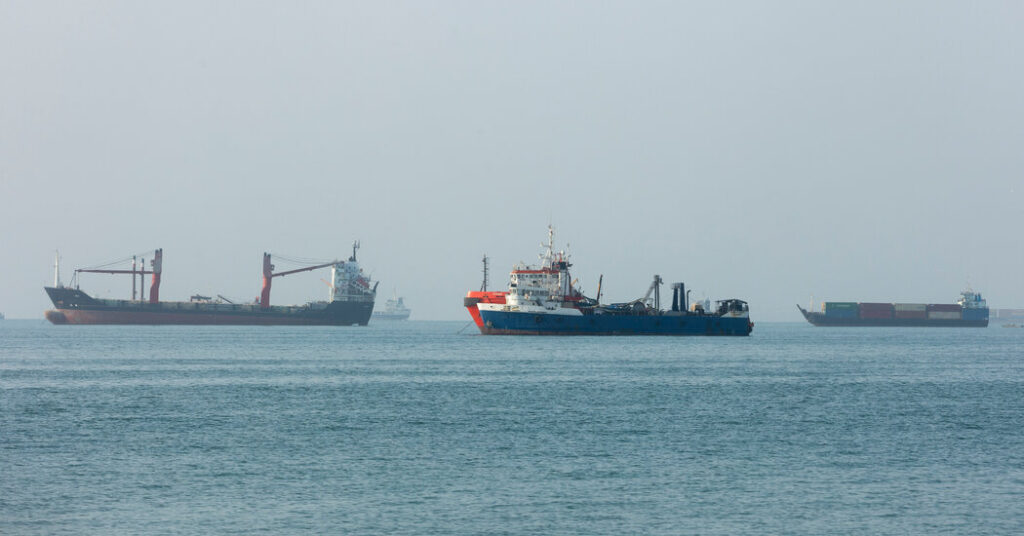
And nearly two dozen Navy warships and scores of U.S. attack planes in and around the Arabian Sea have enforced a blockade of Iranian ports, redirecting 100 vessels, disabling four and allowing 26 humanitarian aid ships to pass since the blockade took effect on April 13, Central Command said on Saturday.
Eric Schmitt is a national security correspondent for The Times. He has reported on U.S. military affairs and counterterrorism for more than three decades. Contact him securely on Signal: ericschmitt.36.
The post U.S. Carries Out Renewed Strikes in Southern Iran appeared first on New York Times.