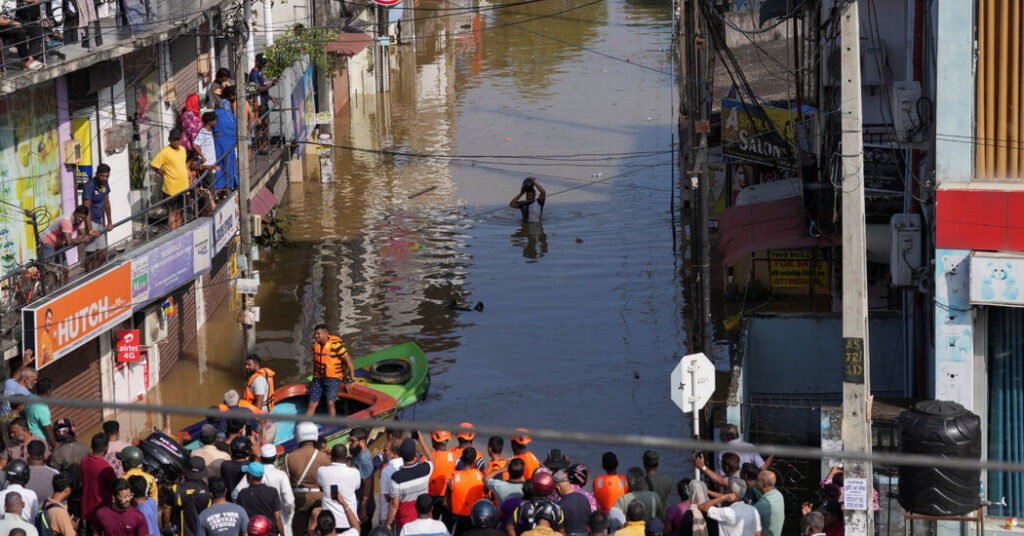
Sri Lanka’s president said that the island nation was grappling with the “largest and most challenging natural disaster in our history,” as the death toll from Cyclone Ditwah rose to 355 on Monday.
With 366 other people still missing, and over a million people affected as entire towns remain under water, officials said they feared the death toll would climb considerably. While the cyclone has passed the country, and is battering India’s southern coast, heavy rainfall and flooding is still predicted in some parts of the island.
The flooding and landslides were widespread, with deaths reported in more than half of the country’s 25 districts and people needing to be evacuated in more than 20 districts, overwhelming emergency response efforts. On Monday, rescue teams, aided by personnel and aircraft from neighboring India, were still trying to reach areas that had become off limits because of the high floods. More than 15,000 homes have been destroyed, according to an initial assessment on Sunday, the United Nations said.
The nationwide destruction is a major setback for the country of 23 million, which is reeling from a series of blows: three decades of civil war that ended in 2009, the devastating Indian Ocean tsunami in 2004 and, more recently, terror attacks and an economic crash.
“As a country, we are facing the largest and most challenging natural disaster in our history,” President Anura Kumara Dissanayake said in a televised address late Sunday. Referring to rescue efforts, he added: “With the nation affected from end to end, this is a highly challenging exercise that needs to be conquered.”
By Monday, the authorities had partially restored train services, electricity and telecommunications, all of which had been disrupted. But the initial assessment of the damage showed that at least 10 bridges were damaged and more than 200 major roads were still “impassable,” according to the country’s road development authority.
Access to clean drinking water remained a major problem in large parts of the country.
“The estimated scale of destruction is severe,” Mr. Dissanayake said.
Mujib Mashal is the South Asia bureau chief for The Times, helping to lead coverage of India and the diverse region around it, including Bangladesh, Sri Lanka, Nepal and Bhutan.
The post Sri Lanka Declares ‘Largest’ Disaster as Cyclone Kills 355 appeared first on New York Times.