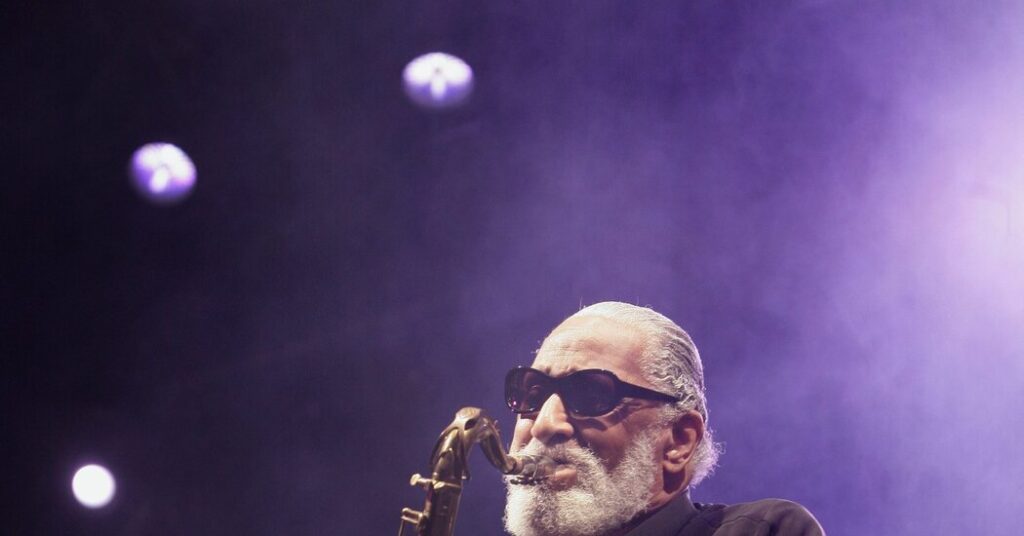
Sonny Rollins’s contribution to jazz can be hard to sum up easily. The saxophone great, who died Monday at 95, didn’t spearhead new movements, like Charlie Parker or Miles Davis; establish a unique compositional universe, like Thelonious Monk or Wayne Shorter; or lead an iconic working band, like John Coltrane or Duke Ellington. But what Rollins unquestionably did do, across his roughly 65-year career, is commit himself to the genre’s core imperative: inventing in real time, brilliantly and indefatigably.
As the critic Stanley Crouch once put it, “Sonny actually embodies what jazz really is, because jazz is really about making the present work.”
Early on, he produced classic recordings under ad hoc circumstances — recording in the middle of the night with a one-off trio on “Way Out West,” assembling another one hours before showtime on “A Night at the ‘Village Vanguard.’” In the ’60s, returning from a self-imposed two-and-a-half-year sabbatical, he brought a startlingly radical approach to a session with his saxophone idol, Coleman Hawkins, and gamely engaged the new jazz vanguard on albums such as “East Broadway Run Down.”
Rollins wrote prolifically, building a repertoire that included future jazz standards such as “Oleo” and “Airegin.” But in his later years, he remained committed to the popular songs that defined his youth, calypsos absorbed through his St. Thomas-born mother and other treasured fare. Taking the stage in 2001, he was happy to regale the audience with what he announced as “a number that I heard a long time ago when I was growing up,” finding renewed inspiration in “Without a Song,” a childhood favorite he had first recorded nearly 40 years earlier.
These 12 albums trace Rollins’s arc from rising star to elder statesman, showing how he never flagged in his restless pursuit of his next spontaneous feat.
‘Saxophone Colossus’ (1957)
Rollins’s mother, Valborg, would often sing calypso songs to her son. One of his favorites — a traditional tune known in many variants, including “Fire Down Below” — became “St. Thomas,” the jaunty opener to his definitive early album. A singsong melody and a shimmying Max Roach beat helped make it Rollins’s signature tune and the blueprint for the saxophonist’s many future calypso forays. The LP features the hard-driving original “Strode Rode” (which honored the trumpeter Freddie Webster, who had died at the Strode Hotel in Chicago in 1947) and an amiable take on Kurt Weill’’s “Moritat” (a.k.a. “Mack the Knife”), culminating with “Blue 7,” a lengthy blues the jazz historian Gunter Schuller would later proclaim a triumph of thematic improvisation. “The thing about the thematic approach, I guess it’s true, but I had never thought about it,” Rollins later said. “I was just playing it.”
 Listen on Spotify, Apple Music or YouTube
‘Way Out West’ (1957)
An avid moviegoer since childhood, Rollins particularly loved Westerns. When the producer Lester Koenig invited him out to Los Angeles in early 1957, he picked up on that theme, choosing tunes like Johnny Mercer’s “I’m an Old Cowhand (From the Rio Grande),” originally sung by Bing Crosby, Martha Raye and others in “Rhythm on the Range” from 1936. The bassist Ray Brown and the drummer Shelly Manne (who used a woodblock, adding a charming clip-clop texture) loped and cooked in turn, fueling the slyly daring style of a leader who, as he later put it, “was really living out my ‘Lone Ranger’ thing.”
Listen on Spotify, Apple Music or YouTube
‘A Night at the ‘Village Vanguard’’ (1958)
During an extended Village Vanguard engagement in the fall of 1957, Rollins couldn’t seem to find a band that suited him. Starting off the run with a quintet, he eventually sacked each of its members. (“I know that I was a pretty hard taskmaster at that time,” he later admitted.) On the day of a planned live recording for Blue Note, he made yet another swap between the afternoon and evening sets, replacing the bassist Donald Bailey and the drummer Pete La Roca with Wilbur Ware and Elvin Jones. The impromptu grouping turned out to be an inspired one, with Ware and Jones providing a foundation of finger-snapping swagger, inspiring relaxed yet marvelously fluent Rollins solos on lengthy performances of standards and originals like “Sonnymoon for Two.”
Listen on Spotify, Apple Music or YouTube
‘Freedom Suite’ (1958)
Rollins wrote “The Freedom Suite,” this LP’s sidelong centerpiece, in 1957 after he faced racial discrimination when trying to rent a New York apartment. “It was an attempt to introduce some kind of Black pride into the conversation of the time,” he later said of the roomy four-movement work, which again found him at the helm of a trio and left plenty of space for the vital contributions of the bassist Oscar Pettiford and Roach, two years before his own “Freedom Now Suite.”
Listen on Spotify, Apple Music or YouTube
‘The Bridge’ (1962)
By 1959, Rollins was one of the most celebrated saxophonists in jazz, but he wasn’t meeting his own high standards. So he decided to take more than two years off from performing and recording, famously spending much of that time practicing on the Williamsburg Bridge, near the Lower East Side apartment he shared with his wife, Lucille. The album that commemorated his return made no radical break with the past, instead showcasing a warm, intimate sound built on the plush chording of the guitarist Jim Hall. Offsetting the relaxed mood was the title track, a Rollins original where he sailed over the brisk up-tempo swing of the bassist Bob Cranshaw and the drummer Ben Riley with marvelous agility.
Listen on Spotify, Apple Music or YouTube
‘Sonny Meets Hawk!’ (1963)
Rollins vocally admired Coleman Hawkins, the master soloist who popularized the tenor in jazz. So when the chance came to record with his hero, after a live appearance at the 1963 Newport Jazz Festival, Rollins fretted over the challenge of, as he later put it, how to “still be natural and normal and myself while I still had this feeling of awe for him.” The answer, it turned out, was to cede traditionalism to Hawkins and turn in some of his most bracingly odd performances to date, such as on “Yesterdays,” where he answers his elder’s fluid musings with tense, choppy murmurs, or “Lover Man,” where he fixates on eerie upper-register squeaks.
Listen on Spotify, Apple Music or YouTube
‘East Broadway Run Down’ (1967)
In the mid-60s, Rollins often dropped by a musicians’ loft at 89 East Broadway for hangouts punctuated by marathon jams. He commemorated the period on this admirably raw LP, where he teamed up with the bassist Jimmy Garrison and Elvin Jones, best known as the rhythm section in John Coltrane’s era-defining, then recently splintered quartet. The 20-minute-plus title track captures him in a mode of deep spontaneity, trading solos with the trumpeter Freddie Hubbard, basking in the unadorned throb of bass and drums, and eventually exploring pure free-time abstraction.
Listen on Spotify, Apple Music or YouTube
‘Don’t Stop the Carnival’ (1978)
Rollins stayed busy in the studio during the ’70s, but his most memorable releases from the period were captured live. Recorded during a multiple-night stand at the Great American Music Hall in San Francisco, “Don’t Stop the Carnival” shows how Rollins adapted his sound to the fusion era, employing electric guitar, keyboard and bass. It’s a treat to hear him unleash a volcanic flow on the title track, a rousing calypso; riff on funky backbeat tunes such as “Camel”; and take flight alongside two high-profile sidemen, the trumpeter Donald Byrd and the drummer Tony Williams, on the up-tempo Byrd swinger “President Hayes.”
Listen on Spotify, Apple Music or YouTube
‘The Solo Album’ (1985)
While committed avant-gardists such as Anthony Braxton and Steve Lacy made a habit of unaccompanied saxophone performances, for Rollins, they were a rarity. That makes the only full solo record Rollins ever made into a fascinating outlier in his catalog. Excerpted from an hour-plus outdoor concert at the Museum of Modern Art’s Abby Aldrich Rockefeller Sculpture Garden, the fully improvised album feels almost like a Sonny Rollins brain scan, in which, for example, an unrelenting run achieved through circular breathing gives way to a cheeky quote from “Pop! Goes the Weasel.” Some reviewers cried foul, calling the album essentially a backstage warm-up disguised as a concert, but as a document of Rollins’s process — a “jukebox of the unconscious,” as his biographer Aidan Levy put it — it’s essential.
Listen on Spotify, Apple Music or YouTube
‘G-Man’ (1987)
In the ’80s, Rollins dug back into a swinging small group sound that, aside from the trusty presence of Bob Cranshaw on electric bass, made little concession to contemporary tastes. As heard on this live album, recorded at the upstate environmental sculpture Opus 40, he was every bit the powerhouse soloist he had been 30 years earlier. (He famously broke his heel mid-show.) Propelled by the snappy rhythm team of Cranshaw, the pianist Mark Soskin and the drummer Marvin Smith, known as Smitty, Rollins draws on a seemingly limitless well of energy as he ascends peak after improvisational peak on riffy tunes such as the title track and a rollicking “Don’t Stop the Carnival.”
Listen on Spotify, Apple Music or YouTube
‘Without a Song: The 9/11 Concert’ (2005)
On Sept. 11, 2001, at the time of the World Trade Center attack, Rollins was in his high-rise apartment just six blocks away from Ground Zero, where he remained stuck for more than 24 hours before being evacuated by the National Guard. He considered canceling his next planned engagement, in Boston on Sept. 15, but Lucille, who had begun managing him in 1971, urged him to honor it. Captured by the Rollins superfan and bootlegger turned collaborator Carl Smith and released four years later, the show became a late-career highlight, featuring Rollins, alongside his regular working band, blowing in heartfelt, magisterial form on old favorites such as the title tune, which had led off “The Bridge” 39 years earlier.
Listen on Spotify, Apple Music or YouTube
‘Road Shows, Vol. 2’ (2011)
In 2008, Rollins began “Road Shows,” a multivolume live series that answered the prayers of many enthusiasts who felt that his best work was done onstage. The second volume was particularly noteworthy, thanks to the inclusion of material from Rollins’s momentous 80th birthday concert at New York’s Beacon Theater in 2010, which featured several distinguished guests: his “Bridge” collaborator Hall and, on a marathon version of “Sonnymoon for Two,” the drummer Roy Haynes, who had reunited with Rollins for a 2007 Carnegie Hall concert after a nearly 50-year break; the eminent bassist Christian McBride, also returning from the Carnegie show; and Ornette Coleman, who met and practiced with Rollins in Los Angeles in 1957 but had never previously performed with him. Despite its leisurely, jam-session feel, the historic meeting lived up to its promise, Coleman’s reedy, warbling alto contrasting beautifully with Rollins’s full-bodied tenor.
The post Sonny Rollins: 12 Essential Albums appeared first on New York Times.