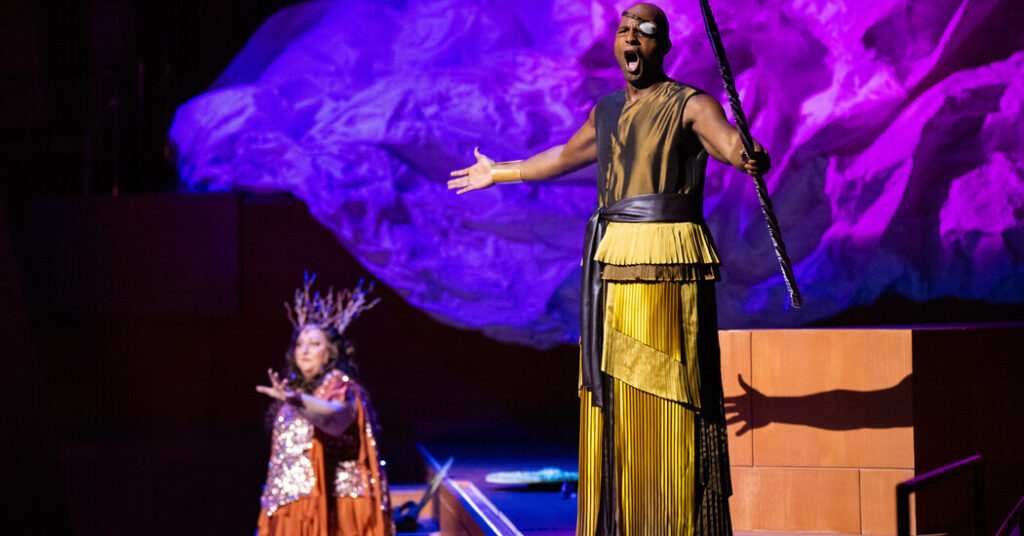
Wotan, the ruler of the gods in Wagner’s “Ring,” has gotten himself into a mess. Backed into a corner, he recounts the selfishness, hypocrisy and scheming that have left him cursed and awaiting ruin. All that remains, he says, is “das Ende”: the end.
This admission of defeat is a whimpering collapse told in music. The two syllables of “Ende” drop an octave. Then Wotan pauses, before repeating the word more softly, and the notes fall even lower.
Not only the heart of “Die Walküre,” the second of the four “Ring” operas, Wotan’s line is the heart of the saga. When the bass-baritone Ryan Speedo Green sang it with the Los Angeles Philharmonic last weekend, however, the moment came and went without drawing much attention to itself at all.
You would have expected more from Green. His Philharmonic performances, in a lightly staged production of “Walküre” spread over three days at Walt Disney Concert Hall, were an opportunity to prove himself before bringing his Wotan to the much-bigger Metropolitan Opera in New York, where a new staging of “Ring” will begin rolling out in 2028.
He has had experience with Wotan already, and lends the role a natural resonance and majesty; two years ago, he sang it with the Philharmonic in “Das Rheingold,” the first “Ring” opera. But beyond sheer force, the character continues to elude him.
Wotan is a flawed, aching patriarch who may behave mercurially but rarely exhibits true anger or viciousness. His pain is never more pronounced than in “Walküre,” in which his aggrieved wife, Fricka, forces his hand, bringing about the death of his child Siegmund; by the end, he also has to brutally punish his favorite daughter, the Valkyrie Brünnhilde.
No matter the agony, Green’s Wotan is constantly, unimaginatively tinged with fury. It was hard to believe this was the same singer who brought such a movingly annihilated portrayal of Marke in Wagner’s “Tristan und Isolde” to the Met just two months ago. He still has time to prepare his Wotan there, but he seems to have a lot of work left to do.
If the Philharmonic’s “Walküre” was something of a preview, it was also a farewell. Like “Rheingold,” it was conducted by Gustavo Dudamel, the orchestra’s music and artistic director, who is leaving for the New York Philharmonic in the fall. And both productions featured sets by Frank Gehry, the titan of architecture and designer of Disney Hall, who died in December.
Disney Hall’s auditorium surrounds the stage in cascades of wood panels; above it towers an organ whose pipes curve outward like an order of French fries. In Gehry’s ingenious concept for the “Ring” operas, directed by Alberto Arvelo, the existing architecture seamlessly extends into sculptural elements of the set, while an added catwalk at the front of the stage turns it into a kind of orchestra pit.
For “Walküre,” Gehry covered the organ and the seats at either side of it with immense, crumpled sheets of paper supported by hidden steel frames; they look like clouds, though more looming and stormy than serene. For the first act, he also designed a geometric wood table and hut; for the third, opaquely glowing horses that resemble his famous fish lamps.
If Gehry made any progress on plans for a “Siegfried” production, it would be a gift to see them realized by his colleagues. It would also provide an opportunity for Dudamel to continue this “Ring,” and hopefully for him to grow with Wagner.
So far, Dudamel’s grasp of this composer has been inconsistent. He recently conducted the orchestral “Forest Murmurs” from “Siegfried” with the New York Philharmonic, and the performance was too deliberately paced to breath as organically as the score wanted. His “Rheingold” in Los Angeles was ploddingly slow, though his “Walküre” opened whirlingly fast, the music’s storm lashing violently and unpredictably. From there, the first act continued at a clip, while the second act deflated, shapeless long before it was over. The third, however, was as gripping was it was beautiful.
Some of Dudamel’s finest moments were matched by the singers onstage, above all the soprano Jessica Faselt as Sieglinde. Her exclamation of “O hehrstes Wunder!” in Act III was extraordinary but almost came as no surprise, given how eloquent and dynamic her performances were on the two previous nights.
Faselt’s Sieglinde was by turns quietly courageous (alongside a persuasively domineering Soloman Howard as Hunding), ecstatic (duetting with a comparatively thin Jamez McCorkle as Siegmund), feeble and frightened (before being rescued by Christine Goerke’s unwieldy Brünnhilde). Green could learn from the nuances of her interpretation as he continues to develop his Wotan.
There is nothing if not nuance, for example, in another of his most important lines. At the end of Act II, after Fricka gets her way and Siegmund is killed, Wotan turns to Hunding and says “geh,” or go: a single syllable, chillingly hushed, that teems with complexity. There should be such intense self-loathing, failure and violence in its delivery that Hunding believably drops dead at the command.
In Green’s performance, though, it was just another word.
Joshua Barone is an editor for The Times covering classical music and dance. He also writes criticism about classical music and opera.
The post A Future Star of the Met Opera’s ‘Ring’ Tries Out His Role appeared first on New York Times.