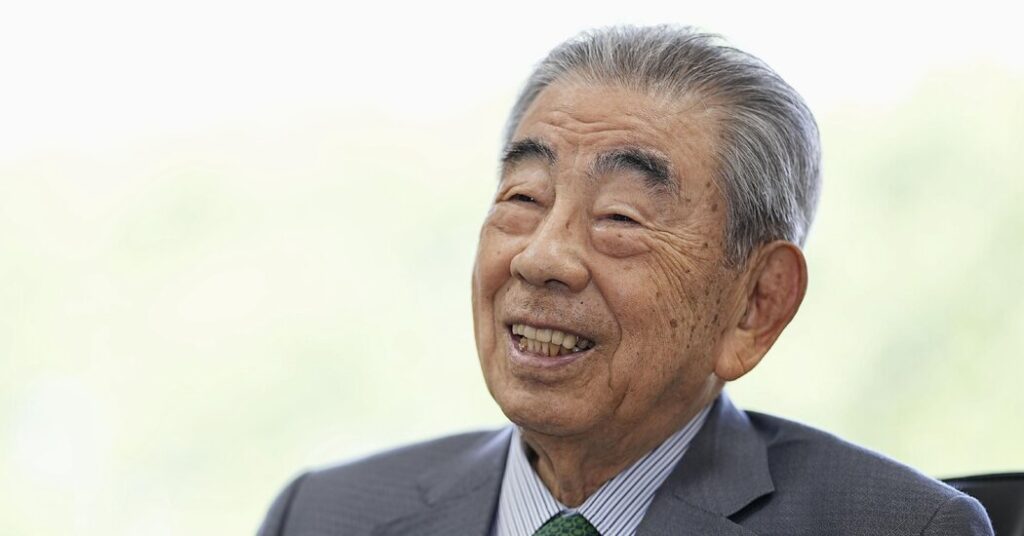
Toshifumi Suzuki, the convenience store pioneer who built 7-Eleven into a fixture of daily life in Japan, died last week of heart failure. He was 93.
Seven & i, the Japanese operator of the 7-Eleven franchise where Mr. Suzuki served as an honorary adviser, confirmed his death on Monday.
Over four decades leading 7-Eleven Japan, Mr. Suzuki transformed the business from a single store on Tokyo’s eastern bay into a sprawling empire of tens of thousands of locations. Known as a relentless innovator, he pioneered many hallmarks of the modern Japanese convenience store — from in-store banking to crisp seaweed-wrapped rice balls — that are beloved to many in Japan and abroad.
Since Mr. Suzuki’s resignation in 2016, 7-Eleven has struggled to maintain its footing. In recent years, the company has faced stagnant profitability, a tumultuous takeover bid from a Canadian rival, and the challenge of bringing in a new chief executive to revive growth. Some in the company lament that its culture of innovation departed when Mr. Suzuki resigned.
Born in Nagano Prefecture, northwest of Tokyo, Mr. Suzuki worked in publishing sales before he was personally recruited by Masatoshi Ito, the founder of Ito-Yokado, a major retail chain in Japan. Mr. Suzuki joined the company and became a director in 1971.
Just a few years later, Mr. Suzuki spotted an American convenience store chain called 7-Eleven, operated by the Dallas-based Southland Corporation, and saw an opportunity to bring it to Japan. At the time, many were skeptical that American-style convenience stores could succeed in a market dominated by small mom-and-pop shops.
Mr. Suzuki was undeterred. His longtime motto was “adapt to change,” a credo he said emerged from his experience during World War II, when his life as a junior high school student was suddenly upended and he realized that things could change in an instant.
In 1973, Mr. Suzuki teamed up with Southland Corporation to bring 7-Eleven to Japan. The following year, the first 7-Eleven opened in Tokyo’s eastern Toyosu neighborhood. Stocked with popular American items like hamburgers, it was an immediate hit. Within two years, the chain had expanded to 100 stores.
Mr. Suzuki pressed ahead, continually adapting and refining 7-Eleven’s operations. In 1975, 7-Eleven introduced 24-hour operations at a store in Fukushima Prefecture, a model that would become standard across Japan’s convenience store industry. He also rolled out the Japanese retail sector’s first large-scale point-of-sale system for item-by-item inventory management.
Over the next three decades, Mr. Suzuki oversaw the opening of thousands of additional stores across Japan. 7-Eleven’s Japanese operator steadily increased its stake in Southland Corporation until the chain became wholly Japanese-owned in 2005.
Under Mr. Suzuki’s leadership, convenience stores began reshaping everyday life in Japan. They began selling staples like rice balls and bento boxes — foods traditionally prepared at home that became some of the stores’ most popular items. 7-Eleven also expanded into services ranging from package shipping to bill payment and introduced machines that brewed fresh coffee at the counter.
By 2015, the 7-Eleven empire had grown to more than 55,000 stores globally, making it the largest convenience store chain in the world. Within the industry, Mr. Suzuki became known as the “God of Retail.”
The following year, Mr. Suzuki resigned after a failed attempt to oust Ryuichi Isaka, then the president of 7-Eleven Japan, on the grounds that Mr. Isaka had failed to meet performance expectations. After the board rejected the proposal, Mr. Suzuki said the vote showed he no longer had the confidence of the company’s leadership.
He remained at the company as an honorary adviser, a post he held until his death.
Mr. Suzuki is survived by his wife and two children, according to local media. A spokesman for Seven & i declined to comment. One of Mr. Suzuki’s sons, Yasuhiro Suzuki, served as an executive at Seven & i until 2016.
For much of the past decade, Seven & i has been in the midst of a major overhaul. The 7-Eleven operator had expanded beyond convenience stores and supermarkets, moving into retail outlets selling everything from stationery to baby goods, but many of those peripheral businesses struggled.
In 2024, Canadian retailer Alimentation Couche-Tard approached Seven & i with a $47 billion takeover offer. Seven & i rejected the bid, but internally, the offer intensified a growing sense of crisis. The company’s stock price and growth prospects had stalled and critics argued that 7-Eleven’s last major product innovation was the freshly brewed counter coffee introduced under Mr. Suzuki in 2013.
Last year, the company gained momentum with the appointment of a new chief executive, Stephen Dacus, who quickly laid out plans to spend billions of dollars on overseas expansion.
Mr. Dacus has said he hopes to revive Mr. Suzuki’s trailblazing spirit at 7-Eleven and use it as a driver of future growth. The demanding nature of Japanese consumers “forces you to innovate,” Mr. Dacus said in an interview last year. “That’s a real big benefit.”
Kiuko Notoya contributed reporting from Tokyo.
River Akira Davis covers Japan for The Times, including its economy and businesses, and is based in Tokyo.
The post Japan’s ‘God’ of Convenience Stores Dies at 93 appeared first on New York Times.