Ask a dancer whether dance is a sport, and you might hear a sigh. It’s an age-old question with no real answer. Dancers are athletes, but artistry drives the form. Dance can be highly competitive, but it’s difficult to judge objectively.
The International Dance League, however, isn’t interested in debating the matter. At its first official competition this month, it broadcast its answer on the marquee of the Manhattan Center in New York: “This is our sport.”
What is the International Dance League? The N.B.A. of dance. The W.W.E. of dance. Formula 1 racing meets the TV show “America’s Best Dance Crew.” These are some of the analogies that came up in conversations with the league’s founders and participants.
The organization’s model is novel in dance, but will sound familiar to fans of professional sports. The league consists of six accomplished dance teams from around the world who are paid to compete, squaring off against each other over the course of a season that culminates in a championship.
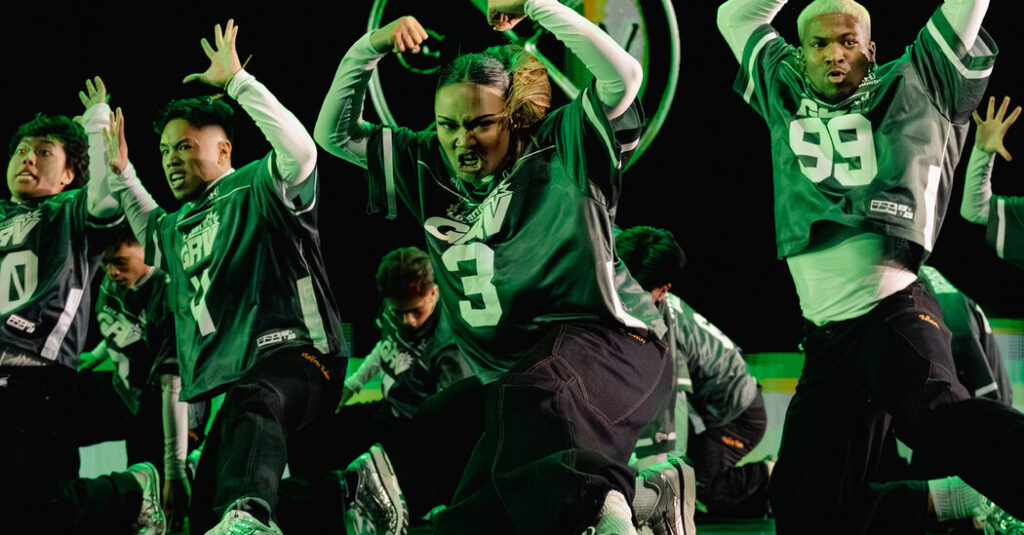
The league’s polished competitions lean hard into the dance-as-sport idea. During the sold-out season opener on May 2 in New York City, there were dramatic N.F.L.-style team walkouts and dancers wearing numbered jerseys. There was even a halftime show, with the rapper Saweetie performing her hits “Tap In” and “My Type.”
It’s rare for dance to get this kind of full-scale commercial production. The league’s size is already impressive — the six teams total about 120 dancers — and its founders, Connor Lim and Evan Zhou, think it has the potential to grow much larger. In 10 years, Lim and Zhou envision 24 teams with 480 dancer-athletes and events scheduled weekly.
“Making dance into a Top 5 sport is essentially our vision,” Lim said in a video interview. “There’s no reason it can’t get that big.”
Lim and Zhou, both 35, grew up dancing in the sprawling world of amateur competitions, in which entrants typically pay to participate. They said they saw the sports model as a way to give dancers the respect and the compensation they deserve.
Many dancers in popular competitive groups amass large online fandoms. But they have few professional outlets beyond dancing behind musicians on tour or in music videos.
Lim and Zhou are betting that building sports-style scaffolding around competitive dance will create a different kind of career path. They want the league to make “the LeBron James of dance, the Serena Williams of dance,” Lim said. “People will know their names. They themselves will be the stars.”
Officially labeling dance a sport has, unsurprisingly, raised eyebrows in the dance world. The International Dance League is also “open style,” meaning that dance of all kinds is permissible. Most teams’ routines collage hip-hop and a variety of other street and club dance forms, many of them developed by Black, brown and queer artists. This stylistic diversity makes league choreography particularly difficult to judge — and raises the specter of appropriation.
But at the season opener, the jubilant crowd was all in. The level and diversity of talent, the flash and wit of the choreography, the sheer quantity of energy blasting from the stage — who could resist?
CREATING A SPORTS league, dance or otherwise, takes a lot of money. Lim and Zhou have experience translating dance-speak to business-speak. In 2014 they founded Steezy Studio, which offers online dance classes. Building Steezy, which now has about two million users, taught them how to court investors and advertisers, and how to market dance effectively.
For the International Dance League, they raised $7 million in seed money and secured sponsors not typically associated with dance, including Honda and e.l.f. Cosmetics. At the New York event, a white Honda was on display at the back of the auditorium. Between dance sets, advertisements played on the giant screens that surrounded the stage.
“Our take is, commercialization is good,” Zhou said. “If you can commercialize something, you can align all the incentives so that it can become sustainable. Otherwise, you’re just constantly relying on the good will of other people to fund your artistic endeavor.”
Making the case for the league to potential backers was straightforward, Lim and Zhou said. Dance’s huge popularity on platforms like TikTok is evidence of its broad mainstream appeal. Collectively, the league’s teams and dancers have about 250 million followers on social media.
The six founding teams were chosen carefully. The teams — Brotherhood, from Vancouver, British Columbia; GRV, from Los Angeles; Jam Republic, representing Southeast Asia; 1MILLION, from Seoul; Quick Style, from Oslo; and the Royal Family, from Auckland, New Zealand — had to be the best of the best, Lim said: “If we were going to call them pros, we wanted people to actually agree with us.” And they had to have the infrastructure to withstand the demands of the league’s season, which over the course of several months makes five international tour stops. Most of the crews are veteran champions of the amateur circuit, with affiliated dance studios that feed their competitive teams.
While the league declined to share specific payment details, each team receives a guaranteed minimum fee. A separate prize pool rewards winners. The league also covers the teams’ travel and lodging expenses, and helps secure dancers’ visas. “Let’s just say it’s millions and millions of dollars being spent on dance,” Lim said.
Is that enough to make being a league dancer a full-time career?
“I can see the path forward,” said Scott Forsyth, a captain of Brotherhood, which won both the New York City contest and, on Saturday, the season’s second event. Before the creation of the league, Brotherhood — a dominant force in amateur competitions during the 2010s — had been on a multiyear hiatus. Its members were struggling with mounting expenses as they grew up and started families. (Forsyth, 34, has one young child and another on the way.) “Now, we’re starting to see a world where a lot of our dancers don’t need to pick up that extra side gig, because of the compensation that is coming from I.D.L.,” he said.
The league also features a community division, a kind of grass-roots tier. At each tour stop, a collection of amateur teams — many of them pulled from the local dance scene — compete for a small prize pool. The division is designed to be a pathway, Lim said, to the professional league. “When you build a long term sport, you need to make sure that everybody from the developmental pipeline can see and aspire to be a pro,” Lim said.
There’s no East Coast representation in the professional league. But at the season opener in Manhattan, the winner of the community division competition was a hometown team: Narratiiiv. The crew took home $10,000, and the audience went bonkers.
UNEQUIVOCALLY DECLARING DANCE a sport is a sticky proposition. (Witness the fraught Olympic debut of breaking in 2024.) Moncell Durden, a dance scholar and an alum of the hip-hop dance company Rennie Harris Puremovement, said he found the concept of the league confusing.
“I just don’t get it,” he said. “You dance because you want to be in community with other people, you dance to release energy and receive energy. But sports? They’re way too heavy on who’s the top dog.”
Evaluating any form that melds the athletic and the artistic is a challenge. To help shape the league’s scoring system, Lim and Zhou said they studied the rules for sports like figure skating, surfing and cheerleading. The league settled on a two-round format for each event. A panel of six expert judges appraises the teams’ performances using a 100-point score sheet, featuring categories like “complexity of choreography,” “technical execution” and “stylistic athleticism.” The tally also includes a fan vote.
The scholar and dancer LaTasha Barnes, whose expertise includes many styles of street and social dance, served as a judge for the New York City competition. Initially, she said, “I was a little conflicted about the directness of the ‘This is our sport’ language.” But she appreciated the nuance of the scoring system, especially the “stylistic athleticism” category.
“So, not just athletic power for power’s sake, but how is that power amplifying the narrative that’s being presented?” Barnes said. “That definitely expanded how we were able to look at what the teams were bringing.”
Durden also expressed concern about the fact that the league has preset routines rather than freestyle battles. Many of the dance forms the teams pull from — popping, locking, waacking, vogue, dancehall — grew out of club and street cultures that are driven by improvisation.
The open-style format also tends to result in magpie choreography, drawing on bits and pieces of various forms. That can preclude a true understanding of the cultural roots of these dances.
“If you can’t have a full-on conversation with someone in their dance language,” Durden said, “and all you have is words and phrases, it might sound beautiful, but you didn’t learn how to speak that language.
The league has assembled a cultural and historical advisory board to help ensure that each dance form is presented accurately during its events. Barnes is a member. She said that seeing some of her mentors on the board — including the hip-hop legend Buddha Stretch and the street and club dance luminary Sekou Heru — convinced her that the league’s heart was in the right place.
“The point is not for us to be tokens of the culture,” Barnes said. “It is for us to actually ensure that the culture is well represented and cared for throughout this process.”
THE LEAGUE’S SPORTS framework is already reshaping the way its dancers work. Moana Davis, a captain of the Royal Family crew, said the team’s rehearsal process now follows an athletic playbook.
“We don’t only treat it as a dance event, but also more like a fitness and stamina event,” Davis said. “We’ve been training from 12 p.m. to 11 p.m. every day.”
The league encourages that athletic mind-set by incorporating the familiar trappings of professional sports throughout its events. Some fit naturally: Nobody does a team walkout better than dancers.
Others might require adjustment. At the New York City show, two color commentators gamely offered instant-replay analysis of the choreography. But the language is still a work in process, and describing the kaleidoscopic dance references proved difficult. (The catchall terms “texture” and “flow” kept recurring, as if the dances were haircuts.)
Good sportsmanship, however, is already part of dance’s lexicon. Both Davis and Forsyth said the league’s high stakes and repeated matchups have fostered not rivalry but camaraderie. There is a sense, Forsyth said, of wanting to be good ambassadors — not just for their teams, but for dance more broadly.
“I’m so pumped for Brotherhood and what this could mean for my guys,” Forsyth said. “But I think I’m even more excited for what this could mean for dance and dancers in the future.”
The post Dance Gets a League of Its Own: ‘This Is Our Sport’ appeared first on New York Times.