Erik Fritchman, a farmer who grows apples and peaches on a sunny mesa in Cedaredge, Colo., should be tending his new saplings right now, but with so little water this spring, he is uprooting trees instead. Better that, he said, than watch them die of thirst.
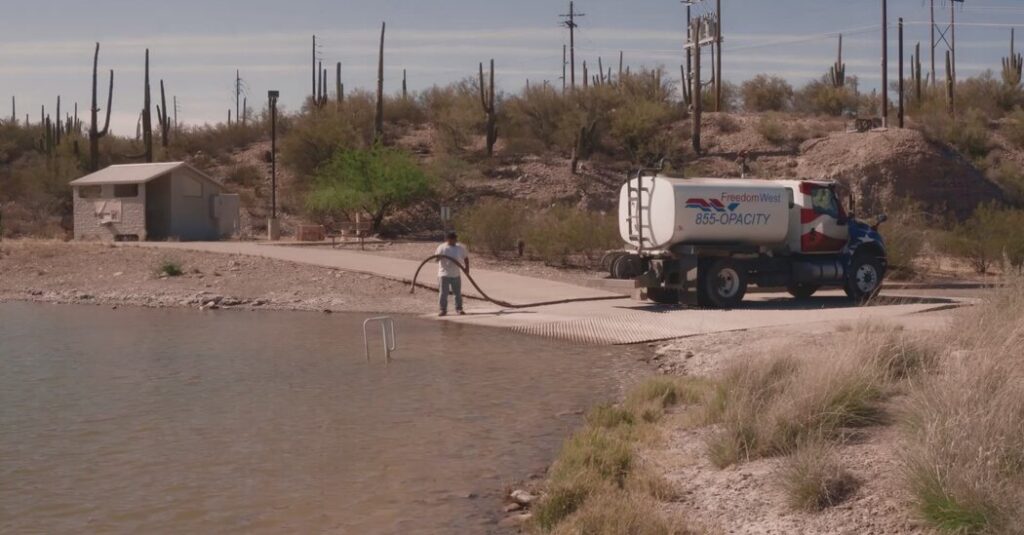
Hundreds of miles downstream, the mayor of the tiny desert town of Kearny, Ariz., is warning residents they will run out of water by July unless they take drastic measures now. He suggested showering together or wearing clothes three times before washing them.
The two towns are emblems of a water crisis spreading across the American West after one of its hottest, driest winters ever — and one that experts warn is a preview of hotter and drier years to come.
Drought, which now covers 70 percent of the West, is forcing cities to restrict water use and farmers to abandon their fields, while raising pressure on Western states and the Trump administration to avert an all-out collapse along the dwindling Colorado River.
Color-coded maps of mountain snowpack glow a four-alarm red, illustrating river basins that have as little as 10 percent of their normal snow levels — or none at all. In western Nebraska or Oklahoma, winter wheat crops are withering, and early-season grass fires have incinerated a million acres, including pastures and croplands.
Water sources are “just drying up,” said James Holiman, a worker with the Colorado Division of Water Resources who manages a network of reservoirs and creeks that bring water to farms. Every day, farmers walk into his office in Cedaredge, in western Colorado, asking when — or if — they are going to see anything in their irrigation ditches.
“We don’t have water for them,” he said.
In a normal year, deep snowfields that served rich and adventurous skiers and snowboarders over the winter would be melting high in the Rockies and trickling into rivers that fill reservoirs and supply water to cities and farms. But unusual winter warmth starved ski resorts of their life blood; then a record-breaking heat wave in March melted what was there far too early.
The parched ground is sponging up much of the remaining moisture before runoff can reach streams, a bad omen for summer wildfires. And gradually rising temperatures mean the air is capable of holding more moisture that it draws from the soil.
Climate models have predicted that scenario for decades, yet “seeing it unfold this year was pretty shocking,” said Daniel McEvoy, a regional climatologist at the Desert Research Institute in Nevada.
The drought conditions make it all the more urgent for the seven Western states that rely on the Colorado River to reach a new agreement on how to share its dwindling flows. The river provides water to 40 million people and 5.5 million acres of farms, but it is only expected to deliver about 13 percent of normal runoff to Lake Powell, the huge reservoir along the Utah-Arizona border that supplies water and hydroelectric power to millions.
To keep Lake Powell from dropping so low it can no longer produce power, the federal government is draining up to 1 million acre feet from the Flaming Gorge Reservoir in Wyoming and sending its water south. An acre-foot of water is equivalent to about 326,000 gallons, about what two or three American households use in a year.
That is raising concerns across the Colorado River basin about diminished emergency water supplies.
The states in the lower Colorado River basin — Arizona, Nevada and California — agreed to draw 3.2 million acre feet less from the river system — as much as several million households use in a year. In exchange, they argued, Colorado, Utah, Wyoming and New Mexico must commit to permanent water cuts.
But those upper-basin states have so far balked.
A preliminary plan the federal Bureau of Reclamation could impose by October could demand similarly large annual cuts across the lower basin states over the next decade, according to a May 13 briefing by Arizona water officials. But any additional cuts would not come easily, said Maxwell Wilson, Phoenix’s water resources management adviser.
“This is going to be very, very hard,” Mr. Wilson said. “There’s no more water after this.”
Long-term solutions will require more creativity, said Christopher Kuzdas, a water program director for Environmental Defense Fund based in Arizona.
“What we’re doing just isn’t working,” Mr. Kuzdas said. “We must free ourselves from this endless cycle of depletion.”
For now, governments are scrambling. Denver is draining a mountain reservoir popular for fishing and sending that water farther downstream, to minimize losses from evaporation.
Along the rivers, rafting outfitters and fishing guides are bracing for a shortened season without much white water. A marina in Frisco, Colo., decided against opening at all this season because of low water levels at the mountain-ringed Dillon Reservoir.
So far, the cutbacks have been a patchwork. Denver and adjacent Aurora, Colo., are among cities that have declared drought emergencies and ordered cuts to outdoor watering. Some water providers in Utah are expecting to turn on their irrigation water later, and shut it off earlier than most years. In Northern New Mexico, the picturesque city of Las Vegas is banning restaurants from serving water, unless a customer specifically asks for it.
But other governments, such as Boulder, Colo., and Salt Lake City, are only calling for voluntary water cutbacks. Boulder says it has cut its water use by 30 percent since the last mandatory restrictions in 2002, and that it has enough reservoir water for now to avoid requiring restrictions.
In Kearny, Ariz., the town on the brink of running out of water, Mayor Curtis Stacy warned those cities: “Just because we’re the first don’t mean we’ll be the last,” he said. “We’re the canary in the copper mine.”
Kearny’s water comes from a reservoir on the Gila River, a tributary of the Colorado. The reservoir has just two percent of its total capacity, and the West’s arcane system of water rights puts Kearny at the back of the line for what’s left, behind farmers, Native American tribes and even mining companies.
The town was given just 77 acre-feet this year, a fraction of the 280 acre-feet it typically uses. Kearny asked residents to cut their water use by 30 percent, banned watering lawns and washing cars, drained its public pool and let the Little League fields go brown. Water use actually spiked after the announcement as some panicked residents hoarded it in buckets and barrels. Locals eventually got on board with the restrictions, but now they must maintain their reduced consumption as long as possible.
Eric Armenta, Kearny’s public works director, worried that shortages like this year’s could scare off future residents and turn his desert community into a ghost town.
“We are fighting to keep Kearny alive,” he said.
In Colorado, farmers across the state’s Western Slope are leaving half or more of their fields unplanted. Mr. Fritchman, the peach farmer, did not plant any saplings this year and uprooted about 12 acres of older trees. He will use his scarce water allotments to keep his younger trees alive.
Recent late spring snowfall in the Rocky Mountains and chances for summer monsoon rains across the Desert Southwest could ease drought conditions and reduce fire risks, Mr. McEvoy said.
Forecasters across the West are watching a “Super El Niño” take shape in the eastern Pacific, a natural climate pattern of warm ocean water that might pummel the Southwest with rain and snow — but not until winter.
In the Uncompaghre Valley, a quilt of farmland fanning out below the peaks of the San Juan Mountains in Southwestern Colorado, Reid Fishering said he hoped that leaving half of his sweet-corn fields bare would preserve enough water to irrigate his remaining crop for Labor Day barbecues — a big payday for a corn farmer.
But he worried about weeds invading his fallowed fields and hurting soil conditions for years to come. If next winter is just as dry, he wasn’t sure he could make it.
“If the cards are stacked against you, you have to fold sometimes,” Mr. Fishering said.
Jack Healy is based in Colorado and covers the west and southwest for The Times.
The post A Terrible Winter for Snow Heads Into a Bleak Summer of Drought appeared first on New York Times.