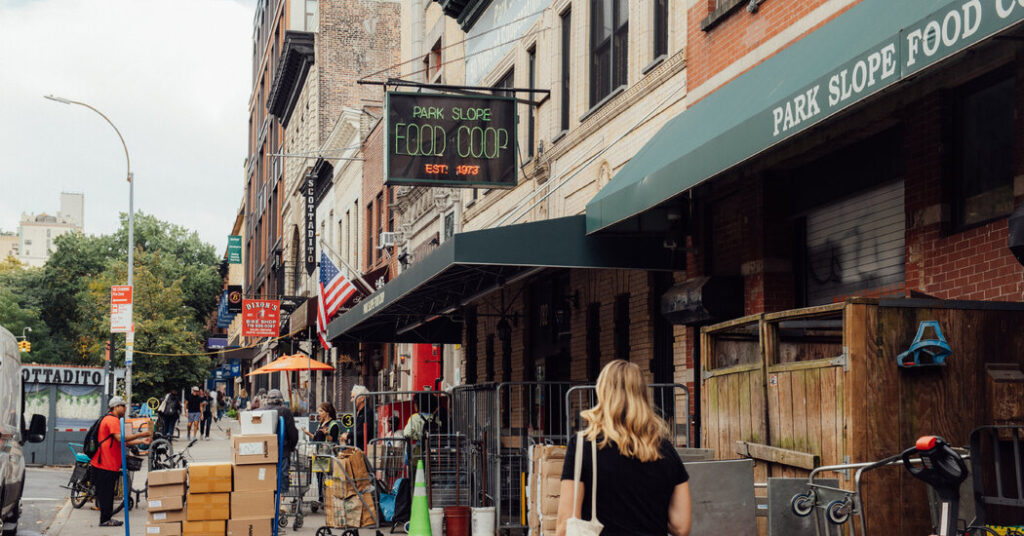
Inside the Park Slope Food Co-op on a recent evening, the aisles bustled with people perusing fresh produce, frozen food and prepared meals.
Outside, other members manned two tables that stood on either side of a debate: whether or not to boycott Israeli products.
Members of the co-op, which serves as a cultural avatar for the anxieties and consumption habits of many Brooklyn liberals, have been bitterly divided over the issue in recent years and have debated the boycott in tense meetings.
The co-op will vote on the matter at its general meeting on Tuesday night. Over the weekend, it sent an email to members informing them that there would be security hired for the meeting and check-in stations added to further protect the meeting. The measures were introduced after the co-op said it received threats and suspicious substances sent through the mail as well as aggressive phone calls and “hostile social media” posts.
“While the overwhelming majority of members have continued to engage respectfully and cooperatively, we have also seen incidents that have gone beyond normal disagreement and escalated into verbal confrontations and, in some cases, physical altercations between Co-op members,” the email read.
In at least one recent instance, a general meeting devolved into laughter at the mention of antisemitism or dark allusions to Jewish domination of the United States, alarming some Jewish leaders and some of the 17,000 members of one of the largest and oldest co-ops in the country.
Many of the boycott campaign’s opponents view it as a local manifestation of the larger Boycott, Divest and Sanctions Movement, known as B.D.S., which seeks to economically and culturally isolate Israel because of its treatment of Palestinians, including during the war in Gaza. Others said it was just a political headache they did not want to deal with while doing their weekly grocery haul.
“I’m sick of the politics,” said Tse Levy, 59, a co-op member since 1998, who was outside the store on a recent day canvassing for the anti-boycott side. “I want to get politics out of the co-op — we should be exchanging recipes.”
Others in Park Slope view the proposed boycott at the co-op as a humane and common sense response to the crisis in the Middle East, which has ballooned from the Hamas-led Oct. 7, 2023, terror attack on Israel into a yearslong series of regional wars in Gaza, Lebanon, Iran and elsewhere.
Alyce Barr, 70, a member of the co-op since 1978 and part of its Members for Palestine subgroup, said that the proposed boycott was in keeping with the grocery’s long history of similar actions. Over the years, she said, the co-op had boycotted Colorado over gay rights; Chile over the leadership of its dictator, Augusto Pinochet Ugarte; U.S. grapes in support of the United Farm Workers of America; and Coca-Cola and Citibank, among others.
“It appears that some members of the co-op community and the co-op administration have developed what I would refer to as a ‘Palestine exception,’” Ms. Barr said. “This is a bright line for some people, and it’s contradictory to the conscience that so many of us have come to expect from the co-op.”
On May 20, as both sides of the debate manned opposing tables outside the co-op, Ruma Farooqui, 59, a member for 25 years who said she was originally from India, stopped to listen before moving on with her bags of groceries.
“I come from a country where nonviolence and economic boycotts worked,” Mr. Farooqui said. “Right now, the way the political environment is, it’s what little we can do.”
But some members were frustrated with the debate in general, without claiming a side.
David Lee, a member for 24 years, said that the co-op environment had become “too charged.” The debate over whether to sell Israeli goods had “dominated the co-op meetings for years, so all the other issues that need to be dealt with get sidelined,” he said.
“If we don’t resolve this, it will just continue to eat away,” he added.
Although products at the co-op change frequently depending on what is available and in season, the boycott would currently apply to fewer than a dozen products, including certain brands of tahini, hair care items and some produce, including peppers and persimmons, according to the Members for Palestine group.
Rabbi Rachel Timoner, the senior rabbi at Congregation Beth Elohim in Park Slope, has been a leader of the anti-boycott side.
In a sermon earlier this month, she called the boycott campaign a “hyperlocal example of a proxy war dividing communities all across America — a war that is laced with antisemitism.”
The rabbi said boycott campaigners at the co-op wanted to align the store with the broader B.D.S. movement, which she told congregants “is not a movement for Palestinian statehood, or for coexistence or for peace. It is part of a larger movement for the elimination of Israel.”
The rabbi ended her sermon by rallying congregants who belonged to the co-op “to join me to do our best collectively to interrupt this proxy war.”
“Why is this petty, annoying fight in our neighborhood grocery store worth so much time and effort?” she said. “Because it is part of something much bigger.”
Rabbi Timoner and other anti-boycott leaders reiterated that message in an open letter sent on May 17 to co-op members. In it, they said they understood why “very strong feelings have emerged on both sides, fracturing this cherished community that we have built around what is, at its heart, a local grocery store.”
But they warned that removing Israeli peppers and other goods from its shelves could unwittingly align the shop with antisemitic forces.
Jonathan Kopp, 59, the chairman of the New York City chapter of J Street, a liberal pro-Israel Jewish advocacy group, signed the letter alongside Rabbi Timoner, and said in an interview that it was important for him to “speak up for J Street supporters in Brownstone Brooklyn.”
People are right to be upset about death and destruction in Gaza, he said, but disputed that aligning a Park Slope grocery store with the global B.D.S. movement was productive. The co-op’s mission statement, he said, promised to be welcoming and accessible to all.
Mr. Kopp said that he supported people making their own individual choices to abstain from purchasing Israeli products in a bid not to support the occupation of the Palestinian Territories, but took issue with the global B.D.S. movement’s viewpoint, which does not recognize Israel as a Jewish state and does not support a two-state solution.
“This will accomplish nothing but divide our community,” Mr. Kopp said. “It is a symbolic gesture with no impact, and there are better ways to achieve these goals.”
The local debate has reached national consciousness in recent weeks as the boycott vote neared.
The Brandeis Center, a nonprofit focused on Jewish civil rights, sent out a statement demanding that the co-op “protect Jewish members from intimidation, retaliation, social targeting.”
“Jewish people should not have to choose between local and organic food and their safety and their voice,” Kenneth L. Marcus, the chief executive of the Brandeis Center, said in the statement. “Protective measures for this upcoming vote are not a procedural nicety. They are the minimum condition for a legitimate vote and a basic obligation to the safety and dignity of every Jewish member.”
The issue even became a talking point in the Democratic congressional primary in New York’s 10th district, which includes Park Slope and features two Jewish candidates. Representative Dan Goldman told The Forward, a news outlet focused on Jewish Americans, that he was encouraging members to vote against the boycott. His challenger, Brad Lander, said that he would vote against the measure if he was a member, but did not recommend a course of action for members themselves.
Claire Fahy reports on New York City and the surrounding area for The Times.
The post Brooklyn Co-op Divided Over Push to Boycott Israeli Products appeared first on New York Times.