Claudia Sahm is one of the Federal Reserve’s most notable alumni: She is the founder of a recession indicator named after her, which has accurately predicted the majority of economic contractions in recent memory.
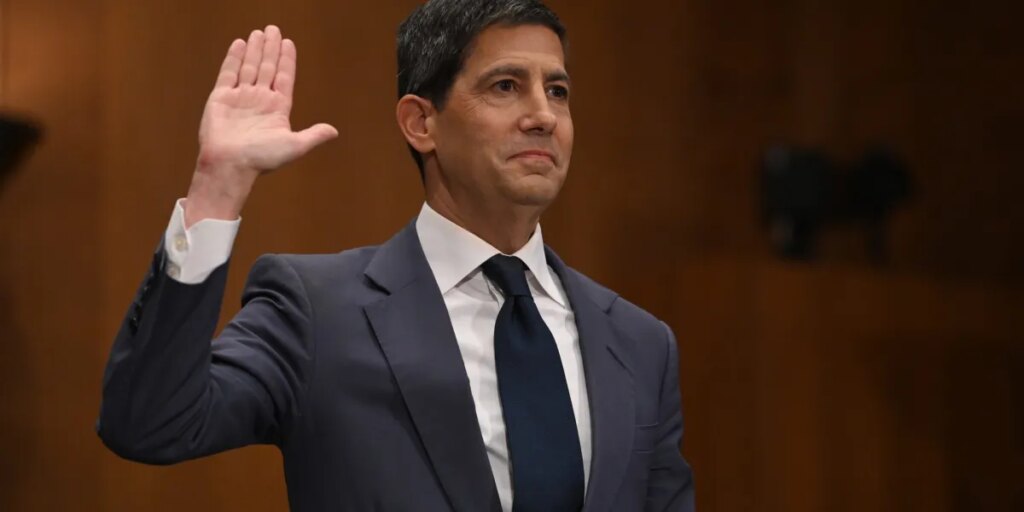
Sahm has concerns about the ultimate direction of the Fed: Warsh’s testimony in front of the Senate Banking Committee left her with more questions than answers, she tells Fortune, and his responses (albeit often without time for explanation) raised the hackles of an economist who worked for the Fed for more than a decade.
“I felt like I was more confused about him after the [Senate Banking] hearing than before the hearing,” Sahm tells Fortune in an exclusive interview. “He didn’t give clear, sharp answers, and part of that was trying to navigate the politics of the hearing, but the reality is he’s going to be Fed chairman.”
Concerns relating to Warsh come with a caveat: They are situated in the context of politics at this moment. Alarm is relatively high after President Donald Trump has persistently sought to influence the path of monetary policy, launching unprecedented attacks on the Fed and its personnel in the process.
The Oval Office has threatened to fire current Chairman Jerome Powell; a legal case has been brought against him, and another has been brought against Board Governor Lisa Cook. Pile on top of this the sharp and public criticism—Trump has called Powell a numbskull, stubborn, and stupid—and any nominee to replace Powell would seem like a shoo-in.
Nonetheless, the contents of Warsh’s testimony still raised eyebrows in some quarters—namely, his views on forward guidance. What baffled Sahm the most was the definiteness of his statement: “I don’t believe in forward guidance.”
“I almost fell out of my chair,” Sahm said. “Over the past 20 years, the Federal Reserve has moved to much more transparent communication … it does have a tool aspect, but also the communication, the press conferences, were also about accountability, transparency. The Fed chair stands out there and takes question from journalists, like answering to the people it’s opening up to try because it’s not just about talking to financial markets, it’s also about ‘Hey, this is what we’re doing’ and showing there are competent people at the Fed, and they think hard about it, and it’s not politics.
“That progression has happened over 20 years at the Fed and it’s going to be near impossible and probably very misguided to put the cat back in the bag.”
Warsh did confirm in his hearing press conferences wouldn’t be scrapped, though all his talk of “regime change” might lead one to assume they will be reshaped in some way.
Warsh wants to reform some elements of forward guidance because he feels it binds the Fed to a predetermined path rather than allowing it to be reactive to the data. He told his Senate Banking hearing: “The Fed tells the whole world what their dots are going to be, what their forecasts are going to be. Well, the Fed’s human then—they hold on to those forecasts longer than they should.”
Here, Warsh is referring to the dot plot, a chart published by the Fed four times a year that shows where each of its top policymakers expect short-term interest rates to head—it’s one of the most closely watched tools in central banking communications.
“If the Fed were to wait until it gets into a meeting before making a decision, incremental deliberation can keep the central bank from compounding its errors,” he added.
“They are imperfect,” Sahm agrees. “They could be improved. But what have you got that’s better?”
Statements of improvement must come with alternatives, highlights Sahm: “There’s been a lot of thought put into the models that are used. There’s a lot of thought put into how the forward guidance can be improved upon, and having worked there and knowing the people, there is a desire to always make the institution better. But there is a very high bar.
“You really have to bring it in terms of a better model, a better idea, that’s what wins, but that is so hard because you have to up your game to make change.”
Current forward guidance models, Warsh argues, are not befitting for “normal times,” having been rolled out in the financial crisis. He outlined in an April 2025 lecture to the IMF that “moving markets with rolling Fed incantations is tempting, but unhelpful to the Fed’s deliberations, and ultimately, to its mission. The central bank should find new comfort in working without applause and without the audience at the edge of its seats.”
A gradual shift
Despite Sahm’s misgivings about aspects of Warsh’s leadership, she doesn’t expect him to be the “agent of chaos” some DC staffers may fear.
After all, Warsh knows what it’s like for the Fed to “chew him up and spit him out,” Sahm reasons—referring to Warsh resigning from the central bank in 2011. At the time, Warsh was the youngest person ever to serve on the central bank’s board, and returned more than a decade later after working with legendary investor Stan Druckenmiller in the interim.
“The economics here are really hard,” Sahm adds. “Above all else, what we’re seeing now is how Kevin Warsh is going to walk into that and how he engages. How he leads is going to determine whether we go from dissent and disagreement that really fits with the economic moment, to chaos on the committee.”
Some analysts have suggested the current disagreement on the rate-setting Federal Open Market Committee is something of a performance: The three governors who voted against the consensus at the last meeting (regional bank presidents Neel Kashkari, Lorie Logan, and Beth Hammack) are speculated to have thrown down the gauntlet against a dovish incoming chairman, while the likes of Stephen Miran have long advocated for the cuts Jerome Powell was hounded for.
But right now the disagreement makes sense, Sahm said: “Miran, I think, is very earnest. He really believes what he writes down in his models—he’s kind of been floating off to the side because he’s just a governor. If you swap Warsh for Miran, the chair can’t just float off to the side.”
Warsh should “know better” than to pull from consensus, Sahm adds, saying playing a longer game on regime change could prove more effective.
“When I disagree with him on a lot of things, I don’t think he is an agent of chaos,” she adds. “I think he wants the Fed to innovate and improve and do policy well. That should lead him to meet the committee where they are, and try to shift things gradually. Maybe all of what we’ve seen in recent months has just been his campaign to get the job.”
Indeed, as an outside critic of the Fed’s leadership to this point, Warsh has framed his feedback as a push for the central bank to progress. Speaking on the Hoover Institution’s (where he previously served as Shepard Family Distinguished Visiting Fellow in economics) Uncommon Knowledge podcast, Warsh said the criticism tabled at the aforementioned IMF speech was “a love letter, more than a cold critique.”
He explained: “It’s a love letter because the institution’s … important. It’s a love letter because if the institution can reform itself, then there can be great things for the institution and the country. But it does mean that it’s time to get things back on track.”
The post ‘I almost fell out of my chair’: Fed stalwart Claudia Sahm fears Kevin Warsh’s policies could undo 20 years of policy progress appeared first on Fortune.