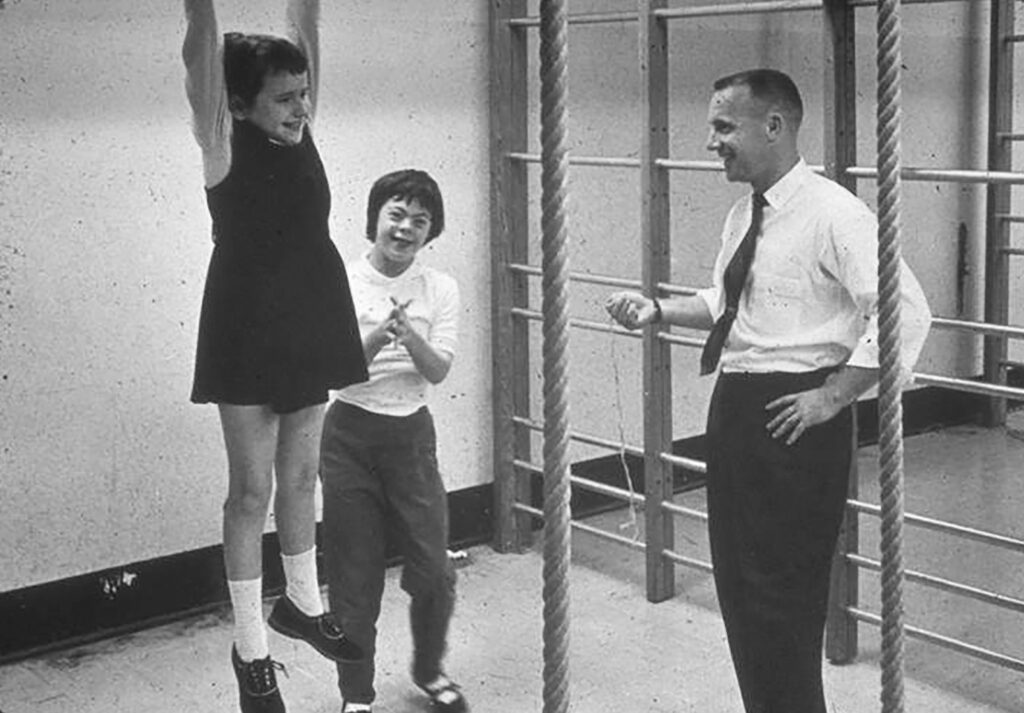
On a sweltering July day in 1968, 1,000 young athletes gathered at Soldier Field in Chicago, where they ran, jumped, threw balls and swam.
Few spectators were there to witness the inaugural Special Olympics International Summer Games. But the competitors, all boys and girls with intellectual disabilities, helped usher in a new and more inclusive era in sports, at a time when children with special needs were often locked away at home or shipped off to institutions.
The event was publicly spearheaded by Eunice Kennedy Shriver, whose brother Robert F. Kennedy had been killed only six weeks earlier, and was mounted with help from a small group of physical education teachers, disabilities experts and physiologists, including a Canadian professor, Frank Hayden, whose research helped convince Shriver that such an event was possible.
For years, parents and educators had believed that young people with Down syndrome and other intellectual disabilities were incapable of playing sports or engaging in physical activities. Dr. Hayden helped dispel that myth, showing that kids with special needs were hindered mainly by lack of opportunity. With guidance and encouragement, he argued, they could see improvement in physical fitness while also gaining social skills and confidence.
“My idea wasn’t to find the fastest runner with an intellectual disability,” he said. “It was to make them fitter and healthier, so they have the opportunity to live their potential.”
Dr. Hayden, who spent years championing the Special Olympics and spreading the movement to countries around the world — a quest that led him to call himself “the Billy Graham of the Special Olympics” — died May 16 at 96.
His death, in Oakville, Ontario, was confirmed by Canada’s Special Olympics organization, which said his “research was the spark that ignited the Special Olympics movement.”
“At the time, the prevailing literature indicated that this was just the way it was going to be: There was no way that kids with intellectual impairments would become more physically active, which would lead to healthier lifestyles and healthier outcomes,” said sports researcher Laura Misener, who holds an endowed chair named in Dr. Hayden’s honor at Western University in Ontario.
“He pushed that narrative aside,” she said, “and demonstrated that kids with intellectual disabilities could be involved in sports and physically active.”
Dr. Hayden never set out to become an expert on disabilities. But while finishing his graduate studies in the early 1960s, preparing to start a job as a research associate at the University of Toronto, he got a call from his new boss, who told him about a Rotary Club grant for a fitness study on children with special needs.
The grant would cover half of Dr. Hayden’s salary.
Was he interested?
After spending two days in the library, where Dr. Hayden discovered that there was virtually no published research on fitness and intellectual disabilities, he decided the answer was yes. “I figured that I would become an instant expert,” he said, “and that I had a blank sheet.”
Over the next few years, he worked with disabled children at the Beverley School in Toronto, leading them in sit-ups, running and jumping activities. The students were about half as physically fit as children without cognitive disabilities, he found, but no wonder: “They didn’t ever run, skate, play ball, didn’t play kick the can.”
Through patient coaching and an exercise plan, he found that the students could grow strong and gain confidence that helped them widen their abilities in other areas. He cited the case of a Beverley student who “learned to read because he played floor hockey,” since he “wanted to know what was being written about him in the school paper.”
Dr. Hayden drew on his research to write a 1964 training manual for people with intellectual disabilities, aimed at educators and parents. He originally intended to distribute 1,000 copies, he said. But the book took off, selling more than 50,000 copies and reinforcing his belief that there was a hunger for new fitness programs, and potential for a large-scale sporting event for children with special needs.
His initial proposal, for a Canadian national games tied to the country’s 100th birthday, went nowhere. But his efforts attracted the attention of Shriver, whose advocacy efforts were informed by her bond with her sister Rosemary Kennedy, who was born with an apparent intellectual disability and institutionalized after a lobotomy. Shriver and her husband, Peace Corps director Sargent Shriver, invited Dr. Hayden to their home and asked if he could organize a national games for the United States.
“I told them I wasn’t coming,” Dr. Hayden said in a 2016 interview for the Canadian Encyclopedia, recalling how he had little interest in leaving Ontario. “But when you keep on saying no to those folks, it means they must have you. I went to Washington for four months and stayed for seven and a half years.”
More from A Notable Life
Renowned for his legal skills, he took on the mob and investigated JFK’s killing
Forced to dance for Mengele at Auschwitz, she was called to help others heal
Diagnosed with colon cancer at 36, she spent her last years helping others with the disease
Working under Eunice Kennedy Shriver, he served as a fitness director for the Joseph P. Kennedy Jr. Foundation, which sponsored the first Special Olympics in partnership with the Chicago Park District. He went on to serve as executive director of the newly established Special Olympics organization, and helped launch dozens of Special Olympics groups worldwide while leading its international development office and office of European affairs.
Special Olympics programs now reach more than 4 million athletes in over 200 countries and territories. Dr. Hayden — better known as “Dr. Frank” — visited many of those events and was a staple at competitions and fundraisers in Canada, where he was accompanied by his wife, Marion Hayden, until her death in 2024.
“He was more excited to meet the athletes than they were excited to meet him,” said Sue McDermott, whose son Darby Taylor, a Special Olympics athlete with autism and an intellectual disability, successfully nominated Dr. Hayden for Canada’s Sports Hall of Fame. “He made Darby feel so special, and he did that for every athlete he met.”
For athletes like Taylor, a 31-year-old from Calgary, Special Olympics can feel like a second family.
Thanks to the group, Taylor said in a phone interview and a recent speech, he’s learned to be a part of a team, to take better care of himself and to be more independent.
“I’ve been blessed to never have been bullied, but I have been ignored,” he said. Yet after going to weekly bocce and floorball programs in Calgary, Alberta, and traveling to competitions across the province, “I’ve become good friends with other people with special needs who don’t stare or laugh at me.”
“If I’m rocking with excitement on the bench,” he said, “they’re often rocking, too.”
A son of Irish immigrants, Francis Joseph Hayden was born in Windsor, Ontario, on Jan. 11, 1930. He grew up in St. Catharines, just west of Niagara Falls, where he gravitated toward wrestling, lacrosse and track and field while playing every sport he could.
After receiving a physical education degree from Western University, he attended the University of Illinois at Urbana-Champaign, earning a PhD in 1962. He later served on the faculty at Western and directed the School of Physical Education and Athletics at McMaster University in Hamilton, Ontario.
Survivors include four children, Murn Meyrick, Laura Thomson, and Jamie and Sean Hayden; six grandchildren; and five great-grandchildren.
Dr. Hayden was named a companion in the Order of Canada and honored through the naming of an Ontario high school, Hayden Secondary. But he often said that his greatest professional reward came from interactions with athletes.
“I guess the greatest thrill I ever got was sitting in a swimming pool watching a girl try to swim 75 yards,” he told the Ottawa Citizen in 1969. “She kept going and the crowd kept cheering her on. You know, the crowd cheered her louder than they would have applauded a gold medal winner in the actual Olympics.”
This article is part of A Notable Life, an obituary feature telling the stories of remarkable people every Saturday.
The post Studying sports and disability, he laid the groundwork for the Special Olympics appeared first on Washington Post.