How do you recreate the setting of one of the most infamous bank robberies of the past half-century, one that lived on not only in counterculture lore, but also on celluloid in a classic film? For David Korins, the scenic designer of the Broadway adaptation of “Dog Day Afternoon,” the answer arrived heavy, and on a pivot.
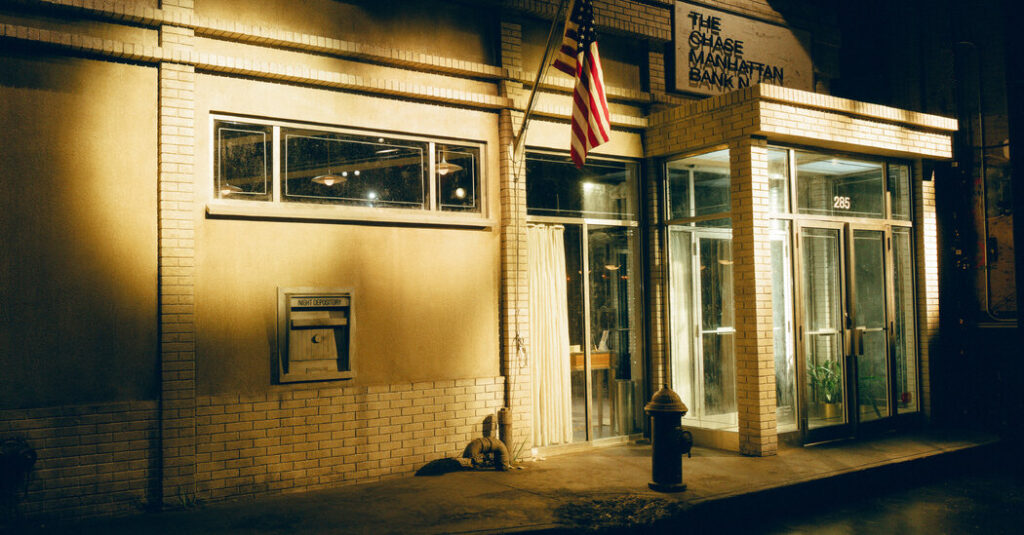
The show opens on the nondescript brick-walled exterior of the bank, a solid, seemingly immovable set for which Korins earned his fifth Tony nomination. But on cue, all 27,000 pounds of it rotates, turning and traveling forward to fill the stage with a familiar interior: tellers’ windows, a manager’s desk and, looming in the background, the vault. With period details down to the paperwork, in a ’70s palette of taupe, gold and burnt orange, it’s transportive and slightly foreboding — the employees finishing their workday will soon become hostages.
The challenge, Korins said during a recent tour of the August Wilson Theater’s stage, “was enormous, because of the impact the space had to have on the narrative. It was a lot about trying to figure out how to trap people inside of this box.”
Korins, one of Broadway’s top designers (“Hamilton,” “Beetlejuice”), started by looking at archival images of the Chase branch at the corner of Avenue P and East Third Street in Brooklyn that armed men, led by a Vietnam War veteran named John Wojtowicz, held up one sweaty day in August 1972. The burglary quickly went south, and attracted a swarm of police officers, news media and a swelling neighborhood crowd. Wojtowicz’s revelation that he was gay and hoped to use his ill-gotten loot to pay for transition surgery for his lover gave the whole escapade dramatic cultural heft. But the bank itself was almost startlingly spare, Korins said, in contrast to the cinematic-looking moments on the street outside, as the ordeal dragged on for hours.
The indelible 1975 Sidney Lumet movie, starring Al Pacino — who bore a strong resemblance to Wojtowicz — and John Cazale as the hapless accomplices Sonny and Sal (Jon Bernthal and Ebon Moss-Bachrach on Broadway), offered more interior design texture, Korins said. The wallpaper he created for the stage had a similar ovoid pattern; the fake plants carried over.
He also visited the block in Brooklyn’s Windsor Terrace neighborhood where the movie’s exterior scenes were filmed, and even took note of the grout work on the building that stood in for the bank onscreen. “There’s an impulse when you’re dealing with a period piece to age the heck out of brick, to knock away at it and make it look rough. And it actually wasn’t,” he said.
Matthew J. Prigge, the author of a forthcoming book about the movie and its impact, “Dog’s Day,” said the space being quotidian was the point. “It’s a boring street, a boring building,” he wrote in an email. “You could pass this scene a hundred times and never think twice about it.”
And Lumet, who died in 2011, was fastidious about detail — “a preparation freak,” said Robert Greenhut, one of the film’s associate producers. The director blocked scenes at the Ukrainian National Home in the East Village, his preferred rehearsal spot, and kept production on a tight schedule. They filmed not in the dog days of summer, but through the fall. “We had to use a lot of spray bottles to put sweat on people,” Greenhut said. The actors chewed ice so their breath wouldn’t be visible outdoors.
Onstage, nearly everything was custom built: the gleaming safe deposit boxes; the doors to the vestibule, with smudged glazed glass and handles that predate handicap accessibility requirements; the desk belonging to Mr. Butterman, the bank’s manager. Korins even added a scuff on the wallpaper behind the desk’s leather chair: “This is where Butterman has leaned back 6,000 times,” he said. The wallpaper, too, is lightly peeling at the seams.
The lived-in quality “just tells you more about what’s happening, right?” Korins said.
Details that audiences never glimpse, like the vintage ledgers in cabinet drawers, posters advertising traveler’s checks, retro brochures (accurate to the period, sourced through bank archives), and faded takeout menus on a corkboard — all were added to help inform the cast’s performance. “You can feel that as an audience member, even if they are not seeing what the prop is doing,” Korins said. (And some are personal touches, he added, like the bowl of lollipops by the teller windows. “I remember as a child just — ‘Yes, Mom, I’ll go with you, if I can get a Dum-Dum.’”)
As the play — written by Stephen Adly Guirgis, and directed by Rupert Goold — evolved, Korins added corners like Butterman’s windowed back office, which no character ever enters, for visual interest. “There could be a whole lot of sad sitting if the set couldn’t keep a buoyancy,” he said.
A big part of that was the pivoting transition, from the bank’s exterior, where the staging of interactions between the crowd and cops is “kind of elemental,” Korins said, to the atmospheric interior, where tension is meant to ratchet up as the heist unfolds.
When adapting a film to the stage you have to ask yourself “what makes it a compelling reason to do it,” he said. “The answer here is, you get to see those people actually trapped. There are no jump cuts, no cross-fades. There’s no cutting away from those two guys, those guns, and those people.”
Even when they are not in the scene, the actors in the bank never leave the set, and they can be glimpsed through the glass, doing what Korins called “silent storytelling.”
As for the revolving design, it was a technical feat. A scene shop in Beacon, N.Y., was enlisted to build a whole new axis of subfloor motors — the set, which is about 36 feet wide, 17 feet tall, and 31 feet deep, was too big to rotate on the usual pair, especially with the weight of the furniture and the cast. Lights and other elements had to be affixed so they would not sway. “Everything that’s not bolted down, Jon Bernthal throws around,” Korins said, pointing out a dented floor ashtray as he gave a tour of the set.
(It went off-track only once, during a rehearsal, he said, when a corner of the facade skidded into a back wall; the mechanism was immediately fixed.)
Korins did, originally, sketch some designs that were easier to execute — sliding panels and columns that simply lifted to reveal the scene. But, he said, that version of the bank didn’t “feel hard to rob,” or like it was “standing for an institution, a metaphor for the country or the government.” It felt, he said, “like a nice theater set.”
In the show’s narrative, Sonny is an antihero battling, as an individual, systems designed to thwart him. Though it is apparent almost from the start that he won’t succeed, said Prigge, the “Dog’s Day” author, “you have his moments along the way where he is the one in charge — a broke and busted gay American telling the cops what to do and humiliating all these forces that have always had their foot on so many necks.”
So how do you tell the story of a bank robber’s rare, if fleeting, power? You move the bank.
Melena Ryzik is a roving culture reporter at The Times, covering the personalities, projects and ideas that drive the creative world.
The post This Is How You Steal a Scene Using Only a Bank appeared first on New York Times.