This is an edition of The Atlantic Daily, a newsletter that guides you through the biggest stories of the day, helps you discover new ideas, and recommends the best in culture. Sign up for it here.
Earlier this year, Nicki Minaj asked her fans to “go out there and make some babies.” Sitting onstage at a D.C. auditorium, the rapper and recent MAGA convert wasn’t just talking about the wonders of parenthood—she was plugging President Trump’s new child-savings accounts.
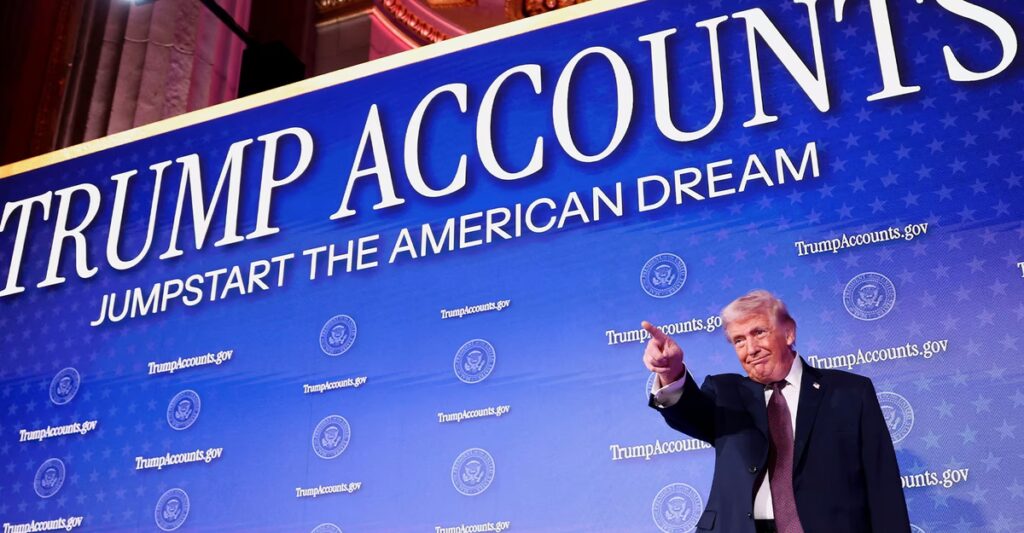
The 530A accounts, better known by their other official name, Trump Accounts, are set to launch on July 4. Much like existing child-savings accounts, these are essentially tax-advantaged investment vehicles. During tax season, any parents of kids up to 18 years old can open a Trump Account on behalf of their child, regardless of their income level; if the child was born in the years 2025 to 2028, they can also receive $1,000 in their account automatically, straight from the federal government. The money can be invested only in American companies, and parents are the account’s custodians until their child turns 18. According to Treasury Secretary Scott Bessent, more than 5 million children have already been enrolled in the program this year.
Trump Accounts have attracted wealthy backers from the private sector, who have agreed to supplement the accounts by offering additional money to qualifying kids. The tech billionaires Michael and Susan Dell are donating $6.25 billion to the program, which will put $250 into the accounts of certain children across the country who are too old to get the $1,000. Ray Dalio, the founder of Bridgewater Associates, is donating $75 million for a similar initiative in Connecticut, which can go to kids who do qualify for the $1,000, and Altimeter Capital CEO Brad Gerstner has said he’s planning on doing something comparable in Indiana. (Minaj also pledged to donate between up to $300,000 exclusively for her fans, but she hasn’t clarified how that might work.) Whatever amount your child qualifies for, you can add an additional $5,000 of your own money to the pot each year. All of it is meant to appreciate as the American economy does, snowballing into something that can give kids a head start when they come of age.
From a financial-planning perspective, taking free money from the government is a no-brainer. And the policy has the potential for bipartisan appeal—although, as Michael Sherraden, a social-development professor at Washington University in St. Louis, told me, the concept of giving children a certain amount of seed money has been “more a Democratic idea than a Republican idea” in recent years. Because of that, Trump Accounts could be “on better footing than most other policy discussions” in terms of their ability to outlast the current administration, he said.
But the way the account is set up could hinder its success. One challenge is that not every child eligible for a Trump Account will get one, because parents have to opt into it on their tax forms. Research has shown that it’s much harder to get people to opt into a policy than to opt out: When Maine launched a similar opt-in program for children born in-state, less than half of parents signed up after five years. Once the program was modified to become opt-out, participation shot up to 100 percent. Families that don’t file taxes—typically those with the lowest incomes—won’t have a chance to check the box. And because eligibility for the private donors’ money is decided according to zip code, per Treasury Department rules, lower-income kids in higher-income areas could miss out, as Time notes.
Trump Accounts draw heavily from decades of existing child-savings-account policies (see: UGMAs, UTMAs, 529 accounts, and “baby bonds” programs), which means that parents have plenty of additional options for their kids. The distinction with Trump Accounts is the MAGA packaging (you’ll need to fill out “Form 4547” in order to sign up), and the specific investment strategy. As research from Vanguard notes, this money is parked exclusively in U.S. companies, meaning that it’s mapped to the ebbs and flows of one country’s economy. If some kind of black-swan event tanks those stocks, these accounts could be vulnerable; other child-savings-account policies give parents the option to invest in both U.S. and international stocks. Donors may also end up shaping the portfolio: According to The New York Times, U.S. officials are considering letting wealthy donors load up these accounts with stock in their own companies, which could exacerbate that portfolio-diversity problem (investments in individual stocks are usually riskier than broad index funds).
The program also happens to be in line with one of the president’s convenient rhetorical fictions. Despite being, fundamentally, a figure of the establishment—a real-estate billionaire in the ranks of Manhattan’s ultra-wealthy and ultra-powerful—Trump came to power in 2016 by selling Americans a faux-populist economic platform. The broad coalition of voters that spurred both of his elections included portions of the working class and some of his fancy friends. Few of the policies Trump has pursued while in office can really be labeled populist (the legislation he’s pushed tends to benefit the wealthy), but he has occasionally made overtures to his working-class base, including in the “big, beautiful bill” and his executive orders.
Trump has always purported to support American families; he once labeled himself, somewhat disturbingly, the “fertilization president.” Trump Accounts theoretically represent the kind of pro-child policy that both parties could unite around, but the branding may be a liability. At a time when a majority of the country disapproves of—or actively reviles—the president, his name alone could end up limiting the program’s success.
Related:
Here are four new stories from The Atlantic:
- David Frum: The new blood libel
- Robert Kagan: Trump’s endgame is surrender.
- Homeland Security’s plan to strong-arm “sanctuary” cities
- A Department of Justice for an age of conspiracy theories
Today’s News
- The Democratic National Committee released a report examining the party’s 2024 election losses after months of internal pressure, despite earlier efforts to keep it private. The report’s author argues that Democrats lost voter trust and failed to project strength and unity, while DNC Chairman Ken Martin acknowledged that he mishandled the process and apologized for trying to suppress the document.
- The Commission of Fine Arts approved President Trump’s proposal to build a 250-foot triumphal arch in Washington, D.C., despite objections to decorative elements including golden eagles and a winged angel atop the structure.
- Trump announced plans to ease restrictions on hydrofluorocarbons, powerful greenhouse gases used in air conditioners and refrigerators, slowing a bipartisan effort to phase out “super pollutants.”
Dispatches
- Time-Travel Thursdays: Will Americans ever lose their grip on the handshake? This default greeting isn’t always as friendly and egalitarian as it seems, Tom Bartlett writes.
Explore all of our newsletters here.
Evening Read

Trump Is Missing the Entire Point of Arches
By Tyler Green
From nearly the beginning of the United States, Americans have used arches to make visual arguments about the nation’s ideals.
When George Washington arrived in Philadelphia after his election as president in 1789, he was welcomed by an arch of laurels and evergreens. Among its erectors was the painter Charles Willson Peale, who also made a 46-foot arch of painted canvas and wood that briefly stood in front of the city’s President’s House, where Washington would live for the bulk of his two terms. Arches, a form that linked the new North American nation to the classical Europe that had informed the Founding Fathers’ republicanism, helped give the U.S. a legitimizing past.
Ever since, artists have used arches to celebrate U.S. republicanism, including to alert us to the plutocratic and autocratic forces that might corrupt it. In other words, they have issued warnings against the very qualities that the latest proposed arch—which President Trump wants to build across the Potomac River from Washington, D.C.—would embody.
More From The Atlantic
- Radio Atlantic: Colleges are at a breaking point.
- The U.S. is holding global vaccination efforts hostage.
- The glorification of mass murder
- What the 18th century can teach the 21st
- Jemele Hill: Hit them where it hurts.
Culture Break

Explore. Granta magazine’s response to accusations of publishing AI-generated fiction points to a new phase in the struggle to keep literature human, Vauhini Vara writes.
Proofread (or don’t). To some, typos are no longer a sign of laziness but evidence of human touch, Michael Waters writes.
Rafaela Jinich contributed to this newsletter.
When you buy a book using a link in this newsletter, we receive a commission. Thank you for supporting The Atlantic.
The post What’s Behind the New Trump Child-Savings Accounts appeared first on The Atlantic.