I’m in Rome for a few days of reporting. Italy used to be synonymous with political instability. Out-of-control public debt. Relentless prime-minister turnover. And demanding bond markets.
These days Italy looks like a haven of stability. France has had seven prime ministers over the last six years. Germany’s right-left coalition looks shaky only a year in. Britain could end up with its seventh prime minister in a decade. Voters aren’t happy.
Bond traders aren’t either. And they’re making their presence felt in politics. Today I write about the power of the bond markets and explain why it’s so formidable right now.
The bond markets come for Britain
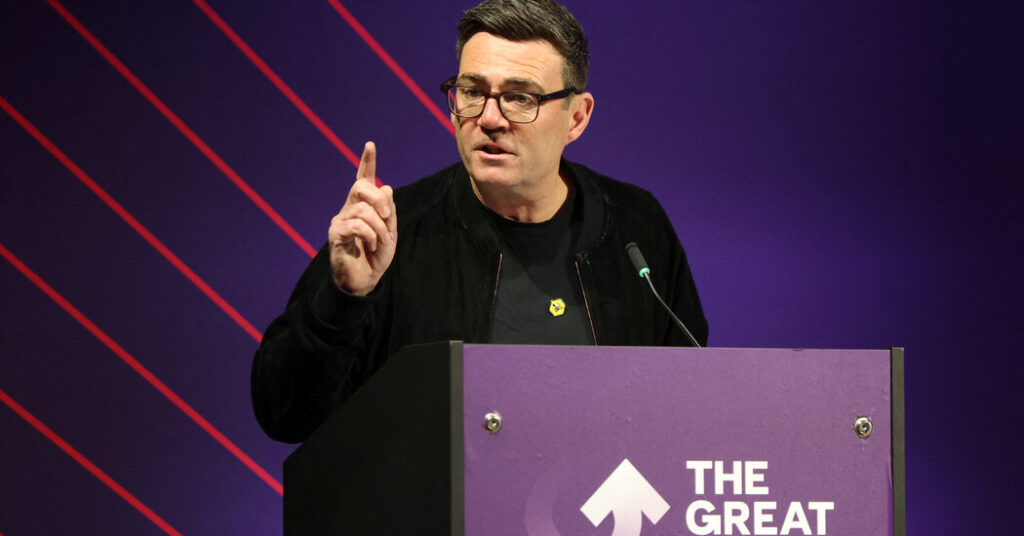
British voters might like Andy Burnham, the mayor of Greater Manchester and one of the leading candidates to replace Prime Minister Keir Starmer. Opinion polls show that he is one of the most popular politicians in the country.
Guess who doesn’t like him?
Bond traders.
Last September, Burnham gave an interview in which he lamented that Britain needed to “get beyond this thing of being in hock to the bond markets.”
The comments were widely interpreted as a sign that Burnham, whose politics lean left, would borrow more to spend more if he were prime minister.
Bond traders — the ones who’d be lending the government that money — are already nervous about Britain’s debt levels. And as the prospect that Burnham might actually occupy Downing Street has risen, they’ve made their displeasure known, going on a selling spree that has pushed interest rates up.
Burnham, for his part, has spent the past few days trying to win them back, as my colleague Eshe Nelson writes. There needs to be a plan to shrink Britain’s debt, he said. And yes, he would keep to the country’s self-imposed strict fiscal rules.
Getting over that thing of being in hock to the bond markets — it’s easier said than done.
In Britain, as Eshe puts it, there’s “a growing sense that the bond market has become an unofficial — and unelected — judge ready to punish leaders who are deemed to have stepped out of line.”
There are reasons investor opinion seems to loom especially large, not just over the race to succeed Starmer, but everywhere. Britain has become a case study in why bond markets are so powerful right now.
‘Bond vigilantes’
Bond markets have been putting fear into the hearts of politicians for a long time.
Bill Clinton came into the White House in 1993 promising spending increases and tax cuts. Then his advisers warned that the bond market would revolt, and Clinton reversed course. (His chief strategist, James Carville, famously said he’d like to be reincarnated as the bond market — “You can intimidate everybody.”)
During the sovereign debt crisis of the 2010s, bond markets almost pushed Greece out of the eurozone. They imposed painfully high borrowing costs on E.U. governments, which responded by imposing painful austerity on voters.
Last year, even President Trump had to change plans when his so-called Liberation Day tariffs sent U.S. Treasury yields soaring.
One analyst years ago coined the term “bond vigilantes” to describe the traders who collectively force governments to make policy U-turns. When they worry that countries are borrowing too much, they start selling off bonds. Prices drop, yields jump and governments immediately face higher borrowing costs.
Countries around the world deal with the bond markets. But there are a few factors that are making Britain particularly vulnerable.
One is the recent memory of how Prime Minister Liz Truss, a Conservative, announced 45 billion pounds’ worth of unfunded tax cuts, which sent traders into a panic. The Bank of England had to intervene as an emergency buyer of long-term government bonds, and Truss resigned after just a few weeks in office. The world has been wary of British bonds ever since.
Britain also has high debt levels, equivalent to about 93 percent of the economy, and inflation running hotter than much of Europe at around 3 percent. Other countries have these problems too. But Ken Rogoff, an economist at Harvard who has written about financial crises, told me that even if Britain’s debt was lower than America’s, or France’s, or Italy’s, it would be more vulnerable to bond markets.
The U.S. is insulated, up to a point, by having the world’s reserve currency, which allows it to find buyers for its debt worldwide. And countries in the eurozone benefit from the healthy balance sheet of Germany, by far its biggest economy. Germany’s debt is only 63 percent of G.D.P. — thanks, perhaps, to the “Swabian housewives” whom Angela Merkel praised during the 2008 financial crisis for knowing that “in the long run, you can’t live beyond your means.”
But Britain might just be the canary in the coal mine, Rogoff said. Because a lot of countries have been living beyond their means for a long time.
A global debt crisis
Interest rates were unusually low for years, Rogoff said — essentially since the financial crisis of 2008. They stayed low for so long that many predicted they’d stay low forever. Governments accumulated historic levels of debt, and bond markets seemed to shrug it off.
Not anymore. Yields have been climbing across the globe. “This has been a brewing storm, and we’re starting to see it over the horizon,” Rogoff said.
The question now is how governments will respond. The combination of higher yields and an era of populist politics is a volatile one. They can fuel each other. Politicians make commitments they can’t afford and are punished, which only reinforces the unsettling feeling that politicians are beholden to a force larger than the will of voters. Rogoff thinks this will all come to a head in the form of a debt crisis in some country before long. But which one?
MORE TOP NEWS
-
A U.S. aircraft carrier and its escort warships entered the southern Caribbean Sea as part of a campaign to pressure the Cuban government.
-
The U.S. announced new entry restrictions for citizens who have recently been in the Democratic Republic of Congo, Uganda or South Sudan, citing the Ebola outbreak.
-
Jeff Bezos lavished praise on Trump in an interview, saying that his second term was “more mature, more disciplined.”
-
The U.S. approved the sale of one of Nvidia’s most powerful A.I. chips to China, but China — seeking to promote homegrown alternatives — has not bought a single one.
-
Russia has hacked thousands of accounts on the social media app Bluesky to spread propaganda about its war in Ukraine.
-
Trump said he would speak with Taiwan’s president, a move that would defy decades of U.S. diplomatic protocol and anger China.
-
China’s housing market shows faint signs of recovery, but a backlog of 90 million empty or unfinished apartments suggests the crisis is far from over.
TOP OF THE WORLD
The most clicked link in your newsletter yesterday was about the man who inadvertently became Australia’s most talked-about runway model.
SPORTS
Football: Thousands of South Koreans turned out to cheer a visiting North Korean women’s football team, unleashing intense emotions.
Hockey: The Montreal Victoire became the first Canadian champions of the Professional Women’s Hockey League.
MORNING READ
When a humpback whale became stranded in the shallow waters of the Baltic Sea near Germany in March, he seemed to bring out the best in the public, which named him Timmy. Crowds flocked to see him. He became a tabloid star and a magnet for marine-mammal-adjacent social media influencers.
After a privately funded attempt to rescue Timmy, the situation took a tragic turn. And then the finger-pointing and conspiracy theories began. Read more.
AROUND THE WORLD
A sexy garden ruffles Chelsea
In the rarefied world of elite British gardening, the century-old Chelsea Flower Show is a top-tier event: Royals, retired football players and British TV stars sip Pimm’s, and judges spend days assessing hundreds of thousands of plants.
This year the event has taken a risqué turn toward the birds and bees, with a garden in competition that explores carnal themes through the medium of houseplants. The suggestively shaped calla lilies and carnivorous plants caused dismay from one Christian group, which called it “soft porn.” Others were more welcoming, including the judges, who awarded it a gold medal. “I think it’s sort of tasteful,” one visitor said. Read more.
RECIPE
Tender and chewy, this big-batch butter mochi is always a hit at parties. It uses coconut milk for richness and a subtle nutty taste, but you can substitute equivalent amounts of whole milk, evaporated milk or a combo of both.
WHERE IS THIS?
Where is this tree?
BEFORE YOU GO …
I loved reading comments from so many of you after writing about nationalism on Tuesday. Thank you. We’re excited about this cool new tool to embed comments in the newsletter. It’s a bit of a cliché to say, “Let’s keep the conversation going,” but I really feel it did. We heard from readers in South Africa, Taiwan, California, Switzerland, Dubai and beyond.
One observation that was an aha moment for me came from Wolfgang, who grew up in eastern Germany and is writing his Ph.D. on Taiwanese nationalism. He reframed the fall of the Berlin Wall as a “nationalist revolution” — a revolution to reunify two German states. I’d never thought of it that way before.
Several of you also raised the issue of terminology that is sometimes used interchangeably, and maybe shouldn’t be: “patriotism” and “nationalism,” for example, or as Francesco from Sardinia wrote, “state” and “nation.”
States “are often artificial constructs, born from postwar treaties or royal marriages,” Francesco said, adding that “nations, on the other hand, are groups of people who share a common history, language, culture and traditions.” My Welsh husband, who gets very frustrated with his German mother-in-law when she uses “England” for “Britain,” couldn’t agree more.
For my song of the week, let me close the loop and give you a nationalist rap by a Black Welsh-language artist, Sage Todz. This is “O Hyd,” Welsh for “still here,” a hip-hop rendition of a much-loved Welsh folk song.
Have a great weekend! — Katrin
TIME TO PLAY
Here are today’s Spelling Bee, Mini Crossword, Wordle and Sudoku. Find all our games here.
We welcome your feedback. Send us your suggestions at [email protected].
Katrin Bennhold is the host of The World, the flagship global newsletter of The New York Times.
The post Britain vs. Bonds appeared first on New York Times.