The Trump administration is known for moving at a fast pace. Every week, The 5-Minute Fix wraps up some of the biggest stories from the administration you may have missed.
This week was a busy one, and we will run down what happened in today’s newsletter as well as Friday’s.
You’re reading The 5-Minute Fix newsletter, a free analysis of the day’s biggest political news. Get it in your inbox every weekday.
Trump’s legal fund is already facing legal challenges
Some of the most controversial figures in modern American politics are trying to get payouts from the $1.8 billion of taxpayer dollarsthe Trump administration set up this week for people who claim they were wronged by the justice system under Democrats.
That includes a man who pointed guns at racial-injustice protesters in 2020; former Illinois governor Rod Blagojevich, who was pardoned by President Donald Trump after being convicted for trying to sell President Barack Obama’s vacant Senate seat; former Republican congressman George Santos, who was expelled from Congress for a variety of ethics and legal issues (and had his sentenced commuted by Trump); as well as hundreds of people convicted — then pardoned — by Trump for the Jan. 6, 2021, attack on the U.S. Capitol.
It’s being portrayed by some as a status symbol, of having been persecuted for fighting for the MAGA cause.
“It’s not a monetary issue for me,” Santos told The Washington Post’s Meryl Kornfield. He was convicted of identity theft and wire fraud. “I’m not injured. I’m able to maintain income. I want to correct the record. I think it’s a great avenue to do so.”
The fund is also facing at least one legal challenge. Two police officers who defended the Capitol during the Jan. 6 attack sued in federal court, arguing the fund violates the Constitution. The 14th Amendment says that “neither the United States nor any State shall assume or pay any debt or obligation incurred in aid of insurrection or rebellion against the United States.”
But the fund itself is so extraordinary — arising from a $10 billion lawsuit the president filed against his own administration — that it’s not clear how the courts would even begin to tackle this, some legal experts say.
Congress could pass legislationlimiting how administrations spend money in legal settlements. On Thursday, Senate Republicans held up plans to fund Immigration and Customs Enforcement, signaling they are at least temporarily considering ways to limit this and what leverage they might have over the White House.
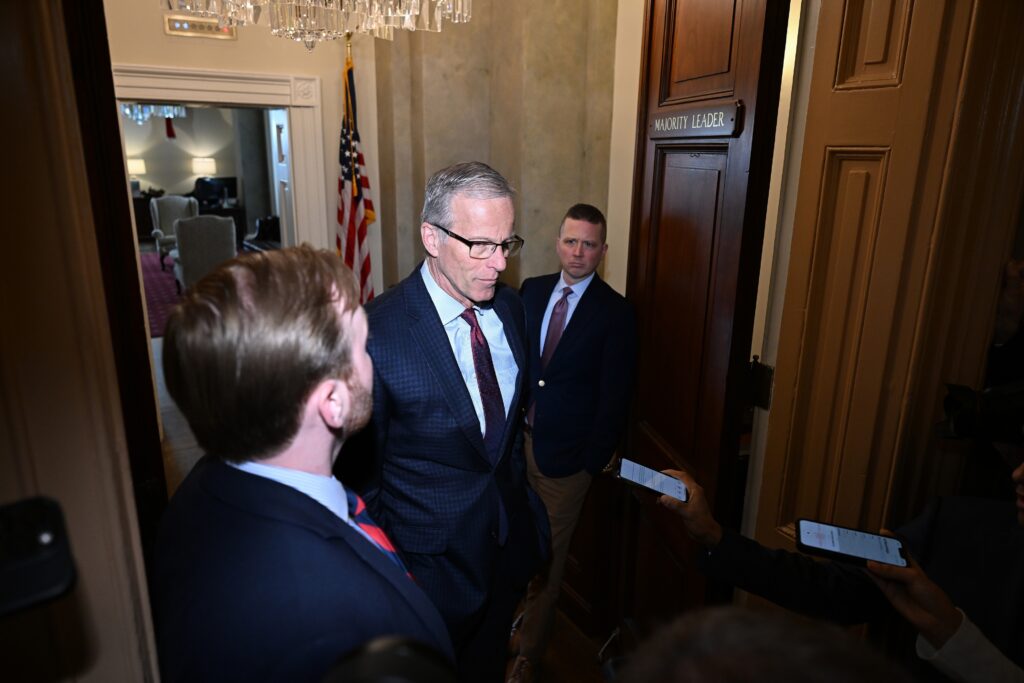
“Not a big fan,” Senate Majority Leader John Thune (R-South Dakota) said this week about it.
“The fund is staggeringly lawless,” said Kimberly Wehle, a professor at the University of Baltimore School of Law and author of the newsletter “The Little Law School With Kim Wehle.” “There should be millions taking to the streets right now.”
Democrats are making thispart of their pitch to voters about why they should have control of the House for Trump’s final two years in office.
“We will get to the bottom of where every dollar has gone,” Rep. Jamie Raskin (D-Maryland) said this week. “They have just gone way too far this time, [and] the public is not going to put up with it.”
Trump says he’s concerned about an Ebola outbreak
A deadly Ebola outbreak roared to life this week in Central Africa, constituting a global public health emergency and quickly knocking on America’s doors in more ways than one.
“I’m concerned about everything,” Trump said this week when a reporter asked about what’s happening, “but certainly I am.”
There are no suspected cases in the United States.
Public health officials warn this virus could be particularly insidious: It’s fast moving, happening in a conflict zone, and there isn’t a vaccine for it.
Doctors in the region say that cuts from the United States and other Western entities to global public health have made it particularly hard to track and treat. The Trump administration withdrew from the World Health Organization last year and eliminated funding in several African countries to track Ebola, train doctors on how to treat it and deliver rapid-response treatment to stem its spread.
Hundreds are suspected to be infected.
“Before, there were resources available, there were international organizations reaching out,” Manenji Mangundu, Oxfam’s country director in the Democratic Republic of Congo, told The Post. “Now, we are just not seeing the resources coming in as we would want. And we are watching cases rise. We are very, very worried.”
A court tells the White House to preserve official records again
For decades, a federal law has mandated that presidential records are public property — every memo, every email about official business must be preserved and turned over to the National Archives when a president leaves office.
Trump has repeatedly run up against the law.
After he left office in 2021, he took official records with him — including highly classified information — culminating in an FBI raid on his home and an indictment alleging that he mishandled classified information. A judge dismissed the case over procedural issues, then Trump won back the White House, and it was dropped entirely.
The second Trump administration recently issued guidelines easing restrictions on recordkeeping, opening the door to personal phone use previously prohibited. But this week a federal judge ordered the White House to preserve every record to comply with a Nixon-era law known as the Presidential Records Act. The White House indicated it plans to appeal.
Donald Sherman, president of Citizens for Responsibility and Ethics in Washington, said this week the judge found that Trump and his administration acted “as though presidential records are theirs to destroy or hoard at will.”
The post What happened under Trump this week appeared first on Washington Post.