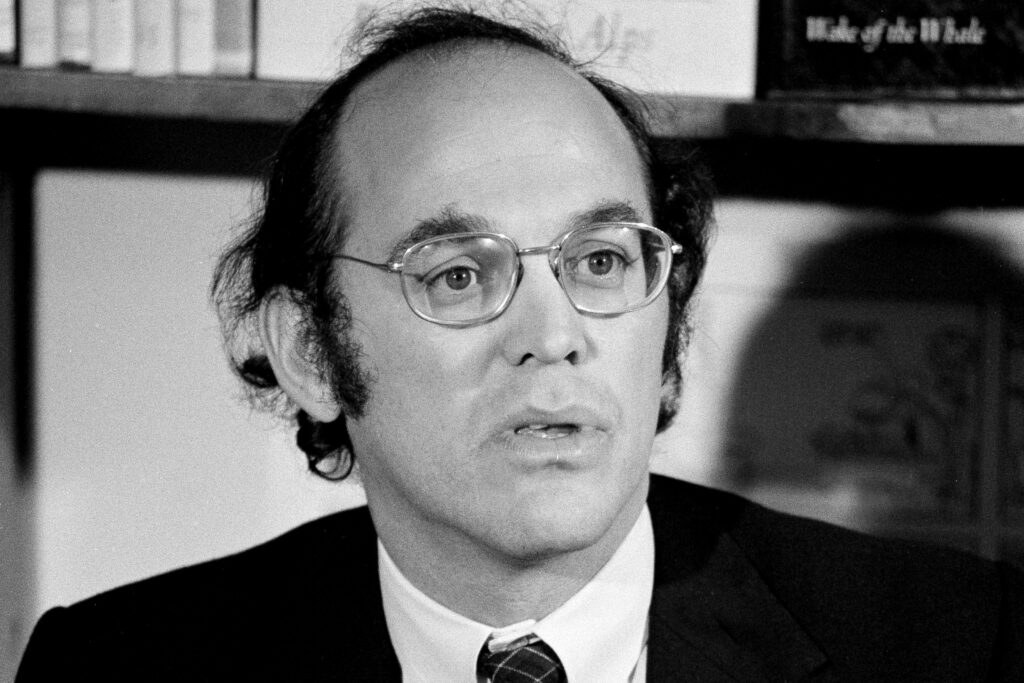
Like most of humanity, Rafe Pomerance had never heard of climate change when he stumbled upon the phrase in a dense government document in the late 1970s. Mr. Pomerance was working as a clean-air lobbyist for the environmental group Friends of the Earth at the time, more concerned with curbing pollution at ground level than tracking an invisible gas way up in the atmosphere.
Yet here on the 66th page of a report on coal liquefaction, federal scientists were warning that surging emissions of carbon dioxide, caused mostly by burning fossil fuels, could cause a “significant and damaging” increase in Earth’s temperature.
“This was so much more profound than the issues I’d been working on,” Mr. Pomerance told The Washington Post in 1989. “I remember thinking: What right does this generation have to warm up the Earth?”
Mr. Pomerance spent the rest of his life trying to avert catastrophic warming, leading the push for the first congressional hearings on the issue and helping negotiate the Kyoto Protocol, a landmark United Nations treaty to curb global greenhouse gas emissions.
The journalist Nathaniel Rich, whose New York Times Magazine article about the early days of climate activism brought Mr. Pomerance some late-in-life glory, described him as “a hyperkinetic lobbyist … who, at great personal cost, tried to warn humanity of what was coming.”
By the time of his death Thursday at 79, the annual amount of carbon dioxide released by humans had nearly doubled, and global average temperatures had risen by more than 2 degrees Fahrenheit. But nearly everyone on Earth has heard about the dangers of climate change.
His death, from lung cancer, was confirmed by his son Benjamin Cooley.
Just a few days after he read the coal report, a colleague showed Mr. Pomerance a newspaper article about a speech by geophysicist Gordon J.F. MacDonald discussing the likely effects of carbon-fueled warming: devastating storms, widespread drought, enough ice sheet melt to submerge major coastal cities.
Mr. Pomerance swiftly tracked down MacDonald’s phone number and asked for a meeting. Over the course of several hours, as MacDonald patiently explained the greenhouse effect, which researchers had been studying since the 19th century, Mr. Pomerance became increasingly appalled that no one beyond a siloed group of scientists seemed to know about the issue.
“I describe the situation as, we were in an empty room,” Mr. Pomerance said in a 2025 webinar hosted by Harvard University’s Belfer Center for Science and International Affairs. “There was no interest, no knowledge, very little work going on.”
Having spent the better part of a decade prowling the halls of Capitol Hill, this was a problem Mr. Pomerance knew how to solve. The lanky, gregarious activist began to arrange meetings between MacDonald and every government official he could find.
Even Mr. Pomerance was surprised by how quickly their effort gained traction. Gus Speth, chair of the White House Council on Environmental Quality under President Jimmy Carter, asked the duo to prepare a memorandum, which he promised to bring to the president. The resulting document prompted the White House to commission a comprehensive assessment of the science on carbon dioxide and climate.
The journal Science summarized the assessment’s findings with a blunt headline: “Gloomsday predictions have no fault.”
But Mr. Pomerance knew that jargon-filled scientific papers alone stood little chance of galvanizing the public — or the politicians whom they elected. In the 1980s, he set about persuading members of Congress to organize hearings on the issue.
Mr. Pomerance himself testified at one of those hearings in 1984, urging politicians not to wait for climate change’s impacts to become clear before taking action to avert it.
“Today we do not know the consequences,” he said. “Once we do, they will be irreversible for several centuries.”
The breakthrough moment finally came in July 1988, when — in the midst of a record-setting heat wave — NASA scientist James Hansen told a panel convened by Sen. Tim Wirth (D-Colorado) that he could already detect the warming effect of humanity’s greenhouse gas pollution.
Later that week, at Mr. Pomerance’s urging, Wirth gave a speech at an international conference in Toronto calling on attendees to adopt the first-ever goal for reducing global carbon emissions. A decade later, at a U.N. climate conference in Kyoto, Japan, Mr. Pomerance would help the world finally agree on a target.
“Rafe knew his science very well, and he was not righteous about it,” Wirth said in a phone interview. “His was a very applied kind of advocacy — not just, ‘You ought to do this,’ but, ‘This is how we might do it.’ Not just that it should be done, but this is how we can get it done.”
Born in New York City on July 19, 1946, Mr. Pomerance credited his environmentalism to his upbringing on a woodsy property in Cos Cob, a quiet area of Greenwich, Connecticut. His father, Ralph, was an architect; his mother, Josephine Wertheim Pomerance, was a prominent peace activist and a granddaughter of diplomat and real estate mogul Henry Morgenthau Sr. Both parents were active in the Democratic Party and often brought him along to political events.
After graduating from Cornell University in 1968, Mr. Pomerance worked as a community organizer in Virginia, then moved to Washington to lobby for the National Welfare Rights Organization.
“I was interested in how government worked and in trying to influence things,” he told the academic journal Daedalus in 2020. “I wanted to get into the action.”
Mr. Pomerance got his chance in 1993, when he was appointed deputy assistant secretary of state for environment and development under President Bill Clinton. The world had recently adopted a U.N. treaty pledging to combat “dangerous human interference with the climate system,” and now parties were trying to agree on rules for achieving that goal. Mr. Pomerance’s task was to help craft an agreement that stood a chance of being adopted by skeptical U.S. politicians — but would still make real progress in curbing the world’s reliance on fossil fuels.
“I remember saying to myself: we’re negotiating the future of the planet and at the same time the future of the global economy,” Mr. Pomerance told Daedalus. “Those were the stakes.”
Adopted in 1997, the Kyoto Protocol was the world’s first binding treaty requiring industrialized nations to cut planet-warming pollution. Studies have found that countries that ratified the agreement saw their annual greenhouse gas emissions fall by as much as 16 percent over 10 years.
But the United States was not among them. Before the Kyoto Protocol was even finalized, the Senate adopted a unanimous resolution in disapproval, arguing that it unfairly penalized wealthy nations without requiring emissions cuts from the developing world.
That resolution, which coincided with an intense lobbying effort funded largely by fossil fuel companies, convinced Mr. Pomerance that U.S. politics was a key obstacle to protecting the global climate.
“If the Congress doesn’t act, it means the United States can’t make commitments to the rest of the world,” he said on a podcast hosted by the World Resources Institute, where he was a senior associate from 1986 to 1993. “And the Congress will not act on this problem in a significant way. They just won’t.”
Mr. Pomerance left government in 1999 to found the Climate Policy Center, pushing for the creation of an advanced research and development program for energy technologies. He went on to hold leadership roles at environmental groups including Clean Air Cool Planet, American Rivers and the League of Conservation Voters.
Recognizing that the rapid melting of polar ice would spell disaster for coastal communities, Mr. Pomerance also became a fierce advocate for policies to protect the Arctic. By framing climate change in terms of sea-level rise — a more tangible threat than a few-degree increase in average global temperature — he hoped to make the issue more politically relevant.
“The fate of Greenland is the fate of Miami. The fate of Jacksonville. The fate of Tampa,” he said in an interview with the public radio initiative StateImpact Pennsylvania. “Ultimately, the United States is going to have to figure out what it wants to do, whether we want to save Florida.”
In addition to his son Benjamin, survivors include two other children, Lilah and Ethan Pomerance; his wife, Lenore Pomerance; two siblings; and seven grandchildren.
It was his family, Mr. Pomerance told Daedalus, that motivated his unrelenting activism. Whenever he felt frustrated by the slow pace of progress or daunted by the enormity of the task ahead, he wore a bracelet one of his granddaughters made for him.
“I use that to remind myself that I have to be outspoken,” Mr. Pomerance said. “Unless there’s some strategic reason not to speak out, I don’t hold back, because this is about her.”
The post Rafe Pomerance, who helped sound the alarm on climate change, dies at 79 appeared first on Washington Post.