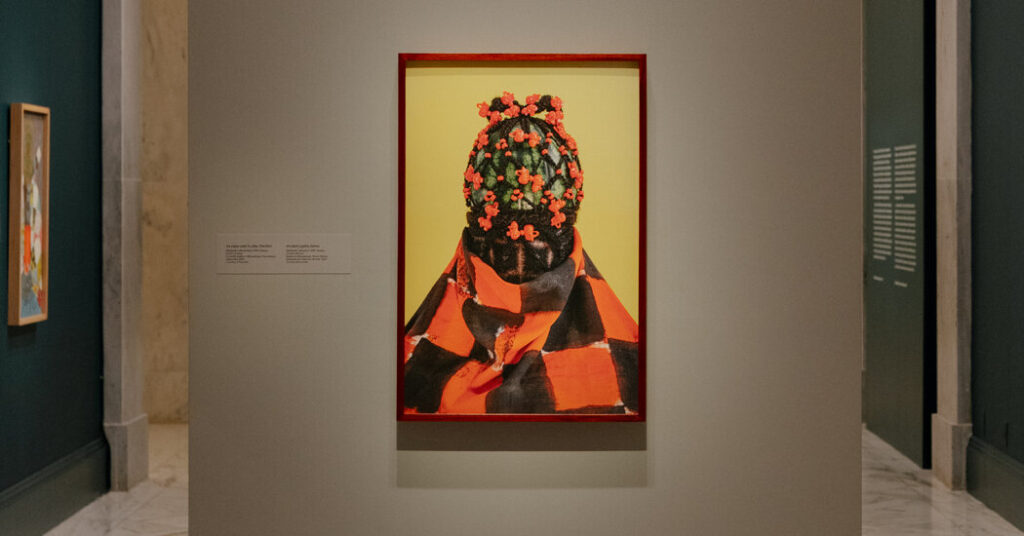
There are compelling images of American life currently on display at the Smithsonian’s National Portrait Gallery: photographs of a nude woman receiving a medical injection, a child’s empty bedroom, a man’s vacant expression.
For many of them, the artists had drawn up language to help viewers further understand their intentions and methods.
But the gallery’s “Outwin Boochever Portrait Competition” show — which runs through August — is largely devoid of the descriptive wall text that typically accompanies artworks on display. Many artists received notice last summer that such text would not be part of the exhibition.
“I was frustrated,” said the photographer Jared Soares, who won second prize for his image of a Black man who had been falsely accused of a crime after being misidentified by facial recognition technology. “It strips the photograph of its context and it is no longer grounded in the story.”
Wall text has become a flashpoint for debate as the language used by the Smithsonian, and other museums, is scrutinized for the way it presents context.
The Trump White House has demanded that eight Smithsonian institutions — including the Portrait Gallery — turn over thousands of documents (including wall texts) for review as part of an effort to replace “divisive or ideologically driven language with unifying, historically accurate and constructive descriptions.”
Concetta Duncan, a Portrait Gallery spokeswoman, said wall text was avoided in the competition because the museum is exploring different approaches to labels.
“Some include quotes or tombstone labels which provide only general information such as the artist’s name and title of the artwork,” she said, adding, “And this year’s labels are an experimental approach that we will evaluate through visitor feedback.”
Traditionally, museum wall text has been no more controversial than signs pointing visitors to the restrooms, and the Smithsonian still has descriptions placed near objects in most of its galleries. But there have been changes at exhibitions in some museums where the subject could be potentially contentious.
Nearly 27,000 people have signed an online petition criticizing the British Museum for recently changing the word “Palestine” on several displays of ancient artifacts. The museum explained that the term had been inaccurately applied and that “Palestine” was no longer historically neutral. (They revised terminology to Canaan, the kingdoms of Israel and Judah, or Judea, depending on the object’s date.)
Among the most scrutinized texts has been one accompanying President Trump’s image in the “America’s Presidents” exhibition at the Portrait Gallery. Several months ago, historians became concerned when language describing his two impeachments was removed as Mr. Trump sought greater control over the institution.
The museum said the removal was temporary and part of a wider redesign of the exhibition. Earlier this month, the language returned as part of that revamp, though the reference is shorter and does not say why Mr. Trump was impeached, as it had previously.
The possibility of more changes at the Smithsonian have led to a grass-roots effort to monitor the existing language in Smithsonian museums.
“When the White House orders museums to comply with a single viewpoint on our shared history, that violates the First Amendment and Americans’ rights to free expression under the Bill of Rights,” said Jessica Dickinson Goodman, a historian at Georgetown University who is part of the effort.
Conservatives argue that the wall text that has been targeted is objectionable because it represents only a progressive viewpoint.
Mike Gonzalez, a senior fellow at the Heritage Foundation, pointed to the Smithsonian’s National Museum of American History where wall text says Buffalo Bill’s Wild West shows “turned the subjugation of Indigenous peoples into theater.”
Gonzalez said that sort of language “puts the worst interpretation on American entertainment” and is part of what he described as an indoctrination where visitors “get hit over the head with didactics and wall texts that maliciously sow doubt about the United States and the West.”
The conservative essayist Heather Mac Donald last year called out language at the Metropolitan Museum of Art that upbraided Dutch still-life paintings for having omitted the “human cost of colonial warfare and slavery.”
“Of course, by definition, a still life features inanimate objects, not human subjects, so any still life would be hard-pressed to portray colonial warfare and slavery,” Mac Donald said. “But never mind.”
The Smithsonian is in a vulnerable position when it comes to White House pressure because so much of its funding — roughly two-thirds — comes from federal sources. Independently financed museums can better resist such pressure, said Bryan Stevenson, founder of the Equal Justice Initiative, the Montgomery, Ala., nonprofit organization that established museums and monuments focused on racial injustice in that city.
The Alabama complex, which draws support from philanthropic, corporate and grass roots fund-raising efforts, has been free to look squarely at the history of slavery and lynching with immersive installations at its museum, memorial and new Montgomery Square site, which explores the Black protest movement from 1955 to 1965.
Trump Administration: Live Updates
Updated
- Republicans in Congress face a series of tests of their loyalty to Trump.
- Trump will ease restrictions on climate ‘super pollutants.’
- Trump again says he will talk to Taiwan’s leader, risking China’s anger.
One installation, “‘Segregation Forever’: Leaders of White Supremacy,” focuses on figures like Strom Thurmond, the long-serving South Carolina senator, and former Gov. George C. Wallace of Alabama, who both fought integration.
“Racist ideologies vaulted many leaders into powerful political positions and national prominence,” the wall text reads, “creating a model for influence and power that can still be seen today.”
Stevenson said: “We are swimming against the current here. We are standing when others are being told to sit down. We are speaking when others have been told to be quiet.”
The Whys of Wall Text
Some historians track the beginning of modern wall labels to the 1850s, when basic information like a painting’s date, title and creator were added in galleries to spare visitors the expense of buying a catalog. That changed by the end of the century, when labels took on an explanatory function akin to text books.
But the pedagogy changed in the postwar era when text was used to pique a visitor’s curiosity and lift a person’s gaze to the artwork itself. Around that time, audio guides were created to simulate the experience of guided tours.
Not every museum agreed on the advisability of labels. At the Museum of Modern Art, the director Alfred Barr in 1941 discouraged text, for a time, in favor of a more visceral art experience. And the Isabella Stewart Gardner Museum and the Barnes Foundation use none, per their founders’ instructions.
In the 1990s, a report from the American Alliance of Museums called on institutions to expand their educational role.
“Museums can no longer confine themselves simply to preservation, scholarship, and exhibition independent of the social context in which they exist,” the study said, adding that “objects are no longer viewed solely as things in themselves, but as things with complex contexts and associated value-laden significance.”
Over time wall texts became standard practice as multiple studies showed their power to enhance the visitor experience and increase engagement.
For example, the label next to a Vermeer painting, “Allegory of the Catholic Faith” at the Metropolitan Museum of Art, takes an image of a woman with her foot atop a globe and provides a short primer on the significance of her pose and other elements of the work.
The painting, the label tells us, was made in the early 1600s when “public celebrations of the Mass were forbidden in the Dutch Republic.” But Vermeer, who had converted to Catholicism before his marriage, depicts the woman as an emblem of the church and her stance as evidence of its triumph.
Wall context proved crucial to calming consternation over a major Philip Guston exhibition that featured his Klan imagery. After museums began postponing their exhibitions in 2020 — prompting an outcry from artists — the show finally opened in Boston in 2022 with an “Emotional Preparedness” pamphlet from a trauma specialist. A message on the wall from the curators noted that many had taken issue with the postponement.
“Wall labels are the smallest piece of real estate in the museum,” said Sandra Jackson-Dumont, a presidential scholar at the Getty Research Institute. “But they loom large in the social and intellectual context of the institution.”
In its recently completed David Geffen Galleries, the Los Angeles County Museum of Art was very deliberate in aiming to provide text that is brief but informative — inviting visitors to learn more through QR codes if they so choose; leaving works of art open to multiple perspectives rather than dictating a single one.
“I have predicted for decades that the culture wars would go to labels because labels are something we construct,” said Michael Govan, the museum’s director. “My mission was to write texts in a different way, that are about why we put this together and why you’re seeing it, and less about some individual work of art.”
“I don’t know if you need labels on presidential portraits, given that you can Google a thousand pages of information about them,” he said.
Govan continued: “It’s just a no-win proposition, no matter what you say. It is reductive. It will have bias of some kind.”
The Outwin Competition
In this year’s “Outwin” exhibition, the Smithsonian’s most prestigious art competition, which is named after its patron, Virginia Outwin Boochever, many artists submitted explanatory texts to accompany their work or discussed language with curators.
Rachel Cox said she hoped that any text would explain that her injection self-portrait was about her struggle with in vitro fertilization treatments.
The photographer Al Rendon said that he expected his image of the bedroom of 9-year-old Jackie Cazares — her bed made and her grieving parents, Javier and Gloria, standing nearby — would be accompanied by text. That is the way it was previously displayed at the Witte Museum in Texas. The text at that museum had explained that the image depicted a tragic consequence of the 2022 Robb Elementary School shooting in Uvalde, Texas.
Asked whether the Smithsonian was concerned that, without wall text, the images may not be viewed in their proper context, Duncan said in an email: “The National Portrait Gallery is continually evaluating how best to present information to visitors, including exploring different approaches to text in exhibitions.”
When Soares, who took second place, was told that his photograph of Alonzo Sawyer’s face being touched by his wife would not have accompanying text, he said he considered withdrawing from the competition. The image had originally appeared in a 2023 New Yorker article about the pitfalls of using facial recognition in law enforcement settings. Sawyer, the article reported, had been one of a number of Black people who had been misidentified as suspects.
At the Portrait Gallery, the image was simply titled, “Misidentified by Artificial Intelligence: Alonzo and Carronne.”
Soares unsuccessfully petitioned the museum to add a QR code that could link viewers to some context. But he ultimately chose to participate, reasoning that visitors could read more about his work, if they purchased the show’s $14.95 catalog. On a recent visit to the gallery with his family, he said curious visitors asked the artist to explain the photograph on view because there was no explanatory text.
“The museum regularly gathers visitor feedback through a variety of channels, including comment cards and public programs,” said Duncan. “Initial responses to this year’s ‘The Outwin 2025’ exhibition have been generally positive.”
Text did accompany the display of the work of the first-prize winner, Kameron Neal, a 2023 video installation “Down the Barrel (of a Lens),” which draws on archival surveillance footage made between 1960 and 1980. Neal said that after working with the curators on wall text for the piece, he was initially told that all text would be removed from the exhibition. That was a problem, he said, and he pushed back.
“I didn’t feel comfortable showing the work without any descriptive context at all,” he said.
The curators ultimately included three sentences with his installation.
But Neal noted that his video is also being shown at MoMA PS1’s “Greater New York” exhibition, where the posted explanation is more than twice as long.
Zachary Small is a Times reporter writing about the art world’s relationship to money, politics and technology.
The post Is Museum Wall Text the Next Political Battleground? appeared first on New York Times.