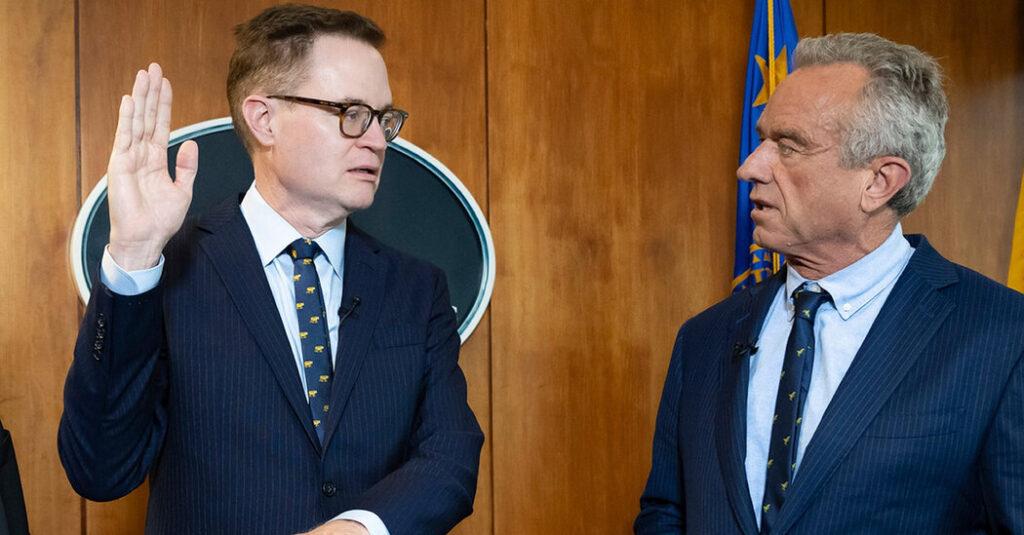
The nation’s largest general science group called on Thursday for the Senate to hold a public hearing on the nomination of Jim O’Neill to head the National Science Foundation and questioned his credentials to run one of the top funders of basic research.
The nomination must be approved by the Senate Committee on Health, Education, Labor and Pensions before being forwarded to the full Senate.
“The committee has repeatedly fast-tracked N.S.F. nominations in closed sessions that are limited to the senators and their staffs,” said Andrew Black, chief of staff at the science group, the American Association for the Advancement of Science.
A public hearing creates a public record that can be checked in the future to see if a nominee’s testimony and promises hold up, he added.
The N.S.F. director serves for six years. Mr. O’Neill has no science degrees or personal background in research, although a profile of him at an anti-aging foundation he once led says he advised and invested in more than 70 science and technology companies.
Mr. O’Neill has a degree in the humanities from Yale University and worked extensively with the Silicon Valley billionaire Peter Thiel before joining the Trump administration. Starting last June, he was deputy secretary at the Department of Health and Human Services and then acting director of the Centers for Disease Control and Prevention.
In March, Mr. Trump nominated Mr. O’Neill to be the N.S.F. director. Soon after, in a social media post, Mr. O’Neill said the government “should take bigger financial risks to pose and answer deeper questions.”
N.S.F.’s scientists and staff, he added, “have built something worth strengthening.” Mr. O’Neill could not be reached for comment.
Many experts have noted his lack of traditional qualifications for the N.S.F. job, questioning his ability to run an agency that has financially supported 274 Nobel laureates and now funds some of the nation’s top scientists.
Science magazine quoted Neal Lane, a former N.S.F. director, as saying Mr. O’Neill would face “a high risk of failure.”
N.S.F. is widely seen as an agency in turmoil. It has had no director for more than a year and is facing budget cuts as Mr. O’Neill awaits Senate confirmation. The administration has canceled or suspended hundreds of N.S.F. grants and recently fired the members of an independent board that oversees the research agency.
On Wednesday, Sudip Parikh, the chief executive officer of the A.A.A.S., based in Washington, D.C., sent a letter to the Senate HELP Committee asking for an open hearing with Mr. O’Neill before the committee votes on his nomination.
“While an unconventional background is not necessarily disqualifying,” Dr. Parikh wrote, “it does require greater scrutiny of the nomination by Congress.”
William J. Broad has reported on science at The Times since 1983. He is based in New York.
The post Science Group Seeks Public Hearing for N.S.F. Nominee appeared first on New York Times.