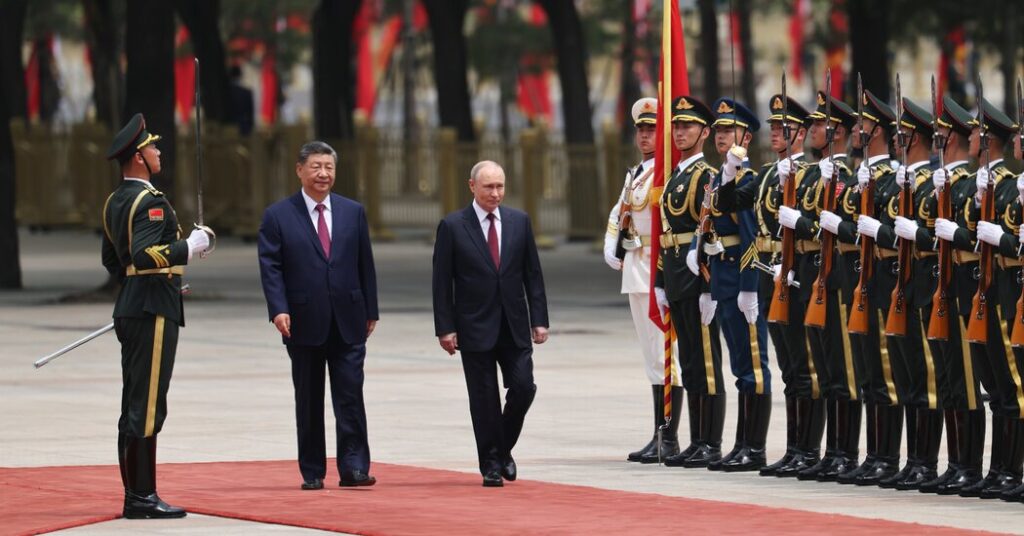
When the Chinese leader, Xi Jinping, hosted President Vladimir V. Putin of Russia in Beijing on Wednesday for what China said was the Russian leader’s 25th visit, the elephant in the room was President Trump.
Less than a week earlier, the American president had made the journey to the Chinese capital. During that trip, Mr. Xi warned Mr. Trump against mishandling Taiwan and asked him to reopen the Strait of Hormuz off the coast of Iran, as China seeks to stabilize its tumultuous relationship with the United States.
Mr. Putin’s visit, by contrast, was decidedly more familiar, even chummy.
Mr. Xi sat down with the Russian leader for tea. The two reminisced in front of photographs about Mr. Putin’s past visits. And while they chose measured words about the United States, the pair signed documents condemning much of what Mr. Trump is doing in the world, ultimately reaffirming their shared front.
Mr. Putin quipped, without Mr. Xi present, that the visit was taking place on the same day that Mao Zedong, 54 years earlier, had “called on the entire world to fight American imperialism.” Then, the Russian leader repeated the mantra that Moscow and Beijing were joining forces not “against anyone” else, but only in service of their own interests and of global harmony.
“We are ready to cooperate with everyone, including our partners around the world, including the United States,” Mr. Putin said.
Throughout the visit, Mr. Xi and Mr. Putin cast themselves as a stabilizing force in a world thrown into tumult by Washington.
“The tide of unilateral hegemony is running rampant,” Mr. Xi said to Mr. Putin, according to Chinese state media. It was an oblique reference to the United States, which this year launched a war in Iran, seized the leader of Venezuela and cut off the main oil supply to Cuba.
Speaking to Mr. Putin inside the Great Hall of the People, Mr. Xi called for a “complete cessation of hostilities” in the Middle East, warning that it would be “unacceptable” if fighting renewed. The Trump administration has been considering relaunching strikes, which have been paused since a cease-fire was announced last month, to force Iran to reopen the Strait of Hormuz.
Mr. Xi acknowledged the pain the crisis is inflicting on China, which relies on the strategic waterway for about 40 percent of its oil imports. There is also growing concern that the ongoing shutdown of the strait could devastate global trade, the chief engine of China’s economy.
“An early end to the conflict would help reduce disruptions to energy supply stability, the smooth operation of industrial and supply chains, and international trade order,” Mr. Xi said.
In joint documents issued during the visit, China and Russia set out a vision of a post-U.S.-led world order that promises nations more equality and mutual respect, even as those stated ideals contrast sharply with Moscow’s invasion of Ukraine and Beijing’s muscle-flexing across Asia.
The two countries jointly warned against a return of the “law of the jungle” in international affairs. Without naming the United States, they condemned the “assassination” and “brazen abduction” of sovereign leaders for the purposes of regime change, as well as “the treacherous launching of military strikes against other countries.”
They also called Mr. Trump’s plans to build a “Golden Dome” missile defense system “a clear threat to strategic stability” and directly said that U.S. and Israeli strikes against Iran had violated international law.
The leaders were eager to show they had enhanced ties. Mr. Xi hailed “a new phase of more active engagement and faster development” between the two countries.
Mr. Putin was equally effusive and opened his remarks to Mr. Xi — whom he again called “my dear friend” — with a Chinese proverb expressing longing: “One day apart feels like three autumns.”
Beneath that show of solidarity, however, lies an uneven relationship. Russia has become increasingly dependent on China since launching an invasion of Ukraine that has turned into a costly stalemate, as Russian soldiers struggle to gain ground and the country’s economy falters.
But the oil shortage caused by the war in Iran has only enhanced Russia’s position as an essential energy supplier to China. Mr. Putin stressed that Russia “remains a reliable supplier of resources amid the Middle East crisis, while China acts as a responsible consumer of these resources.”
Ahead of the trip, Mr. Putin had said Russia and China were close to taking “a highly significant step forward in oil and gas cooperation.” Some analysts interpreted that as a possible sign that the two leaders could agree on Power of Siberia 2, another major gas pipeline that would link the two countries.
Russia has been urging China for years to agree to terms. But Beijing is concerned the pipeline would make China too dependent on one nation for energy supplies. The project has stalled amid disputes over key details, including how much China will pay for the gas.
No agreement was signed on the proposed pipeline on Wednesday. Dmitri S. Peskov, the Kremlin spokesman, said that “some nuances still need to be agreed upon.”
Alexander Gabuev, director of the Carnegie Russia Eurasia Center, said the Russian delegation was likely hoping for a repeat of the negotiations on the first pipeline, Power of Siberia, which took place overnight in 2014 before the two sides agreed on a formula.
“This is really the closest they could have come in terms of calamity in the global market, and I guess the Chinese stay not super impressed by that,” Mr. Gabuev said. “Or the Russians are not making the offer sweet enough.”
Mr. Putin has long pressed for a world in which Washington, Beijing and Moscow would operate as great, equal powers, managing the world among themselves rather than one in which the United States dominates the rest.
“The recent interactions among the three major powers have indeed raised the possibility that the cooperation between China and Russia could provide some new space for the involvement of the United States,” said Zhang Xin, a professor at the Russian Studies Center of the East China Normal University.
“The construction of a multipolar world does not necessarily exclude the United States; what it rejects is specific hegemonic behaviors,” he said.
Yuri Ushakov, Mr. Putin’s foreign policy aide, said that Mr. Putin and Mr. Trump might meet in the Chinese city of Shenzhen in November, presumably on the sidelines of a regional economic forum. Mr. Ushakov also said that Russia was expecting Steve Witkoff and Jared Kushner, Mr. Trump’s special envoys for peace talks, in Russia in “the coming weeks.”
Even as Mr. Xi deepens ties with Mr. Putin, he has invested heavily in courting Mr. Trump, whose tariffs, technology restrictions and support for Taiwan can hurt Beijing’s interests. The Chinese reception of both Mr. Trump and Mr. Putin reflected the balancing act Mr. Xi is striking.
Mr. Putin’s red carpet welcome was similar to Mr. Trump’s, featuring an honor guard inspection, a 21-gun salute and a group of cheering children.
While Mr. Trump had been greeted at the airport by Han Zheng, China’s vice president, Mr. Putin was met by China’s top diplomat, Wang Yi. Yun Sun, director of the China program at the Stimson Center in Washington, said that in her view, Mr. Han was the more senior official, but Mr. Wang played a more active role in foreign policy.
During last week’s summit with Mr. Trump, Mr. Xi was friendly, despite the frequent tensions between the United States and China. Mr. Xi took Mr. Trump inside the secretive Chinese leadership compound in Beijing known as Zhongnanhai on Friday, and seemed to signal that he was being granted rare access.
Mr. Trump asked Mr. Xi if he had hosted other world leaders there.
“Very rarely,” Mr. Xi said. “For example, Putin has been here.”
Ivan Nechepurenko and Valerie Hopkins contributed reporting from Moscow, and Berry Wang from Hong Kong.
David Pierson covers Chinese foreign policy and China’s economic and cultural engagement with the world. He has been a journalist for more than two decades.
The post Days After Hosting Trump, Xi Serves Up Tea and Smiles to Putin appeared first on New York Times.