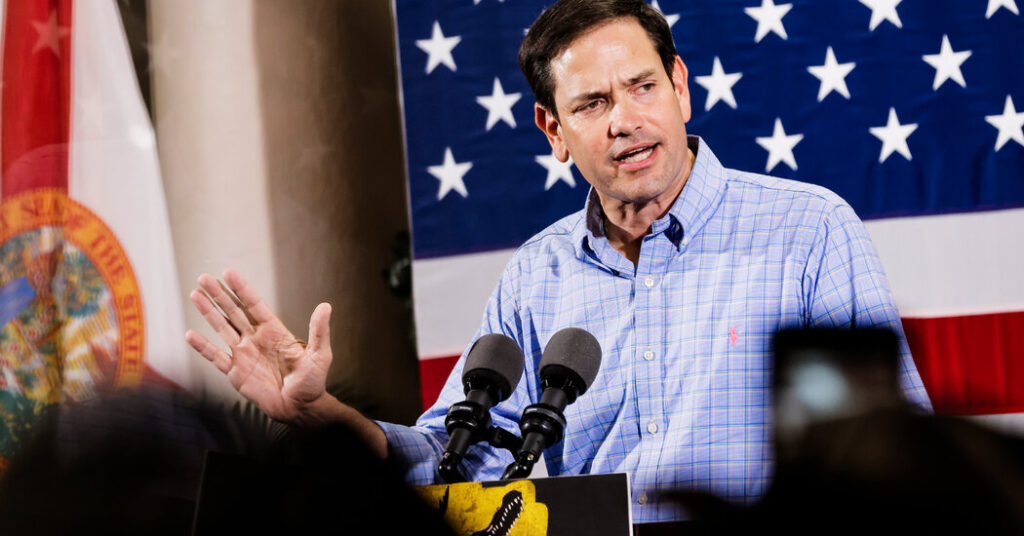
Secretary of State Marco Rubio’s parents emigrated from Cuba to the United States three years before Fidel Castro seized power through a Communist revolution in 1959.
They were looking for economic opportunities. Mr. Rubio’s father, Mario, eventually found work in Florida as a bartender, and his mother, Oriales, as a hotel maid, cashier and Kmart stock clerk.
Yet, Mr. Rubio talks about dismantling the Communist government with the same passion that galvanizes many political exiles who left the island after the revolution. The indictment of the Raúl Castro, 94, the patriarch of the family, is in line with Mr. Rubio’s enduring mission, and it is just the latest in a series of efforts by the U.S. government to weaken Havana that Mr. Rubio has supported or engineered.
“President Trump is offering a new path between the U.S. and a new Cuba,” Mr. Rubio said in a brief video address on Wednesday that was directed at the Cuban people.
“The reason you are forced to survive 22 hours a day without electricity is not due to an oil blockade by the U.S.,” Mr. Rubio said in Spanish. “The real reason you don’t have electricity, fuel or food is because those who control your country have plundered billions of dollars, but nothing has been used to help the people.”
Within Mr. Trump’s cabinet, Mr. Rubio’s focus on Cuba stands out, but it is par for course in the Cuban American milieu of South Florida. There, fiery anti-Communist politics are the norm, and casual banter can revolve around the ways in which the United States might one day oust the leaders in Havana.
“Rubio emerges out of the anti-Cuban politics of Miami,” Benjamin J. Rhodes, a former deputy national security adviser to President Barack Obama, told The New York Times last December.
Mr. Rhodes managed Mr. Obama’s policy of trying to restore, to a degree, U.S. economic and diplomatic ties with Cuba. Mr. Rhodes discussed the policy at the time with Mr. Rubio, who was a U.S. senator representing Florida.
“He’s always been rooted in a regime-change policy toward Havana,” Mr. Rhodes said. “It’s core to his identity.”
Mr. Rubio was one of the architects of the Trump administration’s military campaign against Venezuela, which resulted in U.S. forces seizing Nicolás Maduro, the country’s leader, and bringing him to New York to stand trial on drug trafficking charges. In 2020, the Justice Department got a grand jury indictment against Mr. Maduro.
The aggression against Venezuela was in part aimed at knocking down the pillars of Cuba’s Communist government. Venezuela was the main supplier of oil for Cuba, and the Trump administration has pressured the country’s new ruler, Delcy Rodríguez, an ally of Mr. Maduro, to halt shipments to the island. As a result, Cuba’s economy has come under greater strain than it has seen in decades.
In 2019, during the first Trump administration’s efforts to unseat Mr. Maduro by trying to encourage an uprising, Mr. Rubio told NPR that a weakened Cuba would be a welcome “byproduct” of a change in Venezuela’s government, even if it were not “the central rationale” for pushing out Mr. Maduro. “Anything that’s bad for a Communist dictatorship is something I support,” he said.
Months ago, Mr. Rubio began speaking directly with Raúl Guillermo Rodríguez Castro, a grandson of Raúl Castro, to try to negotiate an economic opening with Cuba that would include some political concessions. U.S. officials were pushing in early March for the Castro family to remove President Miguel Díaz-Canel, which would allow the Trump administration to argue it had successfully engineered political change in Cuba, The New York Times reported.
At the time, U.S. officials were willing to tolerate the Castros staying in power behind the scenes as long as they agreed to guide the country through economic changes pushed by the Trump administration. But U.S. officials have grown impatient with the slow pace of negotiations and what they see as stubbornness on the part of the Castro family.
Edward Wong reports on global affairs, U.S. foreign policy and the State Department for The Times.
The post Rubio Moves Closer to Decades-Long Goal of Transforming Cuba appeared first on New York Times.