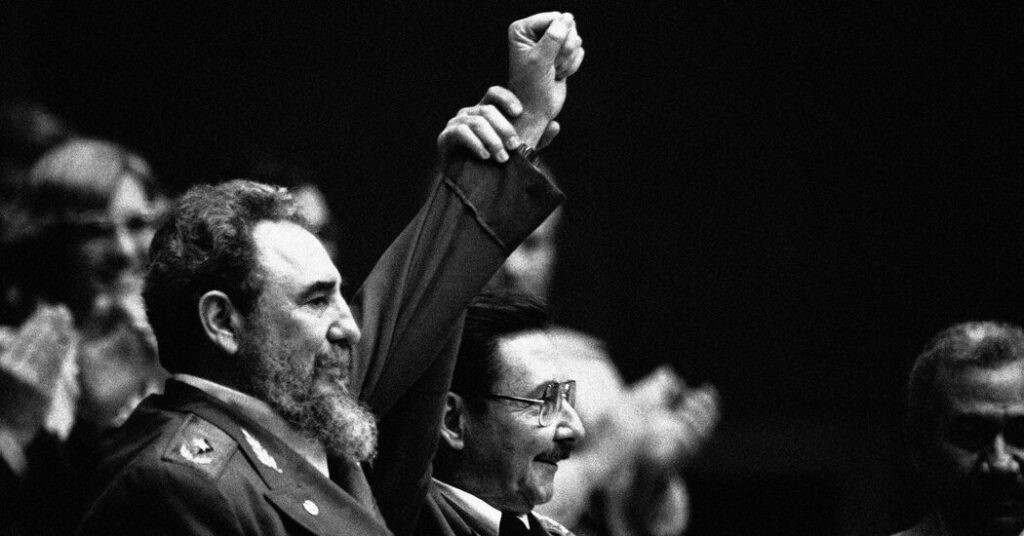
Raúl Castro was Cuba’s defense minister for 49 years and also the country’s president for 12 years, serving until 2018, after his brother Fidel stepped down because of illness.
Raúl Castro is 94 and no longer holds any official title, but he still wields enormous power, experts say, particularly over the military, and he has had a hand in secret negotiations with the Trump administration over the current standoff between Havana and Washington.
Cuban state media still refers to him reverentially as “the leader of the Cuban Revolution” who, along with Fidel, helped to lead the 1959 uprising that toppled a U.S.-aligned dictator.
Raúl Castro is frail, has poor hearing and difficulty speaking, but he still attends important events and was last seen in public on May 1 wearing his military uniform at an International Workers’ Day parade.
Despite being known as a heavy drinker earlier in life with a penchant for shots of neat vodka (he studied in Moscow and was an admirer of the former Soviet Union), Raúl Castro has aged remarkably well, his former chief of staff, Alcibiades Hidalgo, who defected to Florida by raft in 2002, told The New York Times.
“The fact remains that as long as he is alive, he will continue to be a decisive factor in the country’s trajectory,” Mr. Hidalgo said.
While Fidel Castro, who died in 2016, was the revolution’s charismatic leader, Raúl Castro seemed content to stay in the background. “Raúl and Fidel were dramatically different,” said Brian Latell, a former longtime Cuba analyst for the C.I.A. “Fidel was the director, he was the temperamental and creative one. Raúl did all the backstage work.”
After the revolution, it was Raúl Castro who built the new Revolutionary Armed Forces, which repelled the disastrous Bay of Pigs invasion organized by the C.I.A. When Fidel Castro declared Cuba to be a Communist state in 1961, Raúl Castro did the heavy lifting to organize the Cuban Communist Party.
As defense minister under Fidel, Raúl Castro guided the creation of GAESA, an enormous military conglomerate that includes hotels, stores, gas stations and many other businesses. It is considered the most powerful economic force in Cuba.
Experts once regarded Raúl Castro as a potential change agent after he relaxed some of the Cuban government’s most rigorous communist economic policies, for example by allowing Cubans to buy and sell homes and vehicles. In 2015, he restored diplomatic relations with the United States and a year later welcomed President Barack Obama to Havana.
But he kept up the Communist Party’s tight political control over the island’s one-party system and maintained the repressive state security apparatus.
The post Raúl Castro Has Guided Cuba for Decades appeared first on New York Times.