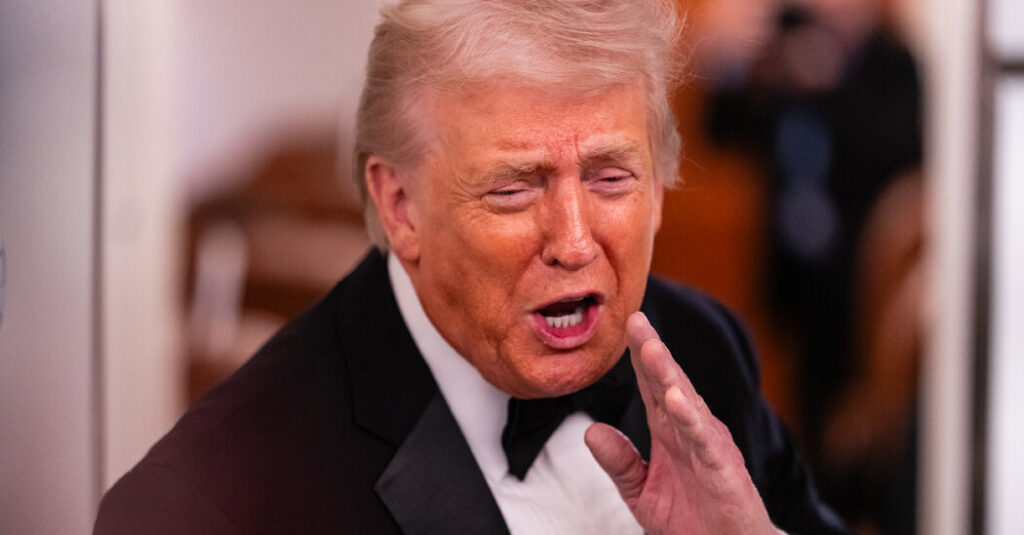
In January, on a flight to his Florida club Mar-a-Lago, President Trump mused about his $10 billion lawsuit against the I.R.S. “I’m supposed to work out a settlement with myself,” he said.
Mr. Trump is a tough negotiator, and, looking in the mirror, he faced an equally tenacious adversary. But the president managed to work out a deal with himself on Monday, one as novel and brazen as the process that spawned it.
He dropped his lawsuit, extracting from his own government a promise to create a $1.8 billion fund to dole out to his political allies. A day later, in a curious addendum, Todd Blanche, Mr. Trump’s former lawyer and the acting attorney general, purported to immunize him from lawsuits arising from a great many things, not least his tax liabilities.
The government of the United States, Mr. Blanche wrote, is “forever barred and precluded” from pursuing claims against Mr. Trump involving “lawfare and/or weaponization” or tax returns.
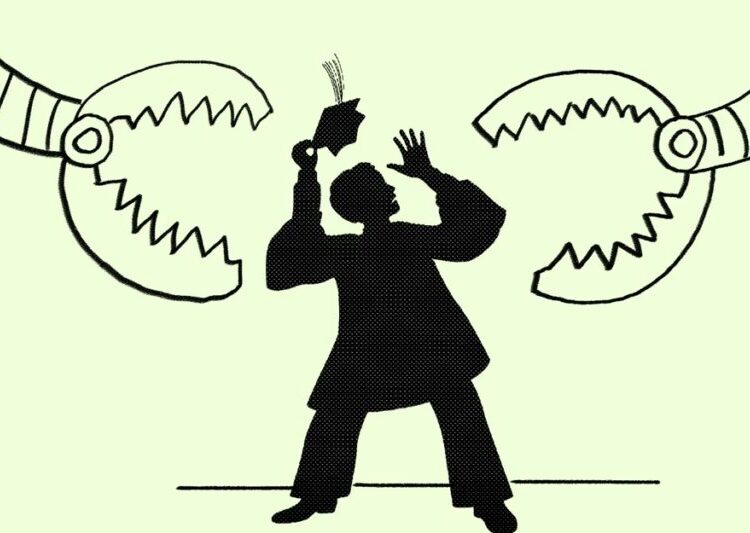
The whole enterprise was a jarring shock to the conventional understanding of the constitutional system, raising what legal experts said were profound questions about presidential power. If the arrangement is allowed to stand, they said, Mr. Trump will have managed simultaneously to thwart Congress’s power of the purse and the ability of the courts to police the separation of powers.
Indeed, Tuesday’s addendum flirted with a grave question with no settled answer: Can the president pardon himself?
In 1976, shortly before President Richard M. Nixon resigned in disgrace for lawless conduct, Mary C. Lawton, the acting head of the Justice Department’s Office of Legal Counsel, wrote in a brief legal opinion that “it would seem” that Mr. Nixon could not pardon himself “under the fundamental rule that no one may be a judge in his own case.”
That opinion has not been withdrawn or tested.
Mr. Trump seems determined to challenge that proposition. While the mechanism was more complicated than a formal self-pardon, the addendum being deemed lawful would have a strikingly similar effect, a declaration from the government that Mr. Trump would not be liable for his private actions.
Legal experts struggled to make sense of this week’s developments, saying tentatively that it was unlikely anyone could sue to stop the moves.
“It is really difficult to think about how to frame a judicial challenge to what the president has done here,” said Samuel R. Bagenstos, a law professor at the University of Michigan. “That doesn’t mean people aren’t trying, and that doesn’t mean something might not succeed.”
Legal challenges are indeed starting to roll in. Two police officers who defended the Capitol on Jan. 6, 2021, sued the Trump administration on Wednesday in an attempt to block the new fund, though it is not clear that they have standing to challenge it.
Congress is another matter. It undoubtedly has the power to act.
The Constitution grants it control of the federal purse. “No money,” it says, “shall be drawn from the Treasury, but in consequence of appropriations made by law.”
That clause, Justice Samuel A. Alito Jr. wrote in a 2024 dissent in an unrelated case, “imposes on Congress an important duty that it cannot sign away.”
But Congress seems to have done essentially that in creating the Judgment Fund, a permanent and uncapped appropriation to pay for court judgments and settlements reached in lawsuits filed against the federal government citing various statutes.
Until the middle of the 20th century, Congress had to enact piecemeal legislation to authorize payments for court awards against the federal government.
To ease that burden, Congress created an early version of the Judgment Fund in 1956, authorizing automatic payments of court judgments of up to $100,000 without congressional action. Larger amounts would still require legislation. In 1961, Congress expanded the fund’s scope to include settlements reached to resolve suits before judgment. And in 1978, it lifted the $100,000 cap, delegating to the executive branch the power to settle cases for any amount under a number of statutes.
Very few people had given the Judgment Fund much thought until this week, but legal experts had long warned that it was ripe for abuse.
“The integrity of the Judgment Fund is dependent on the good faith of executive branch officers,” Paul F. Figley, a former Justice Department official who helped administer the fund from 1978 to 2006, wrote in 2015 in an article in The Journal of Constitutional Law. Its title was telling: “The Judgment Fund: America’s Deepest Pocket and Its Susceptibility to Executive Branch Misuse.”
“It serves a good purpose,” Mr. Figley said in an interview this week. “But it’s subject to manipulation.”
Professor Bagenstos, who served as the general counsel of the Office of Management and Budget and of the Department of Health and Human Services in the Biden administration, wrote in January about the danger posed by the Judgment Fund.
“An administration that wished to spend money on projects or beneficiaries not authorized by Congress,” he wrote, “could simply encourage its desired recipient to bring a lawsuit against the United States and then settle that lawsuit (no matter how frivolous) by making a payment from the Judgment Fund.”
While Congress has ceded power to the executive branch, it could also reclaim it. Indeed, Senator John Thune, Republican of South Dakota and the majority leader, said on Tuesday that he expected lawmakers to scrutinize how the president’s lawsuit had been ended.
Mr. Trump, along with his eldest sons and one of his businesses, filed suit in January against the Treasury Department, along with the I.R.S., an executive agency within the department. But the Treasury secretary, “is and must be the president’s alter ego in the matters of that department,” the Supreme Court said in 1926. The president was suing himself.
A Justice Department news release on Monday said that the “plaintiffs” — that is, Mr. Trump and his family — “will receive a formal apology but no monetary payment or damages of any kind,” a provision the White House used to defend the fund. Still, the opportunity to help direct payments approaching $2 billion to allies has value.
So does the elimination of the threat of an audit. In 2024, The New York Times reported that Mr. Trump could face a tax liability of more than $100 million.
The deal was open to question for other reasons.
The I.R.S. had plenty of defenses to Mr. Trump’s suit. For instance, it might well have been barred by the statute of limitations.
Nor was it clear that the agency was liable for the acts of Charles Littlejohn, a former I.R.S. contractor who pleaded guilty to leaking Mr. Trump’s tax information and whose actions Mr. Trump had cited as a reason he had been wronged by the government.
The sum Mr. Trump sought was also roughly equal to the agency’s annual budget.
And the suit was palpably collusive, ordinarily a reason for a judge to toss a case.
Tuesday’s addendum to the settlement, the codicil purporting to immunize Mr. Trump and his family, raised its own legal questions.
“It’s a really extreme and shocking kind of document,” Professor Bagenstos said.
Even under the Supreme Court’s 2024 decision conferring broad immunity on Mr. Trump for his official acts, purely private conduct, as the filing of a tax return would seem to be, is fair game for prosecution after a president becomes a private citizen. It is not clear whether the addendum could block a future administration from pursuing such a claim.
A series of settlements by the Obama administration that involved dipping into the same fund Mr. Trump now wishes to use illustrate the dynamics of Congress’s open-ended delegation.
Take a lawsuit brought by Native American farmers in 1999 over what they said was discrimination by the Agriculture Department. A judge denied class certification for monetary claims, meaning the government probably did not face a risk of a large court judgment. Still, after more than a decade of litigation, the government in 2011 agreed to settle the suit.
When not enough Native Americans submitted claims, the government paid out only $300 million of $680 million it had agreed to set aside. It redirected the balance to nonprofit groups serving Native Americans.
An appeals court allowed the payment to be made. In a dissent, Judge Janice Rogers Brown of the U.S. Court of Appeals for the District of Columbia Circuit said the majority had taken perverse pleasure in letting the administration do as it wished.
“Perhaps one day, I will possess my colleagues’ schadenfreude toward the executive branch raiding hundreds of millions of taxpayer dollars out of the Treasury, putting them into a slush fund disguised as a settlement, and then doling the money out to whatever constituency the executive wants bankrolled,” she wrote. “But, that day is not today.”
That settlement, though, bore only a superficial resemblance to the deal announced this week. It arose from actual litigation. And Mr. Obama did not stand to directly gain from it.
Adam Liptak is the chief legal affairs correspondent of The Times and the host of The Docket, a newsletter on legal developments. A graduate of Yale Law School, he practiced law for 14 years before joining The Times in 2002.
The post Trump’s $1.8 Billion Fund Tests Constitutional Limits appeared first on New York Times.