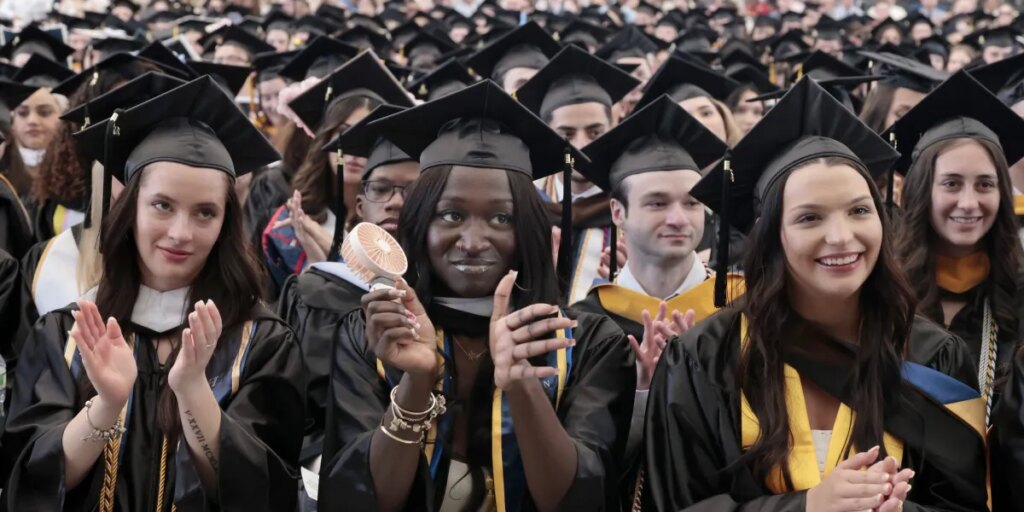
Picture a pretty typical 16-year-old today. Her teacher assigns an AI-assisted research project. She doesn’t open ChatGPT. She doesn’t even Google it. She already knows her answer: no.
The vibe: I don’t want AI to do my thinking for me. That’s the whole point of being a person.
There are millions and millions of teenagers like this. Across classrooms, online forums, and in polling data, a surprising segment of the generation that was supposed to lead AI adoption is instead leading the resistance to it.
The numbers are jarring. An April Gallup survey, conducted in partnership with the GSV Family Foundation, found excitement about AI among Gen Z has dropped 14 percentage points since 2025, falling to just 22%, while anger toward the technology has risen 9 points, to 31%. Among Gen Z non-users of AI, a 2026 Numerator survey of more than 5,000 consumers found 57% say they are not open to adopting it—compared to just 32% of baby boomers. Read that again: Older Americans are more open to AI than young ones. A separate GWS study found 16% of Gen Z expressed disinterest in AI on their smartphones, versus only 9% of older respondents.
That breaks every pattern in the playbook. Teenagers drove the adoption of video games, personal computers, social media, and smartphones—dragging skeptical parents along behind them. With AI, the adults arrived first and loudest. It was CEOs, consultants, and politicians who declared the revolution. And many kids looked up, assessed the situation, and said: pass.
That’s the first reason the kids aren’t alright with AI: It was foisted upon them by their parents, big tech CEOs and President Donald Trump.
1. AI arrived as an assignment, not an adventure
Every technology young people have ever loved came to them as a form of play or transgression. Video games were forbidden fruit. Social media was a space adults didn’t understand and couldn’t control. The internet was a frontier. Each was bottom-up—youth-native, slightly chaotic, coded as theirs.
AI arrived as a mandate. Schools added AI literacy requirements: Nearly three-quarters of K-12 students surveyed by Gallup in 2026 reported their schools had adopted rules about using AI for schoolwork, up from just 51% a year earlier. Employers announced AI-fluency expectations before many students had graduated. The federal government convened task forces. Even well-meaning teachers framed it as a career necessity.
Historically, adults panicked about technology kids loved. With AI, adults loved it first—and for many young people, that alone was a red flag. As the Gallup report concluded: “Gen Z’s relationship with AI is stabilizing but not deepening—adoption is plateauing, enthusiasm is declining, and skepticism is rising.”
It’s just not cool to do what your parents do.
2. It attacks the things they care about most
Gen Z came of age inside a cultural moment that prized authenticity above almost everything. Anti-filter aesthetics, “de-influencing,” the resurgence of vinyl and film photography, the dumbphone movement—all of it reflects a generation that grew up inside algorithmic inauthenticity and has been quietly fleeing it for years. A 2025 Deloitte Gen Z and Millennial Survey documented this values orientation directly, finding mental well-being and authentic connection as top priorities for the cohort.
AI lands directly in the crosshairs of that value system. It generates art. It writes essays. It mimics human voices and relationships. Where earlier disruptive technologies—television, video games, social media—were escapist, AI feels like a replacement: for creativity, for thought, for human contact.
Among teens who reject AI, the critique shows up with striking consistency. The Wall Street Journal‘s reporting on teen AI refusers found recurring themes: AI devalues art, makes people lazy, is bad for the environment, and is fundamentally fake. These aren’t the complaints of Luddites who fear the machine. They’re the complaints of a generation with a worked-out aesthetic and ethical framework—and that sees AI as a violation of it. Nearly 48% of Gen Z now feels AI’s risks outweigh its benefits in work settings, up sharply from 37% who held that view in 2025, the Gallup poll shows.
3. They watched what social media did—and they’re not waiting around
Perhaps most importantly: Gen Z is the first generation to fully adopt a major technology, watch it cause measurable harm to themselves and their peers, and then consciously walk it back. That was the reckoning over social media.
A 2025 Deloitte Gen Z and millennial survey found nearly one-third of Gen Z participants had deleted a social media app in the past year. The dumbphone market is surging among under-30 buyers, with Gen Z framing the downgrade not as nostalgia but as deliberate boundary-setting. The lesson Gen Z drew from the smartphone era—that moving fast and breaking things includes breaking people—appears to be shaping a more preemptively cautious posture toward AI.
That skepticism shows up in the workplace data, too. Eight out of ten Gen Z students surveyed by Gallup believe using AI tools now may complicate their educational experiences in the future. Fewer than 30% of Gen Z workers say they trust AI-assisted work tasks—with almost none trusting work completed solely by AI. For a generation burned once already, skepticism isn’t a bug. It’s a feature.
The unprecedented nature of this particular tech-lash flies in the face of every corporate executive and politician hailing an unstoppable rocket ship, even a renaissance, coming toward humanity in the 21st century. What if the revolution is happening and the kids just don’t show up to the party?
If progress is uncool, unethical and untrustworthy, then maybe it’s not progress at all.
The post 3 reasons kids hate AI—especially the ones who refuse to even try it appeared first on Fortune.