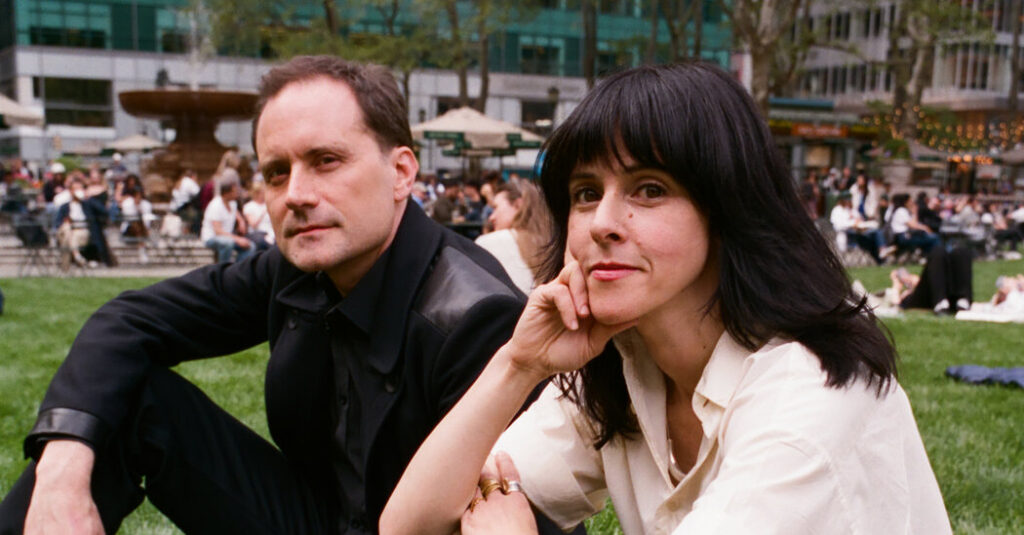
Zayd Ayers Dohrn and Harriet Clark spent much of their adult lives not writing about their parents.
Dohrn, 49, is a son of Bill Ayers and Bernardine Dohrn, founders of the 1960s militant group the Weathermen and its later iteration, the Weather Underground, which aimed to “bring the war home” by bombing government and other public buildings. His earliest years were spent on the run with his parents, changing homes and names to avoid the F.B.I., which had placed his mother on its Most Wanted list.
Clark, 45, is the daughter of Judith Clark, a former member of the Weathermen and a spinoff group, the May 19 Communist Organization. In 1981, when Harriet was less than a year old, her mother was arrested and ultimately sentenced to 75 years to life in prison for her role as a getaway driver in an armored car robbery that ended in the deaths of a security guard and two police officers. (Her father died in 2009.)
For nearly 40 years, Harriet Clark saw her mother only in the visitors’ area of Bedford Hills Correctional Facility, with no expectation that that would ever change, until her mother was granted parole in 2019.
Now, with the film “One Battle After Another,” about a revolutionary group loosely resembling the Weathermen, still echoing in the atmosphere, Dohrn and Clark have new books examining the public and private legacies of their parents’ radical activities.
He documents the history of the movement and life on the run in “Dangerous, Dirty, Violent, and Young: A Fugitive Family in the Revolutionary Underground.” Her book, “The Hill,” which was two decades in the writing, is a novel about a girl growing up with her mother serving life in a prison much like Bedford Hills.
The New York Times had high praise for both, calling Clark’s novel “breathtaking” and Dohrn’s book “meticulously researched” and “deeply felt.”
The two writers met at The Times in April to discuss their work and personal histories. Clark’s mother is now a visiting scholar at the CUNY Graduate Center; Dohrn’s parents are retired, living in Chicago. Clark participated warily, knowing that any publicity around her mother could be painful for the families of the men killed in the robbery.
These excerpts from their conversation have been condensed and edited for clarity.
Since you’re meeting for the first time, is there anything you’d like to ask each other?
ZAYD AYERS DOHRN You and I have both been writers for 20 years, and not touched this story. I definitely unconsciously and consciously resisted it for a long time. So I’m just curious, what reluctance do you have, and what made you do it anyway?
HARRIET CLARK My answer has to do with the difference between us. My whole life, I knew that my life was in relationship to the men killed in her crime, and to the nine children left without their fathers. And I also knew that any time my mother was in any way in the public eye, that was extremely aggravating to families and communities we’d already caused great harm to. There’s no way for me to talk or write about my life that doesn’t risk upsetting and exposing other people. I have lots of thoughts about the political aspects of my life and my parents’ life, but I can’t bring them into the public realm because I don’t want to expose or hurt people.
DOHRN Reckoning with my parents’ choices is important to me, and thinking about harm. But most of the direct harm was to people very close to them: to our family, to their loved ones, to my father’s girlfriend who died in a bomb factory in New York. So for me, it was less about protecting other people and more about just trying to think for myself about whether it was a legacy I wanted to embrace or not.
Two things came together that made me more interested. One was the personal aspect of becoming a father myself. And the other thing is, of course, what’s happening in the world, and the resurgence of a lot of the same issues that spawned the movement and the radicalization of young people in the ’60s and ’70s.
You both became writers looking at the movement rather than participants in it.
DOHRN Almost all the “Weather kids” and “Panther cubs” and children of the movement who I know went into some form of art or writing or thinking. I think it was trying to make sense of ourselves, our childhoods. I used to tell people flippantly when I was starting out as a playwright: I grew up making up names, making up stories, living under assumed identities. So it all felt natural in that way.
CLARK Like all children, we were raised proximate to, and at the mercy of, an adult world we couldn’t well understand, and our childhoods had that quality of incomprehension. It seems to me like part of what you’re doing now is trying to understand what was going on — how had we arrived here, what had shaped these people, what brought us to this moment?
DOHRN Which is an insane thing to do in your 40s.
CLARK Better late than never. In part, what you’re doing in the book is trying to figure out how we tell histories that are non-triumphant and non-vilifying, so as to figure out, How can the past be made to function in the present, in the future? And for me, I’m not trying to triumph over my childhood bewilderment. I wanted to write a book about childhood bewilderment. It was a great relief to discover that other kids also had that feeling, even from very different circumstances.
Harriet, you were working on this novel for 20 years. Did it begin in different directions?
CLARK Yes. There was an era where I thought I had to become more knowing, and I spent years reading histories of activists in the ’30s, ’40s and ’50s, and then in the ’60s and ’70s. I read books about being prison officers. I read a lot of books about being a child of incarcerated parents. It took a long time before I realized that I wanted to write an unknowing book.
The thing that most interests me is what prisons do to families. You know, my mother never saw my room, never saw my friends, never saw my life. I never saw her room. We had to conduct a relationship across profound chasms of not knowing. So I wanted some of that sense of separation, but the companioning.
DOHRN There’s a crucial similarity and a crucial difference in the way we approached it. During the pandemic, what I started to do is just record interviews with my parents. That was the beginning of it, that impulse not to write for the public and not to tell the story exactly, but to preserve their voices and their stories, because I just had a sense that I might want them later, or that I didn’t want to lose them. I didn’t see myself as a part of the story until I really was forced to be like, I want to write about legacy and inheritance and growing up in this world and what I want to say to my own kids about it.
Harriet, you chose to tell your story through a novel rather than nonfiction.
CLARK I’m sure that was largely about just protecting people’s privacy — my family’s, the families impacted by the crime, my own. But also, I love novels. I didn’t want to tell my mother’s story. I think it’s very likely that I wouldn’t have published the book if my mother were still in prison, in part because I couldn’t finish the book until I could look the tragedy in the face. And I don’t know if I could have done that if my mother were still in.
It has been a while since these events. Our language has changed enormously. How did you find the language to write about this movement?
DOHRN What I tried to do is make that moment when these young people were becoming radicalized and trying to change the world feel contemporary. Most of the stuff written by members of that generation has a retrospective, nostalgic look. My book is these dual coming-of-age stories. It’s my coming-of-age story, trying to understand my family, but it’s also my mother’s coming-of-age story, being a young suburban white girl in 1960 starting to realize how big the world was and how unjust things were. That journey from suburban white girl to Top 10 Most Wanted lists and counterculture icon was such a crazy arc for her. But I think you can see it today. You can see young people looking around at the world that they’re inheriting and being like, I’d rather burn it down. I don’t want to be a part of this. And so for me, the language that they spoke resonates in today’s moment.
You grew up with a kind of odd celebrity. If the daughter of Judith Clark goes into a Planned Parenthood meeting or a Sierra Club meeting, let alone a Police Athletic League meeting, it changes the atmosphere of the room. What was that like for you growing up?
CLARK You go first.
DOHRN My life was so normal when I was an adolescent. My mother was running a legal clinic, and my father was a professor, and people would hear our story and just be like, That can’t be true. It felt totally incongruous with our normal, intellectual, middle-class family that we had this notorious past, that my mother had been a Most Wanted fugitive. That all felt strange, and it was a kind of celebrity. It’s not something you ask for as a kid. It was surreal.
CLARK I was in a ballet class, and they would say, you can’t use our changing room because your mother’s in prison. It was as if I were so strange or bad, they felt like I was a contaminant.
But the main place that my mother was a celebrity was inside the prison. When I walked into the visiting room, every single person greeted me, and this was one of the lifesaving aspects of my upbringing. I never had to question that my mother was worthy of respect. I never had to question whether my mother was capable of doing good, of being a good person.
So much of what has been written about the Weather Underground has been either laudatory or demonizing. How did you find the line through that?
CLARK The book that really was transformative for me in this regard was E.L. Doctorow’s “Book of Daniel.” It has such amazing prose, and one part of me was just delighting in it as a reader, and then the other part of me felt this little tug, like, is this disrespectful to the truth of the actual tragedy of the Rosenbergs? Then, about 200 pages in, he has the Death House scene where the kids go to say goodbye to their parents before the government murders them. And he writes it so straight, and you realize that all this time the delights of his language have been making you complicit in not fully looking a tragedy in its face, but he has looked the tragedy in its face. And when I read that Death House scene, I knew I hadn’t looked my tragedy in the face. It took me probably another 10 years to be able to figure out how.
DOHRN Our childhoods were so strange and so marked by these big dramatic events and crimes and murders and jail breaks. And yet, the universal part of these stories is that kids are just born into this world, and nobody thinks their childhood is strange, because it’s just all you ever know. Most people’s parents are a secret that gets kept. It takes a very weird kind of person, like you and me, to want to dig into those secrets.
John Leland is a reporter covering life in New York City for The Times.
The post Mom and Dad Were Radicals. In Two Books, Their Children Write to Understand. appeared first on New York Times.