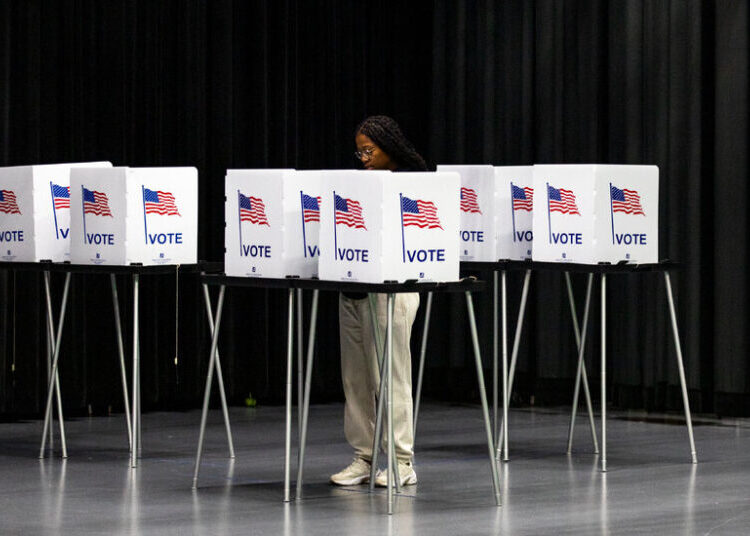
Last week, as President Donald Trump prepared to leave the White House on his way to China for a state visit, he was asked if he would be willing to deploy troops from the National Guard or agents from Immigration and Customs Enforcement (ICE) to polling locations during November’s midterms.
“I would do anything necessary to make sure we have honest elections,” Trump responded.
Trump’s comments are the latest in a litany of confusing and sometimes contradictory statements from his administration about the possibility of deploying federal agents to oversee the elections. It’s already had a chilling effect on voters and election workers.
WIRED spoke to more than a dozen election officials, including secretaries of state and election directors in red and blue states, about the possibility of an ICE deployment to polling locations in November. While some officials say they are not worried, the majority said they had major concerns, especially as these statements come during a much broader attack on elections and democracy from the Trump administration. At least one has actively planned for a scenario in which he’s arrested.
With six months to go before the midterms, the officials said they are now scrambling to reassure voters, replace federal election resources eliminated by Trump, and try to plan for scenarios they have never had to contemplate before.
“The state of things is completely different than it has been in any federal election that I’ve been a part of,” one election director from a western state who requested anonymity to speak openly tells WIRED. “I’ve been doing this for 21 years now, and this is the first time we’ve had to start to prepare for, or at least respond to, public questions about federal interference. It’s ratcheted up to a whole new level now where there is a possibility [ICE is] going to be at polling places.”
These concerns first began when the Trump administration launched mass deployments of ICE agents to cities like Chicago and Minneapolis. Election officials across the country became concerned that those same agents could show up at polling locations. Prominent figures on the right boosted the idea: “We’re going to have ICE surround the polls come November,” former White House adviser Steve Bannon told his podcast listeners on February 3, a day after Trump called to “nationalize” elections. “You can whine and cry and throw your toys out of the pram all you want, but we will never again allow an election to be stolen.” The call for ICE to be deployed to polling locations is rooted in large part in the baseless conspiracy theory that noncitizens vote in huge numbers, even though noncitizen voting accounts for a vanishingly small fraction of a percent of votes cast during US elections.
When asked about Bannon’s claims two days later, White House press secretary Karoline Leavitt refused to rule out the possibility. She said that while she hadn’t heard the president discussing “formal plans” to deploy ICE to polling locations, she added, “I can’t guarantee that an ICE agent won’t be around a polling location in November.”
While the Department of Homeland Security (DHS) later ruled out the possibility that ICE would be deployed to the polls while on a call with scores of election officials, on March 18, the new Homeland Security secretary Markwayne Mullin refused to rule out the possibility during his confirmation hearing, saying he doesn’t “understand what the concern about enforcing immigration at polling places is anyways because … there shouldn’t be any illegals at the polling spot.”
A week later, during the Conservative Political Action Conference meeting, now acting attorney general Todd Blanche endorsed the idea of ICE at the polls and repeated the conspiracy theory about noncitizens voting as an excuse to deploy ICE. “Why is there objection to sending ICE officers to polling places?” he asked. “Illegals can’t vote. It doesn’t make any sense.”
When asked for comment regarding ICE being deployed to the polls, White House spokesperson Abigail Jackson said, “President Trump has been clear: Securing our elections and ensuring only American citizens vote in American elections is a top priority.”
Similarly, a DHS spokesperson referred WIRED to Mullin’s comments, adding, “Elections exist for the American people, not illegal aliens, to choose their leaders.”
Elections have, as specified by the US Constitution, always been run by the states, and despite Trump and his allies calling for elections to be “nationalized,” that will remain the case for the 2026 midterms. Deploying ICE, the National Guard, or any other armed federal agents to polling locations is illegal under US law.
Political messaging, however, has left election officials and voters unsure about what’s to come.
“I think the administration’s track record is such that, as much as I reassure people and tell them that we’ve gotten that assurance [that ICE won’t be at polling locations], I’m not sure how much they believe,” says an election director from an eastern state. “I’m not sure the administration itself really knows the direction it’s going to go in, but we are preparing for all scenarios.” The director asked not to be named due to fears of retribution from the government and concerns that federal election funds could be withheld.
In Maine, secretary of state Shenna Bellows sought to get assurances from the government in writing, sending a letter to the DHS in March seeking confirmation that ICE will not be deployed to the polls. The letter was signed by eight other secretaries of state. Months later, Bellows has yet to receive a response.
“We haven’t received any satisfactory assurances from the federal government, but we don’t expect any,” says Bellows. “Donald Trump doesn’t get to invade our polling places, seize our ballots, or control our elections just because he wants to. The Constitution and federal law could not be more clear that states, not the federal government, are in charge of elections.”
Maine is one of dozens of states the Department of Justice has sued over their refusal to grant access to unredacted voter rolls. Last September, the government filed a lawsuit against Bellows, claiming that in her capacity as secretary of state, Maine had not complied with the National Voter Registration Act. Bellows has filed a motion to dismiss the lawsuit.
Like many other election directors, Bellows and her colleagues are planning for eventualities they have never had to consider before. “Election officials are the world’s best contingency planners,” says Bellows. “In the past, we’ve planned for natural disasters, for electricity outages, for, most recently, bomb threats, and we have been able to oversee successful elections.”
But while recent elections have brought an unprecedented surge in threats against election officials, the threat of federal interference in elections is something entirely new.
“There have been tabletops and everything else including this type of scenario [of ICE at polling stations],” says Jared DeMarinis, Maryland’s administrator of elections. “We have to prepare now for almost any eventuality that will occur. We even have to include in a tabletop exercise of me getting arrested.”
Election directors are also having to plan without many of the federal resources they have relied upon for years.
In March 2025, the Trump administration ordered the Cybersecurity and Infrastructure Security Agency (CISA) to stop almost all work related to election security and removed the role of regional election security advisers, who served as vital links between federal and local officials. CISA has also cut all funding for the Election Infrastructure Information Sharing and Analysis Center, which ensured the timely sharing of information between federal agencies and state officials. As a result, election officials are now cobbling together their own systems and networks, communicating in online Zoom meetings and sharing information with colleagues in messaging apps.
Even so, election officials interviewed by WIRED echoed a similar belief: No matter what the Trump administration does, they say, their team will be able to run safe and secure elections.
“We have to assume that the Trump administration is willing to do anything to win,” says Bellows. “But I have confidence that a majority of Americans will see these tactics for what they are, the desperate attempts of the nation’s biggest loser to interfere, and it won’t work.”
The post Election Officials Are Getting Ready for ICE to Show Up at the Polls appeared first on Wired.