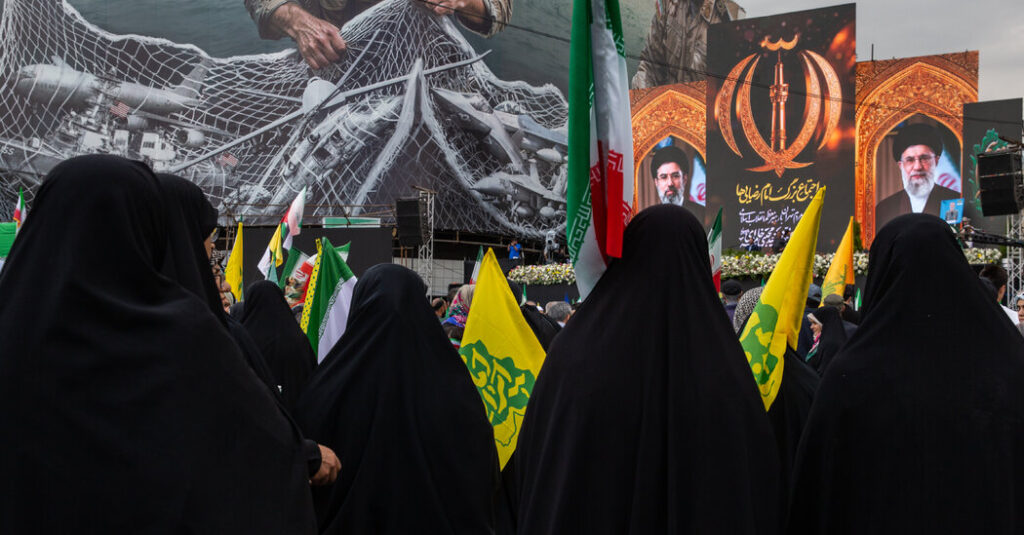
Nearly three months into the conflict, the Iranian regime has succeeded in confounding U.S. and Israeli expectations for a speedy victory.
The regime survived a wave of targeted killings early in the war. It then managed to turn the tables on its more powerful adversaries, introducing something of a stalemate.
Since mid-March, Iran has maintained control over the Strait of Hormuz, an international waterway crucial to the world’s oil and gas trade. It has been able to limit U.S. and Israeli attacks on its energy industry. It even got President Trump to rein in Israel’s war in Lebanon against Hezbollah, an Iranian-backed militia.
“Iran definitely has the advantage here,” said Nicole Grajewski, who teaches at the Center for International Studies at Sciences Po in France and studies Iran’s foreign policy. “The U.S. is just kind of flailing at the moment.”
This is, at first blush, somewhat surprising. The United States has the most powerful military in the world. Iran, a regional power, does not. But wars are not fought in isolation.
To gain an edge over its much more powerful adversary, Iran used a method that game-theory scholars call “triangular coercion,” said Dan Sobelman, a professor at Hebrew University in Jerusalem who studies Iranian deterrence strategies.
The strategy works by attacking a more vulnerable third party that has some leverage over an adversary to gain advantage over an opponent that cannot be outmatched directly.
In this case, the third parties were primarily the Gulf states, which are both militarily vulnerable and economically important to the United States. Iran’s attacks against them early in the war, combined with its ability to effectively close the strait, have for now successfully thwarted a decisive victory for the United States and Israel.
It is a strategy that could have long-term implications not only for the outcome of the current conflict and Iran’s role in the Middle East, but also for the limits of U.S. power elsewhere.
‘Triangular Coercion’
Iran began putting pressure on Gulf states soon after the war began on Feb. 28, by firing on ships going through the Strait of Hormuz, effectively closing the narrow waterway, through which 20 percent of the world’s oil transits.
But the crucial moment when Iran’s triangular-coercion strategy snapped into place came about two and a half weeks later.
On March 18, Israel bombed Iran’s South Pars natural gas field, and Iran retaliated by bombing Ras Laffan, a major liquefied natural gas facility in Qatar, and carrying out drone attacks on refineries in Saudi Arabia and Kuwait.
That retaliation “introduced an equation,” Mr. Sobelman said. “If Israel or the U.S. went after Iran’s energy facilities, Iran was going to go after the Gulf’s energy facilities.”
Within hours, President Trump wrote on social media that Israel’s attack had not been coordinated with the United States, and that there would be no more attacks by Israel on South Pars as long as Iran halted its strikes on Qatar. It marked a turning point in the war. Although the two sides still traded attacks, there appeared to be a ceiling on escalation.
“The United States and Israel are relatively insulated against direct military attacks, but Gulf states like Qatar and the United Arab Emirates are far more vulnerable,” Mr. Sobelman said. “Iran found success by leveraging its vulnerable neighbors against their more powerful patron.”
Iran’s bombing of energy facilities caused oil prices to spike to their highest level since the war began, making it clear that further escalation would lead to economic costs for the United States as well.
That was not enough to end the conflict, but it did introduce “intra-war deterrence,” Ms. Grajewski said, giving Iran significant leverage.
Within days, Mr. Trump announced that the U.S. and Iran were negotiating. On April 8, the two sides agreed to a cease-fire, even though the strait remained closed.
Lasting Implications
The use of this strategy by Iran has shifted much of the focus of the war to the crucial question of how to get the strait reopened — and how to limit Iranian leverage over it in the future.
Efforts to pressure Iran to reopen the crucial waterway have proved unsuccessful.
In April, the U.S. imposed its own blockade of the strait, vowing to keep it in place until Iran and the United States agree to a durable peace deal. That move put considerable pressure on Iran, which also needs revenue from oil exports and will eventually run out of storage space for the oil it produces. But the strait remained closed.
On May 3, Mr. Trump announced “Project Freedom,” a U.S. operation to guide ships stranded in the strait. He backed down a few days later, leaving over a thousand vessels still trapped. “That, I think, speaks volumes of Iran’s capacity to restrain and deter the United States,” Mr. Sobelman said.
As the situation drags on, it is becoming more likely that Iran will seek to maintain at least partial control over the waterway, experts say.
“The longer Iran is able to hold shipping hostage, the more true it becomes that Iran is going to need to be a legitimate stakeholder and beneficiary in the reopening of the strait,” said Nitya Labh, an international security fellow at Chatham House, a London-based research institution.
That will mean that Iran, though deeply damaged by the war, is likely to emerge from it with a valuable new asset. Having at least partial control over the strait would be not only a source of revenue for the regime, but also a form of geopolitical strength.
Iran’s ability to shut down the strait again will serve as an “insurance policy” against future attacks, Ms. Grajewski said.
That scenario points to a broader and potentially more permanent weakness in Mr. Trump’s foreign policy: The United States, while powerful, may not be as insulated against retaliation as Mr. Trump’s team has often seemed to assume.
Not all countries will be willing or able to use triangular coercion against a hostile superpower in the same way. But after Iran’s example, more may try.
Amanda Taub writes the Interpreter, an explanatory column and newsletter about world events. She is based in London.
The post How Iran Gained Leverage in the War appeared first on New York Times.