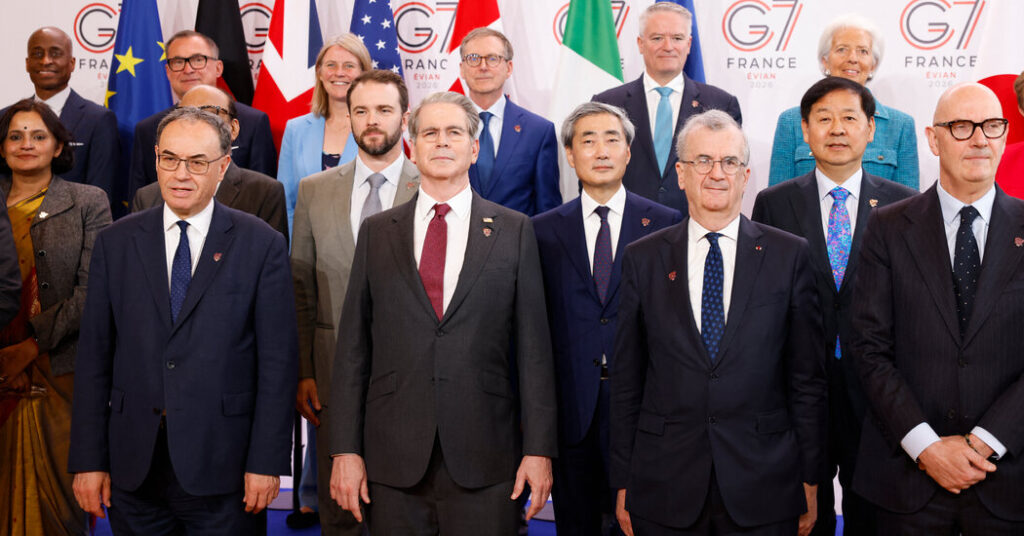
Top economic policymakers from the Group of 7 nations agreed on Tuesday to work together to mitigate the impact of the war with Iran on global energy and food prices, even as fault lines emerged among them over how to ensure that Russia does not benefit from the conflict.
The two-day summit in Paris came at a moment of upheaval for the global economy, which has been destabilized this year by the United States-Israeli led war in Iran. The war fueled a fresh bout of inflation and has been a drag on global growth. It has also created new points of tension between the United States and Europe, which must deal with the fallout of a war that it did not want.
“We acknowledge that global economic uncertainty has heightened risks to growth and to inflation amid the ongoing conflict in the Middle East, particularly through pressures on energy, food and fertilizers supply chains, which particularly affect the most vulnerable countries,” the G7 finance ministers and central bank governors wrote in a joint statement, known as its communiqué. “To mitigate these negative impacts, we recognize that a swift return to free and safe transit through the Strait of Hormuz and a lasting resolution to the conflict are imperative.”
The meetings also focused on how to bolster supply chains of critical minerals, which are dominated by China, and continued support for Ukraine as it continues to fight its four-year war with Russia. The officials pledged to “impose severe costs on Russia” and consider additional sanctions.
That statement was undercut during the meetings, however, after Treasury Secretary Scott Bessent said on Monday evening that the United States would grant a third sanctions reprieve to Russia, giving it permission to sell its seaborne oil.
The move was intended to bolster international oil supplies and help the world’s poorest countries cope with high energy costs while the war persists. Mr. Bessent suggested that the sanctions relief for Russia was only temporary and intended to “help stabilize the physical crude market and ensure oil reaches the most energy-vulnerable countries.”
But the watering down of Russia sanctions was a disappointment to European officials, who have spent the past four years working with the United States to cripple Russia’s economy with coordinated statecraft.
“The waiver on Russian oil — this was not a G7 decision,” Roland Lescure, France’s finance minister, said at a news conference on Tuesday, referring questions about the decision to Mr. Bessent directly. “Nobody wants Russia to have a windfall profit.”
Valdis Dombrovskis, the European commissioner responsible for the trade bloc’s economy, lamented on Tuesday that Russia was gaining from the war in Iran and said that he disagreed with the United States’ decision.
“From an E.U. point of view, we do not think that this is a time to ease pressure on Russia,” Mr. Dombrovskis said. “If anything, we would need to strengthen that pressure.”
Noting that the sanctions exemption had been extended to Russia before, Mr. Dombrovskis added that they were “not so temporary anymore.”
In a post on social media on Tuesday, Mr. Bessent said that he had “constructive discussions” with his counterparts about the global economy, global imbalances, cybersecurity, Iran and critical minerals. He had no further explanation for the Russia sanctions relief, which he had said last month would not be renewed.
Speaking at a conference about combating terrorist financing following the G7 meeting, Mr. Bessent also called on Europe to get tougher on Iran. He asked European policymakers to impose more sanctions on Iranian banks, shell companies and financiers.
“If you share our fury about Iran’s destabilizing agenda, terrorists seeking to hold the global economy hostage, drug cartels poisoning our communities and threats to innocent lives, then now is the time to join the United States in moving aggressively,” Mr. Bessent said.
Pressuring Europe to exert more economic pressure on Iran while the United States eases sanctions on Russia could pose challenges for the Trump administration. Despite the financial might of the United States, adversaries have become more adept at evading U.S. sanctions and coordination with western allies is important for maintaining their effectiveness.
“U.S. sanctions policy is increasingly unilateral and transactional, which diminishes its effectiveness,” said Alex Zerden, the founder of Capitol Peak Strategies and a former official in the Treasury Department’s Office of Terrorism and Financial Intelligence. “The decision to unilaterally relax sanctions against Russia while pushing the G7 to toughen Iran sanctions creates inherent policy tensions.”
It is not clear that the U.S. sanctions on Iran have been effective in negotiations over reopening the Strait of Hormuz or that easing sanctions on Russia have helped to corral oil prices.
Crude prices have for the most part remained above $100 per barrel and volatile since the war started in February. With inflation fears mounting, investors have been selling U.S. Treasury bonds, causing the yield on the 30-year bond to rise to its highest level since 2007.
The International Monetary Fund warned on Tuesday that sustained energy price surges could sharply reduce household purchasing power and force businesses to shutdown. At the same time, the agency urged policymakers to be careful in their responses and to avoid remedies that would add to debt burdens or worsen inflation.
Many G7 nations are pushing ahead with their renewable energy agendas in hopes of buttressing their economies from energy shocks. While the United States no longer favors such technology under Mr. Trump, there was broad agreement that advanced economies need to be less reliant on oil from the Gulf.
“This is the largest energy challenge that we have faced in a generation,” said François-Philippe Champagne, Canada’s finance minister, who explained that Canada hoped to increase its energy exports to countries in Europe and Asia. “I think what you’re going to see is energy systems around the world are being redesigned.”
Alan Rappeport is an economic policy reporter for The Times, based in Washington. He covers the Treasury Department and writes about taxes, trade and fiscal matters.
The post Inflation Fears Cloud G7 Economic Agenda as Iran War Persists appeared first on New York Times.