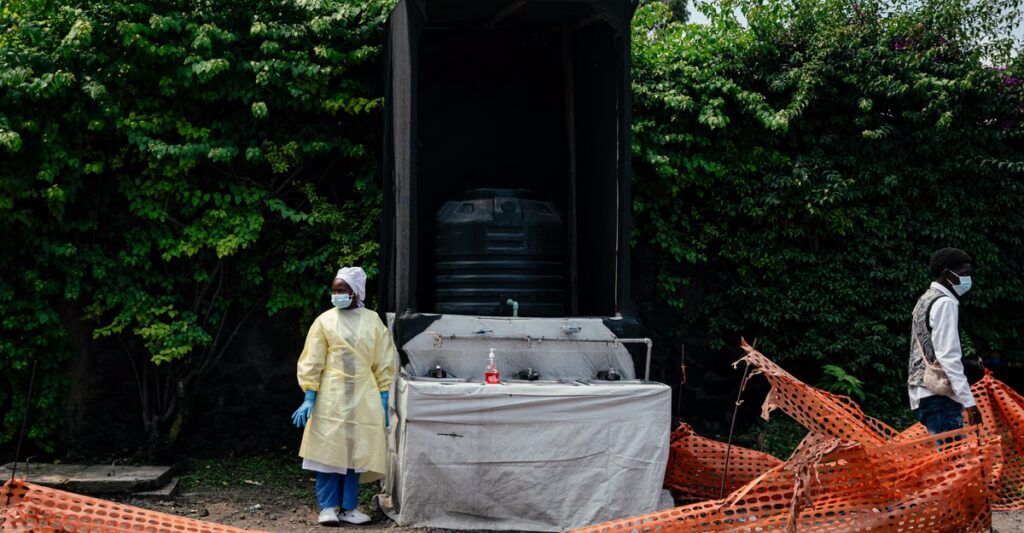
Quite abruptly, the world has jolted into another infectious-disease crisis. On Friday, Africa CDC confirmed a new Ebola outbreak, centered in the Democratic Republic of the Congo; within two days, the World Health Organization declared the epidemic a public-health emergency of international concern. The virus, which has also spread to Uganda, is suspected to have sickened more than 500 people and killed more than 130—counts that suggest to experts that it has been spreading largely undetected in the region for several weeks, if not months.
Central and West Africa have weathered dozens of Ebola outbreaks before. But this new epidemic has already surpassed most others in size, and “my projection is that it will get worse before it gets better,” Nahid Bhadelia, the director of Boston University’s Center on Emerging Infectious Diseases, told us. The global-health backdrop is simply different in 2026, largely the result of a series of public-health decisions made by the United States in the past year and a half—among them, dismantling USAID, withdrawing from the WHO, and ousting infectious-disease experts en masse from the CDC, which remains without a permanent director. As things stand, the outbreak has already reached a point at which experts feel certain it will be very difficult to contain. The world’s fractured global-health community is now playing a lethal game of catch-up with an extremely dangerous virus.
Experts suspect that a number of epidemiological factors helped the crisis quickly swell in size, mostly under the radar. The outbreak so far centers on two mining towns—Mongbwalu and Rwampara—in a region of the DRC where access to health care is inconsistent and traffic in and out is high. During a press conference on Saturday, Jean Kaseya, the director general of Africa CDC, described the area as “very vulnerable and fragile.” Relatively remote regions with high mobility and porous borders can be ideal settings for viruses to spread unnoticed, especially for pathogens such as Ebola, whose early symptoms can resemble those of typhoid and malaria, also endemic to the region. Those parts of the DRC have been plagued by civil unrest and intense armed conflict, raising substantial barriers for sick people to seek care and access tests, Krutika Kuppalli, a Dallas-based infectious-disease physician who ran an Ebola treatment unit in 2014, told us.
The strain driving the outbreak, known as Bundibugyo, is hard to catch and challenging to fight. Rapid diagnostic tests for more common versions of Ebola—the ones most readily deployed—often miss it; early test results using these tools came back negative. The epidemic’s hot spot is also far from the main DRC-based microbiological laboratories that do more precise testing, prolonging the time from sampling to confirmation, Boghuma Titanji, an infectious-disease physician at Emory University, told us. To compound the challenges, Bundibugyo has no approved vaccines or treatments. According to The New York Times, the local response may have been lacking as well: Officials in Ituri province, at the center of the outbreak, were slow to report the first patients to show concerning symptoms, and didn’t immediately dispatch test samples to Kinshasa, the capital.
But a strong international response is a crucial partner to a domestic one. WhenEbola has sparked outbreaks in the past—including the recent, record-breaking one that began in 2014 and reached 28,000 cases—USAID and the CDC, in coordination with the WHO, played instrumental roles in the global response, including detection and early containment. “During the first Trump administration, when they were faced with a situation comparable to this, they did a pretty good job of it,” Jeremy Kondynk, who led the U.S. government’s humanitarian response to Ebola under President Obama during the 2014 outbreak, told us. In 2018, for instance, the Trump administration sent teams from USAID and the CDC to the DRC within days of an Ebola outbreak being declared. The CDC collaborated with the WHO to distribute experimental, single-dose Ebola vaccines.
But under the second Trump administration, which has disparaged public health, cut foreign aid, and demeaned vaccines and other crucial components of the infectious-disease tool kit, U.S. support for global health has been severely weakened, sapping surveillance networks, laboratories, and health-care response teams of resources and personnel. In 2024, some $1.4 billion of the DRC’s foreign aid—more than 70 percent—came from the U.S.; that number has since plummeted, a loss that has kneecapped local health delivery. (In a January 2025 executive order, the White House justified the U.S.’s withdrawal from the WHO by criticizing its “mishandling of the COVID-19 pandemic” and failure to reform.)
The Trump administration’s early freezes on USAID funding compromised the DRC’s ability to deliver medicine to rural clinics, which are typically funneled through pharmacies via a USAID-supported pipeline, as the physician Céline Gounder wrote; those aid cuts also happened around the time that a local rebel group known as M23 took over a province that houses a major humanitarian operation for the eastern DRC, compounding aid groups’ difficulties. Local mortality rates have since skyrocketed, likely from infectious diseases, including ones that can resemble Ebola in symptoms—which, in the case of an outbreak, has made it that much more difficult “to identify the signal from the noise,” Bhadelia told us.
More recently, the U.S. delivered another blow to the DRC. This year, the State Department declined to renew funding for more than 100 foreign-aid programs that the department classified internally as lifesaving. One program under that umbrella, providing “vital emergency health” support in the region where the outbreak is occurring, had its U.S. funding end in March, according to an internal State Department document reviewed by The Atlantic.
In February, the U.S. did commit to supporting health in the DRC in some form: The two countries agreed on a strategic health partnership, to cover infectious disease and other expenditures—though that deal includes just $900 million of U.S. aid, spread over the next five years. This week, the State Department also announced that it would mobilize additional funds to support outbreak containment. (The White House, CDC, State Department, and WHO did not respond to requests for comment at the time of this story’s publication.)
Ultimately, though, the U.S.’s withdrawal from the WHO has still meant that the organization lost its largest funder and one of its most prominent partners in global health, shrinking its capacity to respond to any crisis. And the U.S.’s posture toward global health and foreign aid is now substantially more hostile. A senior State Department official told us that the WHO has been excluded from receiving humanitarian funding from State—which he described as “a major constraint for emergency health programming.” (The official requested anonymity out of fear of retribution for speaking publicly.)
Amid the U.S.’s pullback, other high-income countries have stepped in to help. The European Union, for instance, has announced that it has personal-protective-equipment stockpiles ready to deploy to the region. After decades of battling Ebola, West and Central Africa also have plenty of experience to leverage, including in the absence of typical American assistance: This past December, the DRC declared the end of a separate Ebola outbreak. But the U.S.’s absence from the WHO is especially apparent in conditions of crisis. Under an administration that was friendlier to global public health, “we may have quicker mobilization of resources,” simply because more of them would already be there, Bhadelia said.
In the days since the outbreak was declared, the U.S. government has indicated that it is willing to respond in some capacity. The CDC has held press conferences and announced a travel ban on people returning from the DRC, Uganda, and South Sudan; agency staff based in the DRC and Uganda are assisting with contact tracing and local border screening.
Experts also told us that the country’s ongoing participation in the recent hantavirus cruise-ship outbreak may bode well: At the very least, American public-health officials are still coordinating with international colleagues. Still, “CDC’s capacity to respond is substantially lower than it was a year and half ago,” Tom Frieden, a former CDC director and the president and CEO of Resolve to Save Lives, a global-health nonprofit, told us.
In the meantime, the Ebola outbreak already has spread to multiple countries, and the virus has been detected in regions separated by hundreds of miles; cases have also been reported in some densely populated regions, heightening the risk for further spread. Experts are still trying to suss out when and how, exactly, the virus moved from one place to the next. In all likelihood, the epidemic is even larger than what’s been reported, with many cases still transmitting without notice. Ebola is “very unforgiving,” Frieden told us. “The response has to be close to be perfect” to bring the virus to heel; missed cases mean missed contacts—and lead to more clusters, more deaths, and more chaos. To begin the response this belatedly only lengthens the road to resolution.
“The loss of the chains of transmission is what concerns me most,” Bhadelia said. Ideally, an outbreak would be contained in part through careful contact tracing of all individuals who might have been exposed to infectious people. But the larger an outbreak grows, the less possible that becomes—especially with fewer on-the-ground resources than usual. In recent memory, the U.S.’s leadership and coordination with the WHO was “absolutely essential” for managing the world’s largest Ebola outbreak to date, Frieden said; now the U.S. has “walked away, and that’s a real problem.” The clearest remedy to an outbreak like this is for the world to collaborate on limiting the damage. But that’s precisely the commitment that American leaders have reneged on.
The post The World Is Playing Catch-Up to Ebola appeared first on The Atlantic.