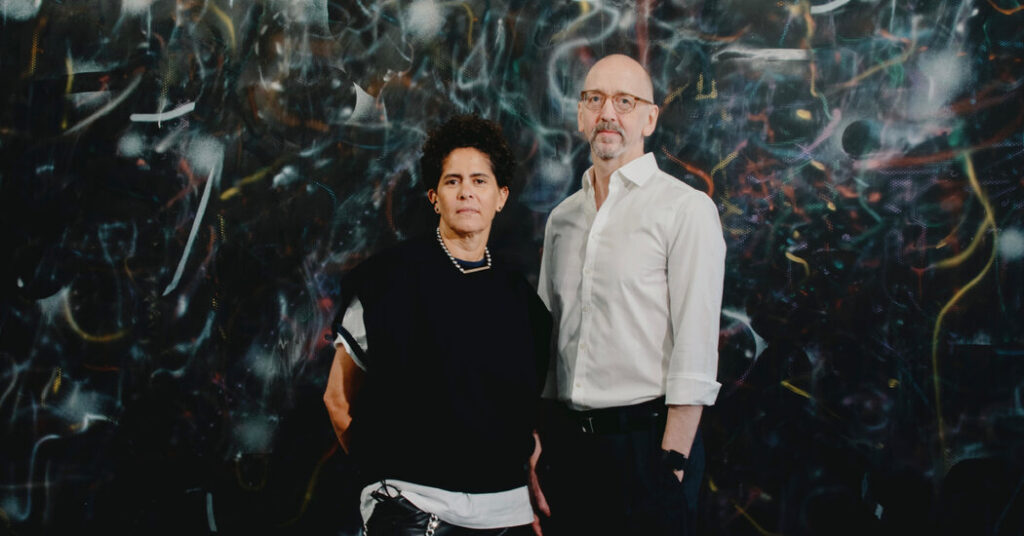
Like most works by Julie Mehretu, her “TRANSpaintings” are abstract. Unusually, they are also translucent, viewable from either side. Which means that as you peer at the layers of squiggly marks and washes of color, you may discern a human figure. That figure might be the shadow of a viewer on the other side. Or it might be a dancer.
With his “Wandering,” the choreographer John Jasperse responds to Mehretu’s exhibition at the Marian Goodman Gallery in TriBeCa, “Our Days, Like a Shadow (a non-abiding hauntology).” During performances, Wednesday to Saturday, seven dancers move through the space, arranging their bodies along the white walls and between the archways. Weaving paths around Mehretu’s translucent paintings, they trace ephemeral lines and arcs, brushing by other Mehretu works on the walls — and by audience members.
Mehretu is a major American artist whose large, dense paintings — which often occlude or efface topical source material, like blurred photos of riots or wildfires — are often read as expressing global turmoil. She was first attracted to working with a choreographer while looking at how her “TRANSpaintings,” which stand in metal brackets by the sculptor Nairy Bahramian, were arranged in another exhibition.
“The installation felt a bit like choreography,” Mehretu said in an interview at the Goodman Gallery. “I wished there could be some kind of performance in the space.”
Mehretu’s partner, the performance studies scholar Ariel Osterweis, proposed several choreographers. Mehretu was drawn to Jasperse, who has been making formally intricate and philosophically searching dances for more than 30 years. (He also directs the dance program at Sarah Lawrence College.)
Mehretu recalled one of Jasperse’s works as “very rigorous, very beautiful but also engaged with this other space you couldn’t see.”
“That’s what painting does,” she continued. “It’s always this one thing suggesting this whole other thing.”
Jasperse, for his part, had long admired Mehretu’s work — and also saw its connection with dance. “There’s something about energy and movement that felt really choreographic to me,” he said.
Both artists were aware that mutual admiration wasn’t enough. “How do we bring something to each other’s work that feels productive?” Jasperse recalled thinking.
Jasperse knew what he didn’t want: “To have the painting function as a décor or backdrop or the dance to be there to kinetically animate the gallery.” Instead, the goal was to create a “space where people can experience Julie’s work and my work,” he said, “and the two are somehow changed by the fact they’re there together.”
As the two artists began to collaborate, Jasperse noticed similarities in how they worked. “The way Julie moves from a source into abstraction made me feel totally at home,” he said. “There’s a kind of layering that’s not about it being shown, to explain the work, but like a river that runs underneath it because we are trying to grapple with our place in history.”
For Jasperse, the drive for abstraction is in tension with his materials: human bodies. “We’re individuals and we have these identities” — with signs of race, gender, class — “that people may or may not read correctly,” he said. His work resists those readings while acknowledging that they can’t be fully evaded. He sees an analogous tension in Mehretu’s paintings.
Mehretu pushed against the idea that abstraction and representation are opposed. “As artists, we’re trying to question those assumptions, play with them,” she said, noting how the body is fundamental to painting and its history. After watching Jasperse’s most recent dance, she told him that it called certain paintings to her mind.
As a choreographer, Jasperse plays with speed and time, but Mehretu insisted that painting is also a time-based medium. She recalled visiting a museum in Amsterdam with one of her sons and telling him that if he sat with a Rembrandt long enough, things would start to move. “And he was like, ‘They start to move?’” she said. “But they do. You start to see the painting differently.”
Mehretu’s paintings alter with changing light and the observer’s point of view. “How do you slow people down?” she asked. “The way the paintings are constantly mutating is part of that.”
For “Wandering,” that perceptual play is framed by the architecture of the Goodman Gallery. Its building is a former industrial space, sliced in half by walls with small arched apertures. “I realized that it’s like two lungs,” Jasperse said. “I’ve long been inspired by the symmetry of the body — moving into that and away from it.” This dance, too, includes a lot of mirroring.
When the gallery is filled with viewers, space might be tight and navigation tricky, especially through those narrow archways. “But I think there’s going to be something provocative about that intimacy,” Mehretu said. “Being close to the paintings and this other activity, trying to understand it with your own discomfort, shyness, exhilaration.”
Challenging their audience, Jasperse and Mehretu challenge themselves. “If I’m just doing the thing I know how to do, I’m not doing my job,” he said.
“There have been moments where we were both kind of lost,” Mehretu said, “but I don’t think either of us was afraid of that.”
“Well, maybe I was a little bit more afraid,” Jasperse replied, laughing. “We all have our personalities.”
Despite its title, “Wandering” has a clear direction, an ascension with the dancers up the three floors of the exhibition. While Hahn Rowe’s sound score for the bottom two floors is largely ambient, the sounds that another composer, Will Johnson, created for the top floor include sampled fragments of digitally altered voices. We hear the invitation “follow me” from dance club tracks and the unmistakable timbre of Nina Simone singing the civil rights-era anthem “I Wish I Knew How It Would Feel to Be Free.”
For a performance that is, in Osterweis’s words, about the “liberatory potential of abstraction,” about an escape from legibility and fixed meanings, that Simone sample is remarkably undisguised.
“With all the violence we’re consuming on a daily level,” Mehretu said, “it’s not surprising to me that Will would slice into that. What she’s singing about is what these paintings and this performance are trying to do: inhabit this world and not be confined. I get goose bumps just thinking about it.”
The post The ‘Energy and Movement’ That Dance and Painting Share appeared first on New York Times.