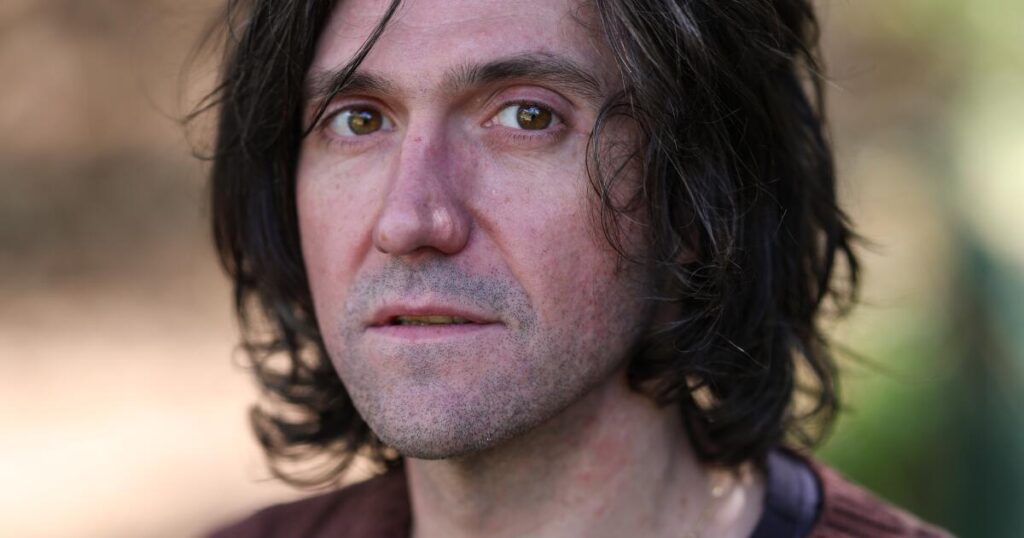
Conor Oberst was still a boyish 24-year-old from Omaha when he dropped the pair of albums that took his band Bright Eyes from indie-rock celebrity to voice-of-a-generation prestige. Released on the same day in January 2005, “I’m Wide Awake, It’s Morning” and “Digital Ash in a Digital Urn” pondered love, war, drugs and technology against the backdrop of Oberst’s recent move to New York — and did it in songs that put frayed-edge folk (on “Wide Awake”) next to sleek electronic pop (on “Digital Ash”).
Two decades later, hints of gray streaked the singer-songwriter’s hair as he sat at a picnic table in Lake Hollywood Park on a mid-April afternoon. Oberst, now 46, splits his time these days between Omaha and Los Angeles; here, he’s cultivated a circle of friends that includes Phoebe Bridgers, with whom he’s recorded under the name Better Oblivion Community Center, and the musician and producer Jonathan Wilson, to whom he once rented his house.
But Oberst is looking back to his New York City era for a string of concerts in which he and Bright Eyes’ Nate Walcott and Mike Mogis are performing both “Wide Awake” and “Digital Ash” from beginning to end. After a date this month at Colorado’s Red Rocks Amphitheatre, Bright Eyes will bring the show to the Hollywood Bowl on Saturday night before wrapping the mini-tour next month at New York’s Forest Hills Stadium.
As he sipped from a bottle of Topo Chico, Oberst spoke about the albums and about the disorienting experience of stardom that helped shape them. He also addressed, for the first time in an interview, his mental-health struggles in the fall of 2024, when widely circulated footage from a gig in Cleveland showed him saying, “I’m gonna kill myself,” while apparently drunk onstage; Oberst, who went on to cancel Bright Eyes’ remaining 2024 tour dates, talked too about a since-deleted social-media post in which a former music-business insider named Adam Voith urged those around Oberst to cut ties with him. (Voith didn’t respond to a request for comment.)
Looking ahead to the Bowl show, Oberst had one piece of news he reckoned fans could use: “People should know we’re doing ‘Wide Awake’ first,” he said. After that the band will welcome the Moldy Peaches onstage to perform, then Bright Eyes will finish the night with “Digital Ash.”
A risky move, given the higher esteem in which many hold “Wide Awake”?
“Hey, if people want to take off, it’s up to them,” Oberst said with a raspy laugh. “But I guarantee the second half is gonna be more exciting.”
Until this tour, were you actively resisting the perform-a-full-album approach? Yes.
It’s really become a thing. It’s been a thing for a minute now. I get the appeal for fans, and for bands too, I suppose. But I’ve always felt like forward motion was the best thing for me. Too much looking back hasn’t been something I’m terribly interested in. But there was kind of a confluence of factors that led to this. We missed the 20th anniversary, but now it’s the 21st.
That’s funnier anyway. I remember being way more excited when I turned 21 than when I turned 20.
There’s a line of argument that for a veteran band, a full-album show is just — A money grab. The irony of these shows is that we’re pretty much spending all the money on production. We decided we’re gonna do three shows and we’re gonna blow it out — make it as great as they can be.
I was happy to remember that Emmylou Harris sings with you on a handful of tracks on “Wide Awake.” How’d she get involved? It was just a shot in the dark. We were talking about who’d be the dream person, and we reached out to her managers and sent her the songs, and she said yes.
Did that surprise you? Oh, yeah. Then me and Mogis went to Nashville and recorded with her. The moment of hearing her in the studio singing my words — a voice you’ve heard on the stereo a million times — it was sort of psychoactive.
At that time you were hanging around quite a few luminaries: Bruce Springsteen, Michael Stipe, Neil Young. I wondered whether you maintained any of those relationships. I just saw Michael a couple weeks ago. I met him when I was 19 or something because of a friend in Athens, and he’s always been kind of a North Star for me — someone who’s been further down the road that you can talk to or get advice from. I’m very lucky to have that.
What have you learned from him? How to navigate the music industry and how to stay true to yourself when there’s a lot of people pulling you in different directions or wanting different things from you. Some of that stuff’s hard to understand if you’re not in it. I was just listening to this New York Times interview with Lena Dunham, and she says there was a point where hearing her name — she felt disassociated from her own name, like her name became a stand-in for other meanings.
She became an avatar for a whole idea. Exactly. I’ve had that same experience, which is pretty wild.
I wanted to read you something from the New York Times. This is from a profile in 2002: “He’s skinny in a way that is only possible for a 22-year-old rocker on the road, with black-jeaned toothpick legs and a chest shaped like a fifth of gin.” “Like a fifth of gin”? OK.
“During the three days I trail his band, the only items of food I see pass his lips are a few pistachios.” I could see that being an impression of me from that time period. Definitely didn’t eat very much. I think “avatar” is a good word — being objectified where the idea of you almost supersedes you in other people’s minds. I don’t know if being misunderstood is the right way to put it, but I’ve always felt like an outsider in the music industry. And we’ve had so many detractors — people that take some twisted satisfaction whenever I have any kind of struggles in life. Actually, not that long ago — 2024 — we had to cancel some shows.
You seemed to be in a rough spot. And I was. But there’s this guy Adam Voith — used to be a booking agent. The day I got sick, a couple of shows before that, I had made a passing comment about suicidal ideation from stage. It was tongue-in-cheek, but this guy gets on the internet and posts this huge thing about how anyone that’s working for Conor should quit, the promoters should stop booking the shows — basically his whole s— should be canceled because he’s clearly endangering himself.
This person does not know me. This person could pick up a phone at any moment and talk to someone who’s probably with me. But instead he decides to go on the internet and do the most narcissistic thing, which is to feign caring for someone that you don’t know just to — what? I guess to get attention for himself.
There’s a joy and happiness in doing these shows — I know people care about it, and it matters a lot to us. But there’s also another thing of: Let’s go do the biggest shows we can in a little bit of a “f— you.” That’s a motivation for me, and I don’t know if that says something — like I’m more motivated by anger than nostalgia? Eighteen months ago, people were trying to end my career — promoters were getting cold feet about booking my shows. Then we went on tour for a year straight playing some of the best shows we’ve ever played. No one cared.
I’ll be honest with you: I was very aware of the cancellations but didn’t know until I was prepping for this that you played shows in 2025. A lot of shows.
Certain stories travel, certain stories don’t. Obviously, our culture is disgusting on so many levels. But, yeah, people want to hear about the worst things — it’s human nature, I suppose. It gets back to that objectification thing: You’re an idea to someone, or you’re a commodity, but you’re not a person to them.
Do you have a sense of when that started for you? Almost right away, honestly. “Fevers and Mirrors” time frame, like 2000 — that’s probably the first record that was in real music magazines. Immediately, it was like the sad-boy emo thing.
“Chest shaped like a fifth of gin” made me think about — Makes me want a fifth of gin.
I was thinking how many of these old articles talk about your physical appearance. What was that like for you? I definitely had eating disorder issues, and I’m sure getting my picture taken all the time probably didn’t help that. I wanted to be pretty in the magazine. I always felt like my job, if you want to call it that — I think of it as a vocation more than a job.
What’s the difference? One you do for money, one you do because you have to. Being a priest is a vocation, for example. But being a musician is both — it’s also my job. It’d be real simple if all you had to do was make records and play concerts. All the other things that come along with it, that’s what you get paid for.
Where are you now on your journey from late 2024? I’m doing so much better. Made some lifestyle changes — I’m not gonna say I’m sober because I’m not. But I gave up the worst of it. I’m trying to go on with life and not dwell on it. But any kind of near-death experience, it does completely change your outlook on the world.
That’s how you’d describe what you were going through? Yeah. People that live in gratitude all the time — you always hear that phrase, and I’m down with it, but it’s a hard place for me to get to. But I got to a place where I wasn’t in such a hurry to be out of this world. I’m like: Things are pretty cool — just ride the wave. That’s sort of my new attitude.
When you called off those shows, you put out a statement blaming problems with your voice. I was not in good shape to sing [laughs].
You’re being very open right now. But clearly you were thinking differently then about telling the world what was going on. I think at the time it was: This is private business — it’s my health and my family. It’s what everyone agreed was the right thing to do. The night I went to the hospital, we were supposed to play Tompkins Square Park [in New York] the next day, so that was the move. Then there was was a temptation to cancel everything the next year too. I begged everyone: “I have to go on tour — I need motivation.”
Is there are any part of you that worries that throwing yourself into work is a temporary fix? I mean, I have a psychiatrist. She’s actually really helped me. The struggle is never-ending — being human is hard. I’m feeling gratitude for the fact that I have a huge support system, which is probably why I’m still here. That’s why the s— with Adam Voith pisses me off. Even though I’ve been in those type of situations, as far as self-harm — I’m not new to any of that — I was surrounded by my band and crew, my friends, my family — people that love me, that actually care about me. But when I think about other people, what that guy did is so irresponsible. If somebody is really in that frame of mind, the worst thing you can do is tell everyone to abandon them and cancel their career. It’s a very dangerous thing that guy did.
I’m gonna read you another quote, this one from the L.A. Times. My predecessor Robert Hilburn called “Wide Awake” “the most absorbing singer-songwriter collection since Bob Dylan’s ‘Time Out of Mind.’” Bobby D always looms large.
Did you welcome that comparison in 2005? It freaked me out. The “new Dylan” thing, it’s famously a curse — calling someone that is like putting a hex on them. But, you know, every songwriter has to kind of rub up against Dylan at some point because he’s such a touchstone. It’s basically shorthand for someone with a guitar and a lot of words.
Did you see “A Complete Unknown”? I did. My rating is: I give Timmy [Chalamet] an A-plus and I give whoever wrote the script a C-minus. That’s a hard role to take on — my hat’s off to the guy. But I hate music biopics. The only one I really like is “Better Man.” Have you seen it? It’s about Robbie Williams.
Wait, the one where he’s a monkey? Yes! You gotta watch it. It’s exactly like a biopic — the rise, the fall, the drugs — but the whole time he’s a CGI monkey and nobody mentions it, which I think is genius.
One last quote — unfortunately, this one from me. I saw you play Town Hall in New York in 2005, and I wrote in the Village Voice, “However powerful you think the songs are on ‘I’m Wide Awake, It’s Morning,’ they sound like demos compared to their wide-awaker live versions. It’s how you know Oberst has become a folk singer.” How does that sit with the way you thought about that music? All of our records, we want them to fit together as a body of work but also be their own individual thing. In our way, weirdly, “Wide Awake” was an experiment: Instead of getting out all the keyboards and all the crazy stuff, let’s make a record that just sounds like a ’70s Jackson Browne record.
Would you say that was the first time you took that approach? For sure — and the last time. But you can’t control the zeitgeist. It happened to hit at a certain point, and there was all this stuff happening — the Iraq war was happening — and I kind of slid right in there. Then the same way I’d gotten frustrated with being the emo sad boy, I got frustrated with being the folk singer. I was very invested in trying not to go to war in Iraq — none of that was feigned in any way. But once you do that, the old-guard liberal folk-singer people want you to do that forever, and I couldn’t. So then you disappoint them. You kind of end up disappointing everyone.
The post Conor Oberst doesn’t do nostalgia. Anger is his motivation appeared first on Los Angeles Times.