Decades ago, Ada Ferrer learned a lesson about what she’d later call the “misencounter between the history I was reading and the history of the people in my life.” During the late 1980s, while pursuing a master’s degree in history at the University of Texas, Ferrer asked her parents to share their memories of events covered in her coursework. Did Adela and Ramón, who had emigrated from Cuba in the early ’60s, remember the nation’s constitutional convention of 1940? They did not. Had they attended Fidel Castro’s massive rallies during the 1959 Cuban Revolution? They had not. Castro’s agrarian reforms hadn’t touched Ramón’s family farm, which was too small to be confiscated; neither parent watched the leader’s hourslong speeches, because they didn’t have a television.
Yet Ferrer’s mother and father were profoundly shaped by the history they hadn’t witnessed directly. So was Ferrer, who has devoted her life to studying the country where, as she writes, “I was born but could not remember.” Today, she is a professor of history at Princeton and the winner of a 2022 Pulitzer Prize for Cuba: An American History, which documents five centuries of evolution and revolution. Her new book, Keeper of My Kin: Memoir of an Immigrant Daughter, is a far more intimate story. Recounting her family’s experiences after the revolution, it is about “utterly ordinary people,” she writes, “always on the margins, absent less as a matter of ideology than from an unconscious sense that history did not belong to them.”
The feeling of being buffeted by forces far outside one’s control may seem familiar today, both in Cuba and in the United States—two neighbors undergoing destabilizing change. The island’s economy is shattered (it recently ran out of oil), and months of United States pressure for political change has led to the pursuit of an indictment of Raúl Castro, the 94-year-old brother of the late leader. Someday, historians will write of this moment when, after decades of repression, Fidel Castro’s revolution collapsed under its own weight, and when President Trump said Cuba was his to “do anything I want with” as he pursued heedless regime change in Latin America and mass deportation in the United States. Any proper account of the current era will also need to reckon with how thousands of families were, as Ferrer writes of her own kin, “broken by history and made by it, too.”
Ferrer planted the seeds for her memoir by beginning Cuba with an account of her family’s immigration to the United States. Her mother had left her son from an earlier relationship—Ada’s half brother Poly, short for Hipolito—behind in Cuba. “Does a revolution change people?” Ferrer asked. “Does migration?” Her new memoir answers these questions with an emphatic yes, and focuses on key turning points including the Mariel Boatlift, the economic crisis after the fall of the Soviet Union, and the brief detente under President Obama.
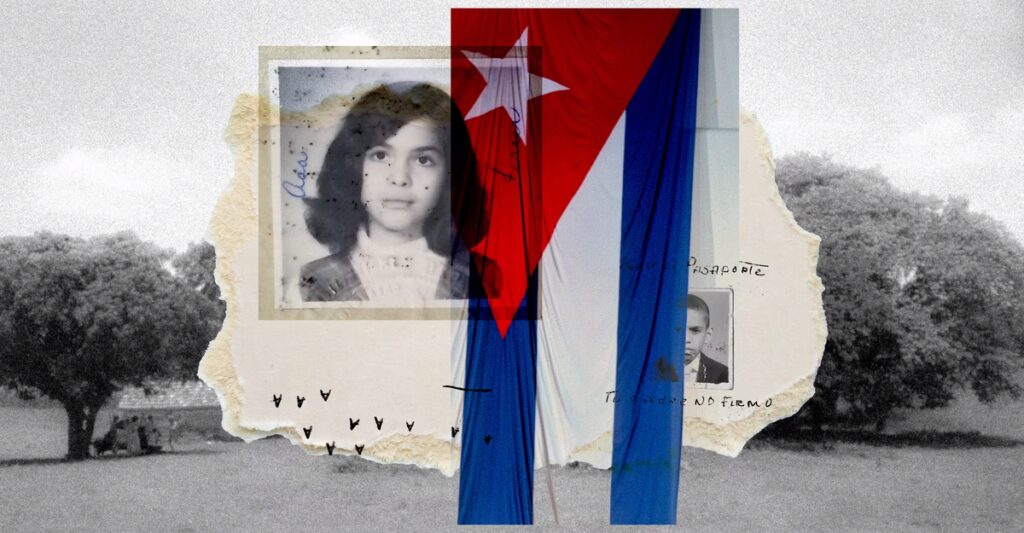
Extraordinary collections of letters made it possible for Ferrer to write her family’s story. After her parents died—her mother in 2020, and her father in 2022—she inherited the moving, often heartbreaking letters that her brother and mother sent back and forth during the years of their separation; anguished letters to Poly from Tía Niña, an aunt who had helped care for him in Cuba, sent after he eventually moved to the United States; the open letters that her father wrote to Castro and U.S. presidents, expressing his dissatisfaction with their leadership; and the correspondence that Ramón maintained with his own estranged son, Ada’s half brother Juan José, a teacher in Cuba.
The preservation of such a wealth of private material isn’t rare. Before Facebook Messenger, when phone calls across the Florida Straits were difficult, letters were the primary way that Cubans communicated with friends and relatives in the United States. Less often does such correspondence wind up in the hands of a historian who can curate and verify them, fill in their gaps with other sources and personal memories, and contextualize them within the sweep of Cuban history. Ferrer is the ideal keeper of her kin’s stories.
Each turn in Cuba’s postrevolutionary history changed the trajectory of Ferrer’s family, leading repeatedly to separations and reunions and reassessments of their relationship to the country. Ferrer’s father left Cuba first, in 1962, three years after Castro’s triumph. He had served in the Cuban army under Fulgencio Batista, the president ousted by the revolution. “Stridently anticommunist” like most Cubans, Ferrer writes, Ramón resolved to leave after being detained as a suspected counterrevolutionary. His departure as a political refugee marked the first time, but not the last, that the revolution had led to the separation of the family.
Adela and Ada followed a year later, in 1963. Poly would spend 17 years apart from the family, with devastating consequences, before joining them as one of thousands of Cubans who had left the island during the boatlift. Their reunion was a complicated one: Ferrer recalls Poly saying of his mother that “just as she had ruined his life by leaving him in Cuba, he was now here to ruin hers.” Only when Adela was in her 90s, in the hospital recovering from a surgery, did she tell Ada about the moment she left her boy behind. It was six in the evening, she recalled, and Poly, then 9 years old, was playing outside with friends. The next morning, she and baby Ada went to the airport. Poly was told that she’d gone to visit relatives in the countryside for a few days. His father wouldn’t allow him to leave Cuba; Adela had no choice but to leave without him.
In the early letters that Poly wrote to his mother, he said he was doing well, going to school every day, taking care of his grandmother, and helping her with errands. Ferrer describes young Poly as “a boy proud to behave, proud to be weathering the shock of his mother’s abrupt and unannounced disappearance,” though he sometimes cried himself to sleep. As he grew older, however, the letters darkened. In 1970, when Poly was a teenager, after he had forgotten to send his mom a Mother’s Day card, he apologized and wrote, “Deep inside me lives the name of my absent mother.” He became fixated on joining his family in the United States. “I will only be well when I have you at my side,” he wrote, and he began to describe his separation from his mother as “the great trauma that I have suffered.”
In 1978, Castro surprised Cuban exiles by inviting them to visit the island. Adela accepted the offer to see Poly, who was now in his 20s, for the first time since she had left Cuba. “In their separation,” Ferrer writes, “Poly had become a man. But my mother had changed as well; she became someone he didn’t know, someone who was mine in a way she might never again be his.” Poly, however, was even more profoundly changed. After he arrived in the U.S., he got a job, but he also drank and did drugs, and he was violent. He stabbed a man, and even attacked Ferrer. After being incarcerated and attempting suicide, he died of “hypertensive crisis,” according to a medical examiner, while sitting on the toilet, home alone in Hialeah, Florida.
Many of Ferrer’s recollections prompt her to reflect on how different her life might have been. When her mother visited Cuba, Ferrer was in high school and contemplating college. She asked her mom to take pictures of the University of Havana because she thought that’s where she would have gone to school if she had stayed in Cuba. In this alternate life, she might not have come to speak more English than Spanish. She might not have attended Vassar, an “elite American college” where she felt like she didn’t quite fit in; one student tells her mother that Ferrer reminds her of their family’s maid, adding that “she’s Hispanic, but not really Hispanic—she’s educated.” Ferrer doesn’t describe herself as a Latina even once in Keeper of My Kin—instead she prefers Cuban, or immigrant—but her expressions of loss and alienation echo the ways many Latinos describe their lives in this country.
These memories also lead Ferrer to wonder how Poly might have turned out differently, and how responsible the family was for his fate. Was there something she or her mother could have done to keep him out of trouble? Might Poly have made better decisions if he’d had better role models? Before she and Poly met, they had expressed tenderness toward each other in their letters. But after he joined the family in New York, Ferrer realized that she didn’t much like her brother, who brought chaos into the household and, she suspects, resented her success. Ferrer’s father was ambivalent about his stepson’s presence as well: He understood how important it was to his wife to be reunited with her son, but he saw that their reunion only intensified her stress and her guilt.
In March 2016, after Obama loosened travel restrictions, the whole family traveled together to Cuba. Like many Cubans in the United States, Ferrer’s father had vowed never to set foot there again while Castro’s party was in power, but he was persuaded to take what would likely be his last opportunity to return. They visited the house where Ramón and Adela had met, cemeteries where relatives were buried, and the house his son, Juan José, had lived in before he died in 2009.
The family trip coincided with Obama’s visit to Cuba. Ferrer watched his speech at her aunt’s house. “We share the same blood,” Obama said. “We both live in a new world, colonized by Europeans. Cuba, like the United States, was built in part by slaves brought here from Africa. Like the United States, the Cuban people can trace their heritage to both slaves and slave owners.” When Ada asked her father, who was no fan of Obama’s, what he thought about the speech, he said, “He killed it!” Back in the United States, he told her that he wanted to spend a year in Cuba. The country was a “disaster,” he said, “but it’s my disaster.”
[Read: Cuba doesn’t care about Marxism]
Ferrer’s father never did make it back. He died in 2022, and so he was spared from seeing Cuba’s descent into greater disaster. Given all of the letters he wrote about U.S.-Cuban relations, I reached out to Ferrer to ask her what she thought her father might have made of Cuba’s situation today. She believes that they would have disagreed about what the solution should be. She thinks that Cuba is stuck—caught between President Miguel Díaz-Canel, who uses the rhetoric of anti-imperialism to mask the ways that his government has failed its people, and Trump, who wants to bring down the Cuban system no matter the human cost because he cares, above all, about being acclaimed as a great man of history. Her father, she thinks, would have argued that the situation has become so bad that he would welcome change at any price, even if it meant increased U.S. control over the island.
Millions of Cubans, including those in exile, wait to see what will become of their island. One lesson Ferrer seeks to impart is that the outcome is sure to shape their lives in unexpected ways. Although historians are likely to focus their attention on government shake-ups, military moves, and diplomatic deals, the fallout of this moment, like all moments, will be seen in the smaller events that break and remake the people in our lives.
*Illustration Sources: Courtesy of Ada Ferrer; Sven Creutzmann / Hulton Archive / Getty; Kwangmoozaa / Getty.
The post A History of ‘Utterly Ordinary People’ appeared first on The Atlantic.