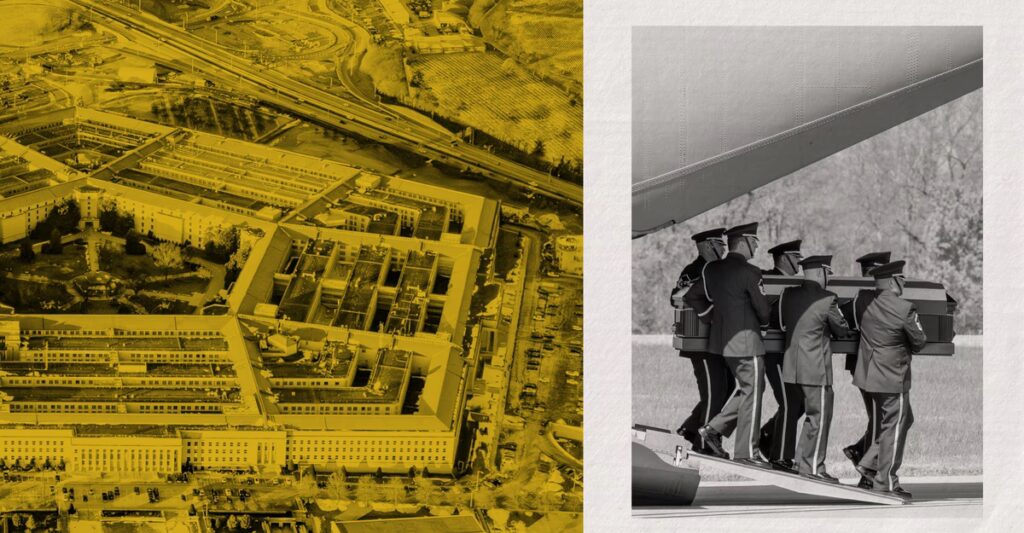
A pair of Air Force refueling planes were flying high over Iraq two weeks into the U.S. and Israeli war against Iran. The KC-135 Stratotankers, which carry up to 200,000 pounds of jet fuel, function as flying gas stations, extending the reach of United States and allied aircraft far from air bases. On March 12, the two tankers collided. One of the planes safely landed with a badly damaged tail; the other crashed, killing six service members, constituting almost half of U.S. military fatalities in the conflict. The same day, U.S. Central Command said that the crash over Iraq’s western Anbar province had occurred in “friendly airspace” and had not been caused by hostile fire.
Initial intelligence reports told a different story. They indicated that the U.S. government had detected anti-aircraft fire by Iran-backed militias in the area around the time of the collision and that the pilots may have been forced to take evasive actions. The reports, which haven’t been previously made public, were described to us by two current officials and one former official. But Centcom’s leaders, citing different, more highly classified information, were convinced that those initial reports were mistaken. Militias had never fired surface-to-air missiles that could have threatened the aircraft, according to their assessment. The initial reports may have picked up instead on launches of missiles aimed at ground targets. That’s why the Pentagon statement asserted that no hostile fire was involved and that the skies were friendly. An Air Force–led investigation is expected to conclude that the disaster was an “avoidable mishap” by pilots operating in congested airspace, military officials told us.
Centcom’s quick and definitive public assessment of the incident, despite intelligence suggesting a more complicated picture, fits a Trump-administration pattern of omitting from its public statements important details about the conduct of the war. Senior officials have trumpeted military successes—two days before the crash, Secretary of Defense Pete Hegseth said the U.S. had “total air dominance”—and have downplayed the resilience of Iranian forces and their armed proxy groups across the Middle East.
The contrasting accounts of what preceded the crash point to the confusion of a crowded battlefield, as well as to the serious threat that Iran’s proxies in neighboring Iraq pose to the U.S. and Israeli war effort 23 years after President George W. Bush ordered Iraq’s invasion in pursuit of Saddam Hussein. President Trump said within hours of the start of the Iran war that one of his goals was to “ensure that the region’s terrorist proxies can no longer destabilize the region or the world and attack our forces.”
But those groups remain a potent force: Iran-sponsored militias have pounded U.S. facilities across Iraq with relentless rocket and drone attacks since the war began, forcing a near-total evacuation of the U.S. embassy in Baghdad. Iran’s proxies in Iraq also possess advanced arsenals, including ballistic missiles and anti-aircraft weapons. Early in the conflict, one official said, U.S. intelligence indicated that a refueling tanker narrowly avoided a militia missile in the same area of western Iraq where the deadly collision occurred. A Centcom spokesperson disputed that account, saying it had no indication of such an incident.
The war is now subject to a shaky cease-fire as the United States and Iran continue an extended standoff over control of the Strait of Hormuz, the vital waterway for global energy supplies that Iran has effectively closed.
Those killed in the March 12 crash include three active-duty airmen from the 6th Air Refueling Wing based in Tampa, Florida, and three National Guard airmen from the Ohio Air National Guard’s 121st Air Refueling Wing. A Pentagon official declined to comment, saying that providing details before the Air Force probe is complete would be premature. The official, like others we interviewed, spoke on condition of anonymity to discuss sensitive matters. A family member of one of the service members who was killed recently told us that the Pentagon relayed to him that the incident was under investigation but that it has not provided any more information since.
The Iraqi government is a U.S. security partner. Washington helped build up the country’s security forces in the more than two decades since the 2003 invasion. But the State Department says militias, which operate both within the state’s security apparatus and outside of it, have struck U.S. sites in Iraq more than 600 times with drone and missile attacks since the war began on the last day of February. Their targets have included bases, diplomatic facilities, and aircraft on the ground, Phillip Smyth, an independent analyst of Iraqi proxy groups, told us. Iraq is “definitely not a friendly airspace,” as the Pentagon asserted, Smyth said. The Iraqi militias have also claimed or carried out as many as 5,200 strikes on military and civilian targets in Persian Gulf countries as well as on Jordan and Syria.
Other Iranian proxies in the region include the Houthis in Yemen, Hamas in Gaza, and Hezbollah in Lebanon. But the militias in Iraq, many of whose members are on Iraqi-government payrolls as part of the paramilitary Popular Mobilization Forces, may be the most potent and the least discussed, Aaron Zelin, a fellow at the Washington Institute for Near East Policy who studies Mideastern extremist groups, told us.
Israel has devastated Gaza in its campaign against Hamas and, in recent weeks, has targeted Hezbollah strongholds in southern Lebanon. Last year, the U.S. carried out a monthslong campaign against the Houthis to stop attacks on ships transiting around the Bab el-Mandeb, the strait that separates the Arabian Peninsula from the Horn of Africa. But Iran’s network of proxies in Iraq has faced comparatively fewer U.S. strikes since the Iran war began, reflecting a U.S. desire not to be seen as reengaging in Iraq two decades after its invasion. Neither the U.S. nor Israel has done much targeting of the groups’ top leadership in Iraq during that time, allowing the militias to preserve their command structures and maintain operations. “These guys have only consolidated more of the state,” Zelin said. “I suspect the same dynamics will continue unless the U.S. and its allies—or Iraqis themselves—decide they want to do something far more serious about it.”
[Read: Trump ditched hearts and minds in the Iran war]
Like the regime in Tehran, the Iraqi militias have sought to force the United States to expend costly air-defense munitions to protect personnel and facilities. U.S. officials, including Hegseth and General Dan Caine, chairman of the Joint Chiefs of Staff, have publicly minimized any concerns about the depletion of U.S. munitions. But not everyone in the administration trusts those assurances. In White House meetings, Vice President Vance has repeatedly questioned the Pentagon about the accuracy of such claims.
The U.S. military has been in intermittent conflict with Iraqi militias for more than 20 years. (Hegseth, who served in the Iraq war as a National Guardsman, has cited the hundreds of U.S. soldiers killed by those Iranian proxies as a justification for the current conflict.) In subsequent years, however, U.S. forces entered an awkward, arms-length alliance with the militias as both Washington and Baghdad battled the Islamic State. Today, the militias and their affiliated parties wield formidable political power, holding roughly one-third of the seats in Iraq’s 329-member Parliament, despite the United States’ role as Iraq’s chief Western ally.
The militias’ violence during the Iran war has intensified friction between Washington and Baghdad. In the past month, U.S. officials have suspended security aid to Iraq, halted the transfer of U.S. dollars generated by Iraqi oil sales, and thrown their support behind a new prime minister–elect in an effort to force the government to take on the militias.
The administration can apply that pressure because Trump is already inclined to pull remaining U.S. forces from Iraq and is willing to risk severing the relationship, Victoria Taylor, who served as a senior State Department official for Iraq and Iran during the Biden administration, told us. Trump recently withdrew U.S. forces from neighboring Syria, another center of what remains of the Islamist insurgency.
Kataib Hezbollah, which has been designated by the U.S. as a terrorist group since 2009, is the most powerful of the Iraqi militias equipped, trained, and funded by Iran. It’s the group that some of the early intelligence suggested had been targeting the U.S. tankers.
The group has a history of launching attacks on U.S. assets and allied targets across the Middle East. U.S. officials blamed it for the recent kidnapping of the American freelance journalist Shelly Kittleson in Baghdad. (She was released a week later.) Federal prosecutors also recently charged Mohammad Baqer Saad Dawood al-Saadi, an alleged senior member of Kataib Hezbollah, with involvement in at least 18 attacks or attempted attacks in the U.S., Canada, and Europe.
Two senior Iraqi officials told us that Kataib Hezbollah has an arsenal of advanced weapons, including ballistic missiles, and has begun manufacturing its own missiles and drones, as do Iran-linked militia groups in Lebanon and Yemen.
[Read: The Pentagon may not be giving Trump the full picture of the war]
Among Iran-backed militias’ most powerful weapons is the 358, a surface-to-air missile that experts say can loiter before striking its target and reach an altitude of up to roughly 30,000 feet. Kataib Hezbollah is believed to have possessed the missile at one point in the past, though whether it still does is unclear. Iraqi officials do not believe that the group has used one so far in the war, and the militia does not appear to have successfully targeted any foreign aircraft.
Unlike in previous American wars, when the Pentagon allowed journalists to witness the wars alongside deployed forces, details about the Iran war have come almost exclusively from the top—and have been uniformly positive. Hegseth and Caine have held a number of Pentagon press briefings in which they have focused on the degradation of Iranian forces and missile capabilities as well as the overall number of targets hit—more than 13,000 inside Iran before the cease-fire kicked in.
Admiral Brad Cooper, the head of Centcom, has also participated, and last week he was on Capitol Hill, where he was pressed by lawmakers about the war’s civilian casualties. He said that Centcom was investigating one incident, the bombing of a school in southern Iran on the war’s first day, which killed about 170 people, in an apparently errant U.S. strike. But Airwars, a watchdog group that has worked closely with Centcom in the past, has identified some 300 incidents in the Iran war that involved civilian casualties that the group claims merit investigation. Whether those incidents involved U.S. or Israeli strikes is unclear. During his congressional testimony, Cooper said there were initial investigations into allegations of civilian casualties, but those have not yet found any U.S. involvement. Centcom declined to comment further.
Despite Hegseth’s claims about America’s air dominance, the war has thrust American pilots into dangerous airspace over Iran. Iranian forces have shot down an American F-15E Strike Eagle and an A-10 Warthog. They have also damaged a F-35 stealth fighter jet, forcing the pilot to make an emergency landing. After mounting major rescue operations, the Pentagon was able to safely recover the F-15 and A-10 aircrews.
Much about the March 12 incident in which the refueling tanker went down remains unknown. Soon after the crash, a coalition of Iran-backed Iraqi-militia groups known as the Islamic Resistance in Iraq—which includes Kataib Hezbollah—claimed responsibility, saying that it had used “appropriate weaponry” to shoot down the tanker “in defense of our country’s sovereignty and its airspace violated by the aircraft of the occupation forces.” The coalition also claimed responsibility for damaging the second aircraft. American officials have dismissed those assertions as disinformation.
One of the U.S. officials we spoke with said that the pair of tankers was on a mission that involved refueling Israeli aircraft. Both Centcom and the Israel Defense Forces declined to comment. Iraqi officials described the tanker crash as an accident. One said the U.S. government asked members of Iraq’s elite Counter Terrorism Service to help retrieve the fallen airmen. Centcom declined to comment on that too.
For now, the prospect of further U.S. casualties appears reduced after Trump said yesterday that he had held back a planned attack against Iran to give a new Iranian peace proposal a chance. The pause may also provide Iran’s proxy militias with the opportunity to regroup to harass U.S. forces anew.
Marie-Rose Sheinerman and Isaac Stanley-Becker contributed reporting.
*Illustration sources: Michael Clevenger / USA TODAY / Reuters; Sapphire / Getty; Jen Golbeck / SOPA Images / Getty
The post What Caused a Midair Crash That Killed Six U.S. Troops? appeared first on The Atlantic.