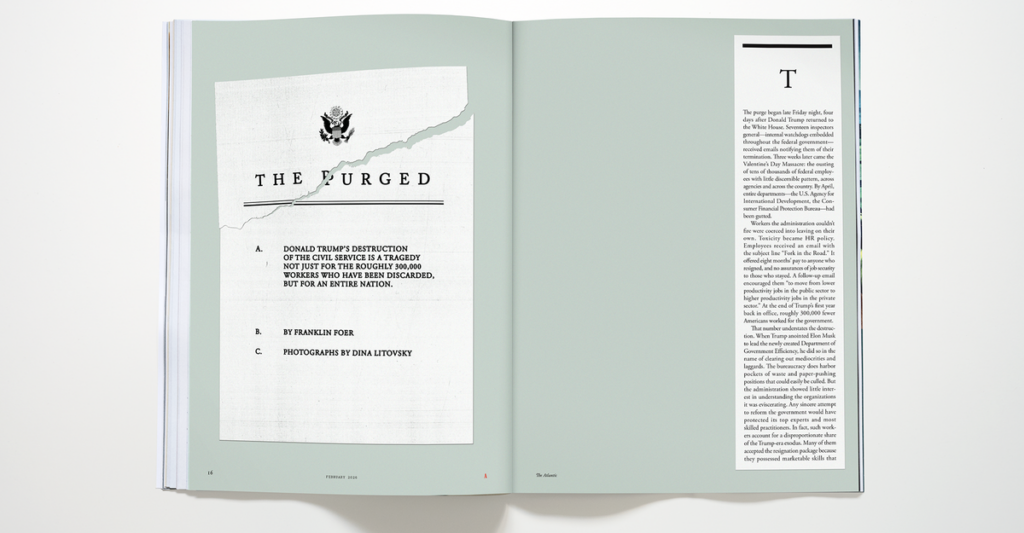
The Purged
Donald Trump’s destruction of the civil service is a tragedy not just for the roughly 300,000 workers who have been discarded, but for an entire nation, Franklin Foer wrote in the February issue.
I read Franklin Foer’s “The Purged” in one held breath. This is how to weigh the stakes of our political moment—one life at a time. No statistic can adequately describe America’s losses. Each of the 50 people profiled in Foer’s essay is so gifted and generous, so essential to what the United States means—or at least to what it used to mean. I salute Foer’s courage to tell the story head-on. His narrative journalism is letting us see one another whole.
Rita Charon New York, N.Y.
There but for the grace of God go I. I never worked directly for the federal government, but I did research and consulting as a contractor for the Department of Energy’s National Laboratories, the Environmental Protection Agency, and the National Center for Atmospheric Research. I am a meteorologist, an atmospheric physicist, and an environmental economist, now retired. I worked on significant problems, including air quality, acid deposition, and the safety of liquefied gases. I developed simulation techniques for the accidental release of toxic chemicals. I don’t know the people in the article personally, but I do know them—I know their value. Their individual loss is our national loss.
Daniel J. McNaughton Newport, R.I.
I worked in state government for 29 years. Franklin Foer’s 50 profiles are an important reminder that we’ll feel the consequences of Donald Trump’s purge for decades. I tend to think of government work as that of quiet competence. When we travel on interstate highways, we do not think about the work done to locate an appropriate site for a road, to build it, and then to maintain it. When we fly, we hope that the plane meets safety standards but spare little thought for the federal staff who developed those standards and enforce them for our benefit.
I was reminded of the importance of federal expertise last year, when the remnants of Hurricane Helene roared through the mountains and left astounding damage to public and private infrastructure. The Mitchell News-Journal, the local paper in rural Mitchell County, North Carolina, has on multiple occasions reported on confusion among employees of the Federal Emergency Management Agency over how to follow the agency’s own internal guidelines. I am sure that FEMA can and should be made more efficient. But destroying morale and stirring chaos with on-again, off-again layoffs is certainly not the way to do it.
John Dorney Durham, N.C.
I am a retired federal civil servant and a disabled veteran. I worked for the U.S. Postal Service for many years. I always took great pride in my desire to go above and beyond to help others get what they wanted or needed. On behalf of the millions of current and former federal civil-service employees, I am truly grateful for Franklin Foer’s research and reporting in this article.
In my 32-year career, the other civil-service employees and members of the military I worked alongside were dedicated, honest, and hardworking professionals. When I started to hear claims that federal employees were overpaid poor performers, or that they supported a particular political agenda that undermined the administration’s, or that they amounted to an unelected, overly partisan bureaucracy, I was shocked. These claims were so the opposite of my own experience that I thought surely anyone hearing them would disregard them as false.
Nyleen Mullally Rapid City, S.D.
I was very moved by the depth of reporting in Franklin Foer’s story on purged government employees. The profiles helped fill in the picture—that these are real people, and that their absence will be felt for a very long time. The damage to our culture and our progress as a nation is much larger than many people realize. Thank you for helping us keep that fact front of mind, now and into the future. I hope some of this strength can be rebuilt—but first we’ll need to rebuild the reputation of government.
Evelyn Luengas Fort Worth, Texas
from the archives
“I was holding myself together, but just barely,” Sherry Winfield confesses in “Dinah’s Hat,” a new short story by Stephen King. Sherry and her friend Morris have just ventured from their trailer park to a beach with Dinah, the mysterious child Morris cares for; there, they encounter a group of young bullies. “In time,” Sherry recalls thinking of the events that follow, “I’ll be able to convince myself that never happened.”
“Dinah’s Hat” isn’t the first work of fiction King has written for The Atlantic. In the magazine’s May 2011 issue, he published “Herman Wouk Is Still Alive,” a short story told from the perspective of two aging poets, Phil and Pauline, picnicking at a rest stop in Maine, and two mothers, Brenda and Jasmine, eager to take their children on a road trip up I-95. Compared with much of King’s other work, the horrors of “Herman Wouk Is Still Alive” are fairly quotidian—dead-end jobs and deadbeat dads, aging, depression. The story, nevertheless, builds to a haunting conclusion.
In a 2011 interview with The Atlantic’s James Parker, King explained that the story had emerged from a bet with his son Owen on that year’s NCAA basketball tournament: The winner would provide a title for a short story; the loser would have to write it. Owen, victorious, proffered the phrase “Herman Wouk Is Still Alive,” inspired by news coverage he’d read that Wouk, the Pulitzer Prize–winning author of War and Remembrance and The Caine Mutiny, was still writing well into his 90s. In King’s eventual story, Phil and Pauline read a fictionalized New York Times article testifying to Wouk’s longevity. “The ideas don’t stop just because one is old,” Wouk tells his interviewer. “The body weakens, but the words never do.” His sentiment inspires the two poets, both in their 70s—until, moments later, tragedy renders language powerless.
Wouk himself was asked about King’s story in a Q&A published with his 2012 novel, The Lawgiver. “I read Mr. King’s short story and enjoyed it,” Wouk said. “As for the longevity, I share his evident puzzlement, with boundless gratitude to my forebears and my Maker.” He continued, “It helps to have work I love, with much work yet to do by His grace.” Wouk died in 2019, just 10 days before his 104th birthday.
— Andrew Aoyama, Deputy Managing Editor
Behind the Cover
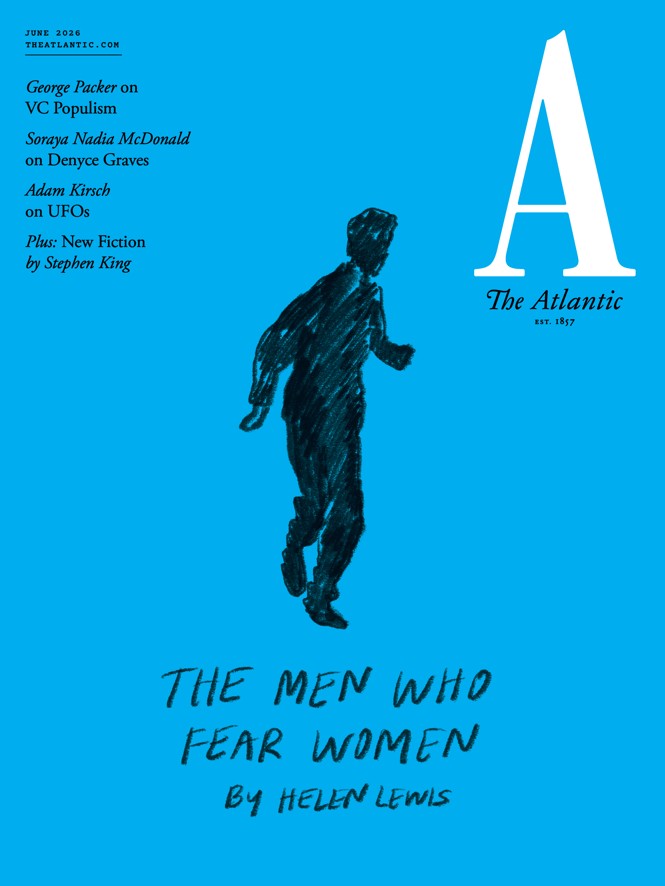
In this month’s cover story, “The Men Who Don’t Want Women to Vote,” Helen Lewis argues that “masculinism”—a movement seeking to counter the advances of feminism and place men back at the center of public life—has become the most important uniting force on the American right. Many men are drawn to masculinism, Lewis writes, because they feel that they have lost status to women. For the cover, we depicted the fear that undergirds their resentment: A rough silhouette of a man runs toward the viewer, looking over his shoulder at an imagined threat.
— Liz Hart, Art Director
This article appears in the June 2026 print edition with the headline “The Commons.” When you buy a book using a link on this page, we receive a commission. Thank you for supporting The Atlantic.
The post ‘The Destruction of the Civil Service Is Our National Loss’ appeared first on The Atlantic.