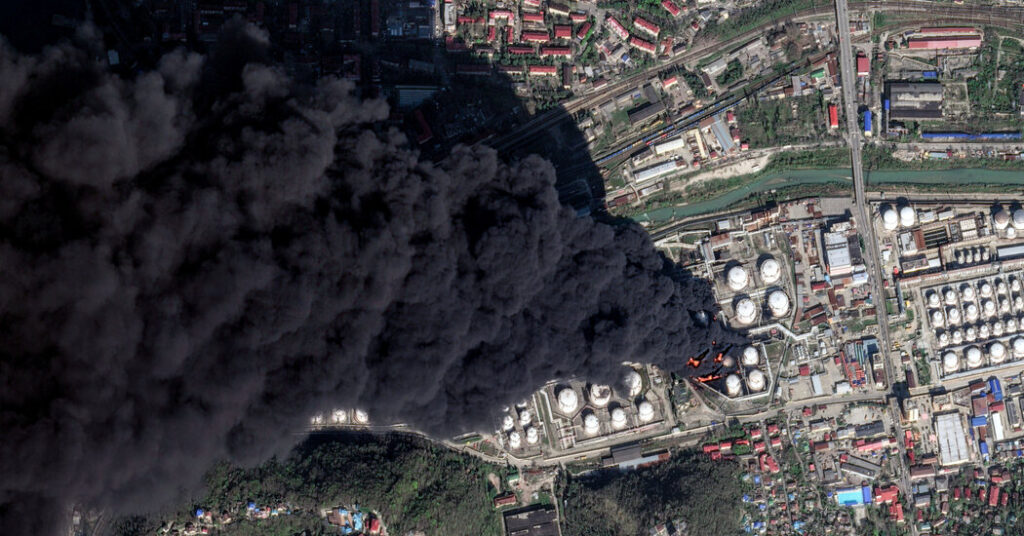
Yevgeny Vitishko, who lives in the Russian town of Tuapse, always wears white shirts. But the day a local oil refinery caught fire after a Ukrainian drone strike, he thought that would not be a good idea.
“I could see droplets of oil and soot on my clothes,” said Mr. Vitishko, 52, a prominent environmental activist. “The smell was so strong. It’s like you’re standing next to an exhaust pipe.”
An ecological disaster is unfolding in Tuapse, a resort town and port on the Black Sea. Four drone attacks in April and May, part of a growing campaign of Ukrainian strikes on energy export infrastructure deep inside Russia, have caused what Mr. Vitishko called the biggest oil spill along Russia’s Black Sea coast during his lifetime.
Apocalyptic pictures of oil-laden rain and towering clouds of pitch-black smoke have emerged. Dangerous levels of toxins have filled the air, the local authorities say, and tons of oil have been released into waterways. Russian officials have refused to publicly estimate how much oil has been spilled, reporting only that about one million cubic feet of contaminated pebbles and soil has been removed from the coast line.
More than four years into the fighting, Ukraine is bringing the war home to Russia. Kyiv now produces large numbers of its own long-range drones and cruise missiles, and in scores of attacks this year, Ukrainian forces have been firing them at oil facilities and other sites up to 1,000 miles into Russian territory.
The attacks are intended to cut into Russia’s oil revenue just as Moscow expects a windfall from supply disruptions in the Middle East.
On Sunday, Ukraine took aim at the Moscow region, targeting the capital’s refinery and a fuel-loading facility northwest of the city in one of the largest waves of attacks of the war. Four people were killed, including three who died in strikes on residential buildings in the Moscow suburbs, officials said.
The Ukrainian attacks have flipped the script in the war. Moscow’s forces have long targeted Ukraine’s civilian infrastructure with missiles and drones. Russia has also caused environmental disasters, including when it blew up a major dam in Ukraine in 2023.
The Russian military has struggled to intercept the Ukrainian strikes, lacking enough air defense systems to protect every refinery across the country’s vast geography. The attacks have cost Russia tens of millions of barrels in oil exports, analysts say. Russian energy companies have spent large sums to buy signal jammers, giant metal nets and other protective measures for their facilities.
Beyond the economic costs, the attacks in Tuapse have added an environmental disaster. Bloggers normally loyal to the Russian government have accused Moscow of trying to conceal the scale of the damage, which Mr. Vitishko said would take years to clean up.
The local authorities were initially slow to address the hazards, taking two days to publicly acknowledge dangerous air pollution levels, and three days to order an evacuation of several houses near the refinery.
Municipal officials even went ahead with a tree-planting event, lining up participants for promotional photos despite an immense plume of dark smoke in the background.
And cleanup efforts — apparently with an eye on maintaining tourism revenue — have focused on the shore, not on the soil or on a river that runs through the city. Sergei Boyko, head of the Tuapse municipality, has promised that the beach season will open on June 1 as planned.
Mr. Vitishko, who has traveled along the coast to document the damage, said, “Officials do not want to see the real scale of the oil spill.” He said that more than 40 miles of coastline had been affected.
Voices like his have become rare in Russia. Independent environmentalists, often seen as a threat to the Kremlin’s authority, have been sidelined and threatened with criminal charges. In 2023, Moscow banned Greenpeace and WWF.
Ukrainian strikes on other Russian oil refineries have killed workers and caused fires that took days to put out. The assault on Tuapse, however, “was the first time an attack on oil infrastructure became a subject of public discussion,” said Eugene Simonov, an environmental expert with the Ukraine War Environmental Consequences Work Group, a research organization.
The damage around Tuapse threatens to compound a December 2024 oil spill near another Black Sea port, Anapa, about 130 miles up the coast. Mr. Vitishko said that spill, which happened after two aging tankers sank in a storm, had still not been fully cleaned up.
After she heard about the damage, Yulia Strelets, a 27-year-old beautician from the Moscow suburbs, traveled to Tuapse in April to help to clean up the oil. She said that she could see the billowing smoke five miles away.
“As soon as I reached the town, I realized we’re dealing with a terrible disaster,” she said. “When I stepped out of the car, the oil smell was so bad, I felt nauseous and sick.”
Ms. Strelets, who had previously worked on the cleanup of the Anapa spill, spent two weeks in Tuapse shoveling oil-smeared pebbles from the beach.
Svetlana, a 40-year-old resident of Tuapse who works in construction, said she had initially stayed inside after the refinery was struck.
Bored with the indoors, she eventually went for a walk when the refinery was still on fire.
“It was just two kilometers away to the downtown, but I just couldn’t make it,” Svetlana said, adding: “The air felt stale and putrid. I felt sick.” She asked that her last name be withheld to avoid potential official repercussions.
Svetlana said that when she and her husband moved to Tuapse, the opportunities seemed like a dream. Housing in the city, which has a population of about 60,000, was more affordable than elsewhere on the Black Sea coast, and the refinery provided steady jobs.
Tuapse was targeted by Ukrainian drones in three assaults last year, but air defense systems intercepted most of them, and residents did not panic, Svetlana said.
“The thinking went like this: ‘It’s somewhere far. Not a big deal’,” she said about views of the war.
But the attacks this year, as well as security-related internet restrictions that have angered Russians, have pushed some to reconsider their support of the war, she noted.
“People started to say that things are going nowhere, that we’re not going to reach any goals in the war and maybe no one needs it,” she said.
In April, Svetlana sent her child to stay with relatives elsewhere. She said that she was taking life in Tuapse one month at a time.
While the Kremlin has gone to great lengths to make the war feel distant to Russians, awareness of Ukraine’s strikes is growing. The share of Russians who say that the Ukrainian attacks on Russia — not the war inside Ukraine — is the biggest news of the moment rose to 18 percent this month, from 2 percent in early February, according to a survey by FOM, a government-aligned polling organization.
Ukraine’s strikes have shattered a “cornerstone” of the wartime compact between the Russian government and the public, said Alexandra Prokopenko, a former official at the Russian Central Bank who is now a fellow at the Carnegie Russia Eurasia Center in Berlin.
The state is failing Russians “in its basic function: to shield them from a military threat,” she said.
The recurring strikes, she added, created a problem for oil and gas companies contemplating modernization work.
“What’s the point of investing in infrastructure upgrades if the state is not offering protection and all of that could be smashed into pieces by the drones again?” Ms. Prokopenko said.
Nataliia Novosolova contributed reporting.
The post As Ukraine Hits Oil Refineries, Russians Pay a Heavy Environmental Toll appeared first on New York Times.