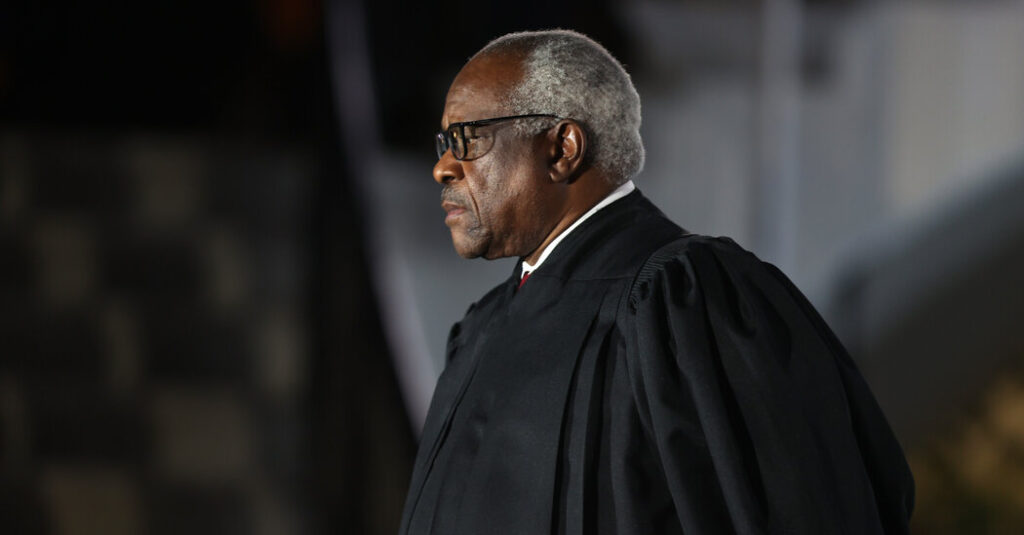
As of May 7, Justice Clarence Thomas is the second-longest-serving Supreme Court justice in American history. When he took his judicial oath on Oct. 23, 1991, nearly half of Americans alive today were not yet born. Text was a noun and not a verb. Justice Thomas now trails only William O. Douglas, who served 36 years before stepping down in 1975 (although much of his last year was overshadowed by a stroke that left him partly paralyzed and paranoid).
Justice Thomas is far from alone in his durability. Justice John Paul Stevens served 35 years before he stepped down in 2010. In the past half-century, Justices William J. Brennan Jr., Hugo Black, William Rehnquist and Anthony Kennedy all joined the three-decade club. The average justice’s tenure is now more than 28 years, by far the longest among modern democracies.
Whatever your politics, we should be able to agree that in a representative democracy, no one should hold so much power for so long.
Why aren’t term limits in place already? Because until recently there was no clear need for them. Throughout most of American history, the average justice served for about 15 years. The Constitution’s framers gave justices life tenure in order to insulate them from day-to-day politics.
But the average life expectancy in 1787 was about half what it is today, and the framers almost certainly did not envision a single justice sitting for as many as 10 presidential administrations — a near-monarchical stretch of time. The only way to force one from the bench is through impeachment in the House followed by conviction by two-thirds of the Senate, which has never happened before.
Hence the appeal of term limits, which can be imposed through federal law, despite the claims of some legal scholars (and, no doubt, the feelings of some Supreme Court justices). Multiple term-limit bills have been introduced in Congress over the past few years, all of which contain the same basic features: 18-year terms for justices, with regularized appointments every two years. On a nine-justice court, each president would get two appointments per four-year term. After their terms, justices would transition to senior status, a system similar to the one currently used in federal courts, including for Supreme Court justices who retire from active service. A senior justice could sit temporarily in the lower federal courts, and could fill in at the Supreme Court if an active justice is recused from or unable to hear a case.
Such a law would have multiple benefits. First, it would return justices’ terms roughly to the length that they averaged until the 1970s.
Second, it would establish a more democratically faithful system in which the court’s membership better reflects the nation’s electoral choices. The predictability of appointments could also reduce the heat of confirmation hearings, which have turned into partisan circuses full of grandstanding by lawmakers and obfuscation, if not outright dishonesty, by nominees.
Third, it would bring the American high court into line with every other democracy and the 49 states that impose term limits, age limits or both on their high court judges. (Rhode Island is the exception.)
To understand how meaningful these changes would be in practice, we can look again to Justice Thomas. For starters, they would eliminate multigenerational tenures like his. In two more years, Justice Thomas would be the longest-serving justice ever, yet he is still relatively youthful in Supreme Court terms — more than a decade younger than Justice Stevens was when he stepped down. Health permitting, Justice Thomas could serve on the court for half a century. Republicans, if not Democrats, have learned from this example, tapping ever-younger nominees to lock in an ideological sympathizer far into the future. Life tenure, in other words, incentivizes partisan gamesmanship at the expense of democratic legitimacy.
Meanwhile, regularly timed appointments would ensure that actuarial quirks do not define the court for decades. Justice Thomas got his seat after his predecessor, Justice Thurgood Marshall, retired because of failing health, giving President George H.W. Bush a vacancy to fill. As it turned out, Marshall died on Jan. 24, 1993 — four days after Bill Clinton entered the White House. Had Marshall held his seat until the end, as many justices have done, Clinton would have filled that vacancy, and not with Justice Thomas, but with someone far more in line with Marshall’s robust commitment to civil rights and racial equality.
Or consider what happened in 2020, when Justice Ruth Bader Ginsburg died weeks before Election Day. In a matter of days, Senator Mitch McConnell and his Republican colleagues rushed through the confirmation of Amy Coney Barrett to complete a 6-3 right-wing supermajority, even though four years earlier the Republicans had blocked President Barack Obama from filling a vacancy for nine months on the grounds that the election was too close. Millions of Americans had already cast their ballots by the time Justice Barrett was sworn in.
To prevent this sort of bad-faith, norm-shattering behavior, any term-limit bill would need to contain a fast-track mechanism to ensure a timely up-or-down Senate vote on all nominees.
Of all the smart Supreme Court reforms under debate, term limits are one of the most popular across the political spectrum, with multiple polls averaging 73 percent support. Leading Republicans, including Senators Josh Hawley and Ted Cruz and then-Senator Marco Rubio, have expressed support for term limits.
There are many choices about how to carry out such a reform, including whether to exempt current justices.
That would be a tough pill to swallow, given the countless ethical scandals of Justices Thomas and Samuel Alito, for starters. But changing the Supreme Court is a long game, and if a forward-looking bill is the price of passage through Congress, it’s worth considering. (Of course, a prospective law would also grow the court temporarily as new members are added; the court would return to nine when the last of the current justices retires.)
What about the claim that term limits may be adopted only by constitutional amendment? As my colleagues at the Brennan Center for Justice have explained, and as dozens of leading legal scholars and retired judges agree, that’s not true. Congress has the clear authority to pass such a law as part of its unquestioned power to alter the size, jurisdiction and other key elements of the court. The court itself ruled in a 1934 case that “Congress may lighten judicial duties,” and that federal judges do not lose their office (or their salary) by assuming senior status.
Might justices be tempted to take financial advantage of a post-judicial life, thus calling into question the integrity of their votes and opinions while on the court? It is possible, but life tenure is no guarantee against the dangers of corruption. As illustrated by the close personal relationships Justices Thomas and Alito have developed with wealthy G.O.P. donors, for some with business before the court, the knowledge that justices are installed for life makes it, if anything, more appealing to ply them with favors and seek to win their allegiance for decades to come.
Term limits are just one fix, but they are an essential one, and they will require a Congress and president committed to helping the Supreme Court regain the trust and respect of the American people.
The Times is committed to publishing a diversity of letters to the editor. We’d like to hear what you think about this or any of our articles. Here are some tips. And here’s our email: [email protected].
Follow the New York Times Opinion section on Facebook, Instagram, TikTok, Bluesky, WhatsApp and Threads.
The post Three Decades on the Supreme Court Is Too Long appeared first on New York Times.