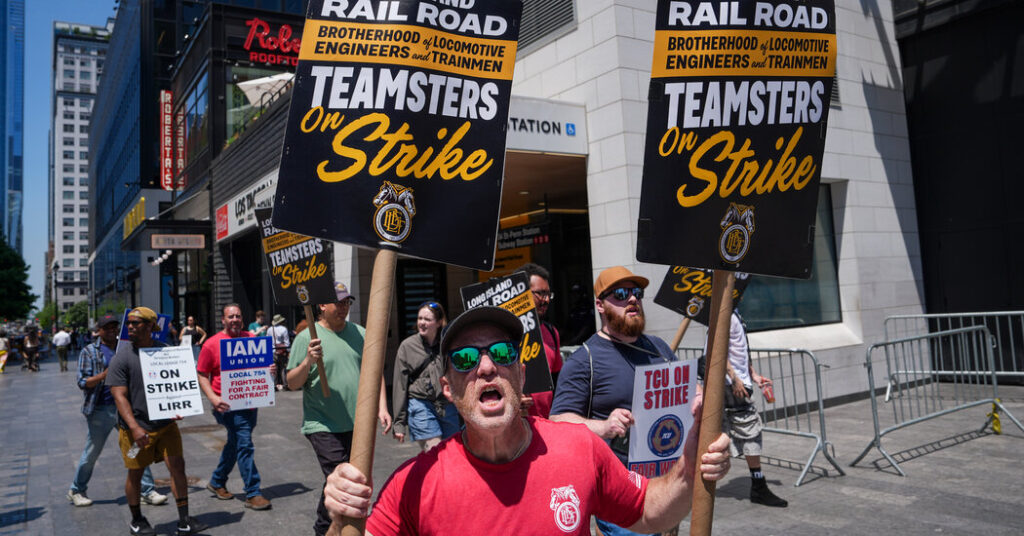
Transit authorities and workers’ unions reached a deal on Monday to end a strike that shut down the Long Island Rail Road, America’s busiest passenger rail service, and upended the routines of a quarter million weekday riders.
Officials said that service on the railroad — which carries about 270,000 people a day between New York City and its eastern suburbs — will gradually resume on Tuesday, with full service restored in time for the evening rush hour.
Gov. Kathy Hochul sounded triumphant at a news conference alongside officials from the Metropolitan Transportation Authority late Monday, emphasizing that the deal would avoid raising taxes and fares. Officials did not disclose details of the labor agreement, noting that the contract must still be ratified.
“I always believed we could reach a good, fair compromise that achieved two principles,” Ms. Hochul said. “Protecting affordability for Long Islanders and commuters, while giving fair wages to employees.”The deal signaled the end of a nightmare for many commuters who rely on the railroad. Thousands of them got a glimpse of what a protracted labor dispute could look like as they took a patchwork of buses, car pools and subway trains to clock in on time. At least one company rented hotel rooms to help employees avoid the headache, while some workers heeded calls to work from home.
“Three hours going to work is just not worth it — my job doesn’t pay that much,” Vanessa Zhang, 38, said in an interview Monday morning at the Hicksville station on Long Island, where transit officials were providing a limited number of shuttle buses to Queens.
She had missed the last bus to get to her retail sales job in Midtown Manhattan by a hair. Her only other options were buses on a different, unfamiliar network, or a pricey Uber.
“I’ll take a sick day,” she said, before heading home.
Members of the five unions that represent about half the Long Island Rail Road work force — more than 3,500 employees, including engineers, signal workers and others who are vital to train operations — walked off the job early Saturday morning, after three years of failed efforts to secure higher wages. They have not received a raise since 2022.
Kevin Sexton, the national vice president of the Brotherhood of Locomotive Engineers and Trainmen, said the unions wanted to discuss the specifics with their members before telling the public. Still, he said he expected the workers covered by the deal to ratify it.
While some details of the agreement were still unclear, the deal included what effectively amounted to a 4.5 percent wage increase in 2026, over a period slightly longer than a year, according to three people familiar with the negotiations. The unions previously sought a 5 percent increase, while the M.T.A.’s offer was closer to 3 percent.
The shutdown was becoming a painful ordeal for riders, a major economic strain on the region and a growing political liability for Ms. Hochul, who is seeking re-election this year.
The state comptroller’s office had said before the weekend that the strike could cost the region $61 million a day in lost economic activity.
Earlier on Monday, Gary Dellaverson, a former M.T.A. executive and labor negotiator who advised the authority in the talks, said he “had no confidence” that a deal was imminent.
But urgency was building.
The New York Knicks will face the Cleveland Cavaliers at Madison Square Garden on Tuesday night in the first game of the Eastern Conference finals, and thousands of fans were expecting to take the L.I.R.R. to the series. Memorial Day, when thousands of New York City residents flock to Long Island, is less than a week away.
Earlier in negotiations, the unions said they were willing to accept a retroactive 9.5 percent wage increase covering the last three years — the same deal the M.T.A. offered several other transit and civil service unions in recent months.
But they were also seeking an up to 5 percent raise in the current year, a demand that exceeds what the agency has offered to other unions.
The M.T.A. has argued that the unions’ wage demands could lead to higher fares for passengers or reductions in service. The authority negotiates with more than 80 different unions, and acceding to much higher wage increases with one group could force it to pay substantially more when other contracts come due.
The unions pointed to the recommendations of two federal review panels that supported a higher wage increase than the M.T.A. had offered, and said they were unwilling to cede other parts of their contract, like changes to longstanding work rules, that could reduce their overall income.
On Monday, the two sides remained about 1 percentage point apart on wage increases for 2026. The unions rejected an M.T.A. proposal that would have required new employees to cover more health care costs under a model different from the one current employees use.
Cash compensation for members of the five holdout unions averaged over $136,000 in 2025, according to M.T.A. figures, making them among the highest-paid rail workers in the nation.
But leaders of the negotiating unions argued that their workers don’t make enough money to keep up with the cost of living in one of the country’s most expensive metro areas.
In response to the strike, which shut down 126 rail stations across the region, the M.T.A. began providing free shuttle bus service between a handful of stations on Long Island and two subway stops in Queens.
The authority warned that the buses could accommodate only about 13,000 riders during the morning and evening rushes, but by Monday afternoon, fewer than 2,200 riders had used the service, according to the M.T.A. Reserving the buses costs the agency about $550,000 a day.
Many stranded riders said they sympathized with the unions — but interviews suggested they had their limits.
Mandy Ramzan, 50, who lives in Long Island City in Queens, joined a long line of rerouted commuters at a bus stop on Roosevelt Avenue in Flushing.
She was transferring from the No. 7 train in the hopes of getting to her job in Great Neck in Nassau County, where she is the director of an assisted living center.
That detour was adding an hour to her morning commute, she said.
Standing in line with a warming iced coffee, Ms. Ramzan said she had mixed feelings about the labor dispute.
“Listen, people deserve to be paid. I get it,” she said. “But there are also a lot of commuters who are really feeling it this morning.”
The strike was unwelcome for Ms. Hochul, whose opponent in the November governor’s race, Bruce Blakeman, a Republican and the Nassau County executive, has close ties to Long Island. Ms. Hochul lost the region in the 2022 election.
“This strike never should have happened,” Mr. Blakeman said in a statement. “Union leaders do not trust Kathy Hochul when she says she doesn’t have the money for their workers,” he added.
Ms. Hochul has directed some of her frustration at President Trump, whom she has blamed for increasing the odds of a strike. The president controls the National Mediation Board, which last year released the unions from mediation, a decision that cleared the path for a possible walkout.
On Saturday, Mr. Trump said the governor “knows, full well, that I have NOTHING TO DO WITH IT,” before expressing his support for Mr. Blakeman.
The suspension was expected to have an outsize effect on middle-class workers who cannot work from home, both on Long Island and in New York City.
A growing number of Queens residents rely on the Long Island Rail Road, and an influx of passengers from the suburbs boarding the subway in that borough could add to the challenge.
Queens has some busy L.I.R.R. stations, including the hub at Jamaica, where many train lines converge and where riders can connect to the subway and the AirTrain to Kennedy International Airport.
The last time Long Island Rail Road workers walked out, in 1994, the dispute was resolved in two days. The longest strike on the railroad occurred in the summer of 1960, when service was suspended for 26 days as workers pushed for better wages and other demands. It led to the institution of a five-day workweek for the rail workers.
Sean Piccoli, Nate Schweber and Grace Ashford contributed reporting. Kirsten Noyes contributed research.
Stefanos Chen is a Times reporter covering New York City’s transit system.
The post L.I.R.R. Strike Ends After Tens of Thousands Endure Painful Commutes appeared first on New York Times.