The frantic mother’s call came in at 9:42 a.m. on Monday: Her son was missing.
That wasn’t all, she told the San Diego police. Several guns were gone, and so was her car, and her 17-year-old might have a friend with him.
The police were alarmed and began a desperate hunt for the two teenagers. They were somewhere in California’s second largest city, a sprawling community of 1.4 million people nestled amid palms and purple jacarandas.
A license plate reader seemed to show them near a mall, and officers rushed there. Then, they converged on the high school one of the teenagers attended. Those turned out to be the wrong places.
The teens’ target was a mosque, the police said. They shot and killed three people there, including a security guard who worked for the mosque and whose actions, police said, likely saved lives. And then the teens killed themselves, the police said.
The grounds of the Islamic Center of San Diego, the largest mosque in San Diego County, include a school.
“I’ll tell you what got me,” Chief Scott Wahl of the San Diego Police Department said at a news conference. “Watching kids come running out, just thankful to be alive.”
The shooting came amid increased threats and acts of violence against religious institutions in America, fueled by the wars in the Middle East. In March, a man attacked a synagogue outside Detroit with a truck before he died in a confrontation with security guards. The growing threats have prompted increased security at mosques, synagogues and churches across America.
In the hours after the attack, a grim and familiar American ritual played out. Politicians and other leaders condemned the violence, while officials in Los Angeles and other major cities in the United States said that police officers would increase patrols at religious sites.
“No one should ever fear for their safety while attending prayers or studying in elementary school,” said Tazheen Nizam, the executive director of the San Diego chapter of the Council on American-Islamic Relations, which reported more civil rights complaints by Muslims in 2025 than in any year since 1996.
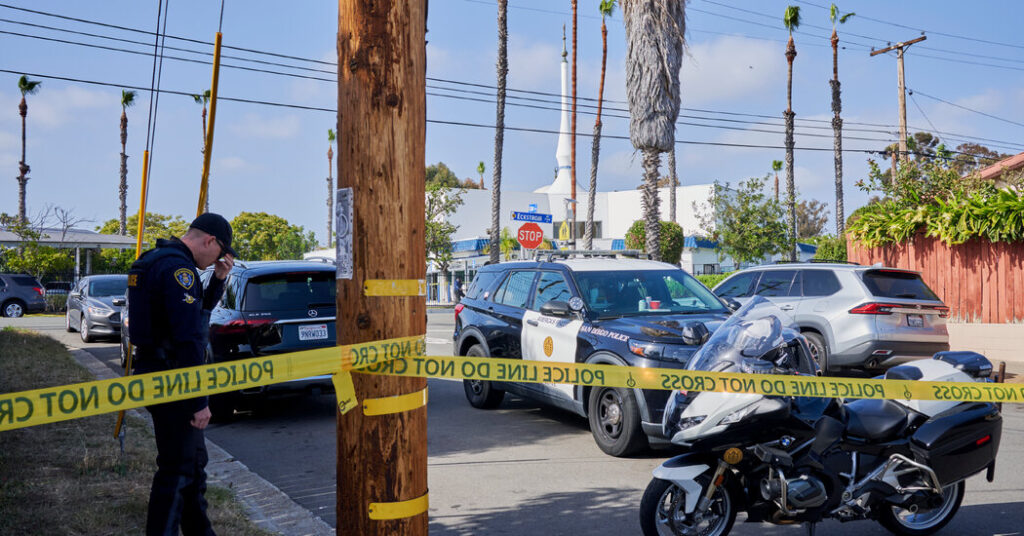
In San Diego, officers were dispatched to the mosque just before noon Monday. Drop what you’re doing, they were told. People were reporting gunfire.
The first officers on the scene found three dead men just outside the entrance to the house of worship. As dozens of officers rushed inside, breaching doors and going room to room, a fresh round of gunshots was reported a couple of blocks away. There, police found a landscape worker who had been shot at. He was unhurt, police said, but a bullet may have ricocheted off the helmet he wore.
A few minutes later, the police discovered a vehicle in the street holding the two dead suspects — one 17, the other 18. The teens, police said, had shot themselves after unleashing carnage at the mosque.
In the late morning, as the haze typical of a May in Southern California was burning off, Vanessa Chavez was fixing herself an early lunch when she heard four gunshots, one after another, coming from the direction of the nearby mosque.
She raced to another room to get a better view, and saw a security guard get hit by at least two gunshots, she said. Children playing outside were quickly herded in.
Soon, her neighborhood, normally a quiet, leafy area shaded by eucalyptus trees and the blooming jacarandas, resembled a war zone, with scores of officers, SWAT teams and a helicopter circling overhead.
As reporters and officials gathered at a park a block from the mosque, the building’s entrance was taped off and quiet, but through the gates, a covered body could be seen lying on the ground.
“Now seeing that he lost his life, it was very brave of him,” Ms. Chavez, 46, said in an interview, referring to the security guard.
Arturo Gonzalez, a pro-immigrant activist in San Diego, was near the mosque when the shooting began, and soon after saw panicked parents looking for their children.
“At first, they weren’t letting them in,” said Mr. Gonzalez, 23. “Parents were crying. It was really scary. And I actually shouted at a police officer to let one mother in and they finally did.”
Chief Wahl praised the slain guard as a hero. “I think it’s fair to say his actions were heroic, and undoubtedly saved lives today,” he said.
As agents from the F.B.I. and the Bureau of Alcohol, Tobacco, Firearms and Explosives rushed Monday afternoon to assist local police, some clues were starting to emerge. Investigators began executing search warrants on Monday afternoon.
Chief Wahl said investigators were collecting footage from the many security cameras at the mosque.
“There is going to be a tremendous amount of information and details that we’re going to try and sort and put this puzzle back together again,” he said.
Investigators recovered anti-Islamic writing in the car where the suspects were found dead, according to two law enforcement officials briefed on the matter who requested anonymity because they were not authorized to share details publicly. The words “hate speech” were written on one of the guns used in the attack.
Chief Wahl said investigators had not uncovered any threats toward a specific place. Still, “there was definitely hate rhetoric involved,” Chief Wahl said.
The Islamic Center is not just a place of worship but also a community center, a place for people to gather. There is a library and a busy schedule of classes unrelated to religion, such as smoking cessation groups, said Linda Sarsour, a Brooklyn-based activist and advocate for Muslims who has visited the place many times. She is friends with the center’s imam, Taha Hassane.
“You drop your kids off at school and then you might go hang out with your friends at the mosque because they have a lounge area, like a coffee shop,” Ms. Sarsour said. “It’s one of those kinds of places that’s not just like you go pray at the mosque and you leave.”
Mr. Hassane, addressing reporters in a park late Monday afternoon, said, “My community is mourning. This is something we have never expected to take place, but at the same time, the religious intolerance and the hate, unfortunately, that exists in our nation is unprecedented. All of us, we are responsible for spreading the culture of tolerance, the culture of love.”
Pooja Salhotra contributed reporting.
Tim Arango is a correspondent covering national news. He is based in Los Angeles.
The post A Fearful Phone Call and a Frantic Search Preceded Mosque Shooting appeared first on New York Times.