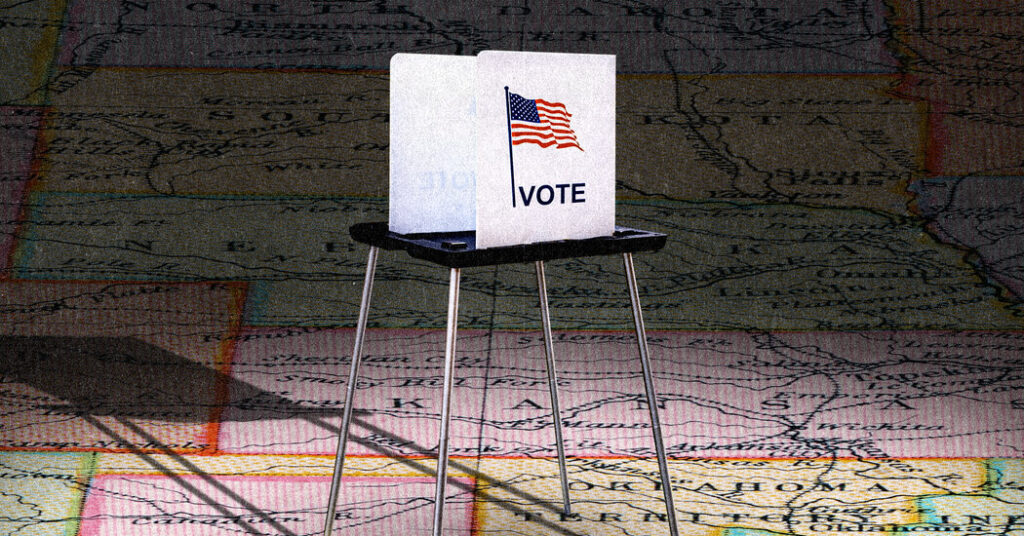
Nearly 10 months ago, President Trump announced that he was “entitled” to five additional House seats from Texas. Thus began the redistricting crisis that has engulfed the nation. The last thing the president wants is a functioning House of Representatives that could serve as a check on his efforts to undermine our democracy and to enrich himself and his family.
Last month, the Supreme Court made it easier for Republicans to skew voting maps in their favor, gutting much of what was left of the landmark Voting Rights Act of 1965 and setting off another round of frantic redistricting that will in effect diminish Americans’ voting power and could result in many Black members of Congress losing their seats.
Make no mistake: Republicans, with the aid of the court, are attacking the right to vote for all Americans, whose representatives in Congress will increasingly reflect the preferences of district line-drawers and their most partisan supporters. The next time Democrats take control of Congress and the White House, their top priority must be to rebuild and reimagine American democracy, creating a system that, more than ever before, reflects and is responsive to the will of the American people. That means banning partisan gerrymandering — and much more.
The times demand a thorough response, because things that seemed inconceivable only a decade ago are now happening.
Mr. Trump’s mid-decade redistricting push aims to rig the 2026 and 2028 House elections in favor of the G.O.P. The potential effects on the next House’s partisan makeup have been offset somewhat by moves in states such as California, where Democrats redrew maps to help their own candidates. Although I have fought — and will continue to fight — for reforms to end partisan gerrymandering, I could not let my enduring commitment to fairness blind me to the reality of what was unfolding. Democrats could not stand by while Republicans tried to steal the midterm election. In California, voters approved the new maps.
Just as the redistricting frenzy seemed to be calming, the conservative Supreme Court majority’s Louisiana v. Callais decision spurred a shameful, but historically familiar, rush by Republican-run state capitols in Alabama, Georgia, Louisiana, Mississippi, South Carolina and Tennessee to erase the representation and voting power of Black people.
The Callais decision might not have been surprising in its direction — Chief Justice John G. Roberts Jr. has steadily dismantled the Voting Rights Act over his tenure at the court — but its scope and timing were brazen. If the court were fair-minded, the justices would not have ultimately gutted a law they upheld and enforced in recent years.
In a voting rights case in the 2022 election year, the court said in the first week of February that it was too close to primary elections to enforce a decision that would have protected minority voters. Yet this past week, the court allowed Alabama to suddenly change its map in the wake of Callais, even with an election looming.
This is far from the only instance in which the Roberts court has misled Americans with inconsistent reasoning that favored one ideological side. In the 2013 ruling that stripped the Justice Department of its power to stop unfair electoral processes — Shelby County v. Holder decision, decided when I was attorney general — the court noted that the Voting Rights Act’s Section 2 would remain available to combat discriminatory voting laws. In Callais, the court all but wiped away Section 2.
Along with the Callais and Shelby County decisions, Citizens United in 2010 gave power to the wealthy, and another, Rucho v. Common Cause in 2019, closed federal courthouses to lawsuits challenging partisan gerrymandering. These decisions are at least partly responsible for the divided state in which we find ourselves.
White Americans need to understand that these decisions diminish their votes, too. When the Supreme Court effectively ended the Voting Rights Act’s ban on racial vote dilution, it did so by describing that practice as acceptable partisan gerrymandering. The court is enshrining a practice that dilutes the power of every American, allows politicians to choose their voters and enhances the power of special interests.
In the short term, pro-democracy forces can ask state courts to toss skewed maps in states that restrict partisan gerrymandering. Meanwhile, if Republicans continue to redraw their maps for partisan advantage, Democratic states must be willing to respond by redrawing maps in the states they control, even if it means suspending for a time the independent redistricting commissions that I have fought for.
Despite the obstacles that the Roberts court and the Republican Party have put in front of them, citizens must use the power they have to vote in local, state and federal elections to begin to carve a path to ultimately achieve much-needed reforms. A focused and determined citizenry can slow or stop the erosion of our democratic norms — just ask Immigration and Customs Enforcement about Minneapolis.
Long term, Congress needs to pass new voting rights legislation and reform the Supreme Court, so that this hyper-ideological majority cannot use a skewed reading of the Constitution to block laws that protect democracy.
When Democrats eventually take control of Congress and the White House, top of their list should be banning partisan gerrymandering and mid-decade redistricting, along with reviving protections against racial gerrymandering and guarding against other forms of voter suppression. Democratic senators should exempt such a bill from being filibustered, preventing Republicans from blocking it. Senators Joe Manchin and Kyrsten Sinema prevented this from happening in 2021 when Democrats had the power to do it, which is one reason the country is in its current mess.
Even this would not be enough. The Supreme Court’s destruction of the Voting Rights Act, a law that was enacted and repeatedly reauthorized in Congress with overwhelming bipartisan support and under multiple Republican presidents, shows that democracy reforms will be at legal risk as long as a radical court majority rules with obvious favoritism for one side. Senate Republicans constructed this majority by freezing out Democratic court nominees while fast-tracking Republican ones. The court needs to be reined in and reinvigorated.
Congress should impose Supreme Court term limits of 18 years, a binding code of ethics that applies to the justices and a provision that requires a new justice to be appointed in the first and third years of each presidential term. This would expand the court’s membership at first, but, over time, the court would revert to a nine-member institution. Vacancies and appointments would be less subject to partisan manipulation and drama, and public confidence in the court’s independence would grow.
On the day I was born in 1951, it would have been unthinkable to have a Black U.S. attorney general serving under a Black U.S. president. But what once seemed impossible was achieved because Americans’ attitudes changed through the toil and sacrifice of the brave citizens, of many colors and backgrounds, who powered the civil rights movement. New generations need to start a movement that restores and enhances this legacy — and they need to begin now.
Eric H. Holder Jr. is the chairman of the National Democratic Redistricting Committee. He was attorney general of the United States from 2009 to 2015. Source photographs by Stefania Pelfini la Waziya and mikroman6/Getty Images.
The Times is committed to publishing a diversity of letters to the editor. We’d like to hear what you think about this or any of our articles. Here are some tips. And here’s our email: [email protected].
Follow the New York Times Opinion section on Facebook, Instagram, TikTok, Bluesky, WhatsApp and Threads.
The post This Redistricting Chaos Must End appeared first on New York Times.