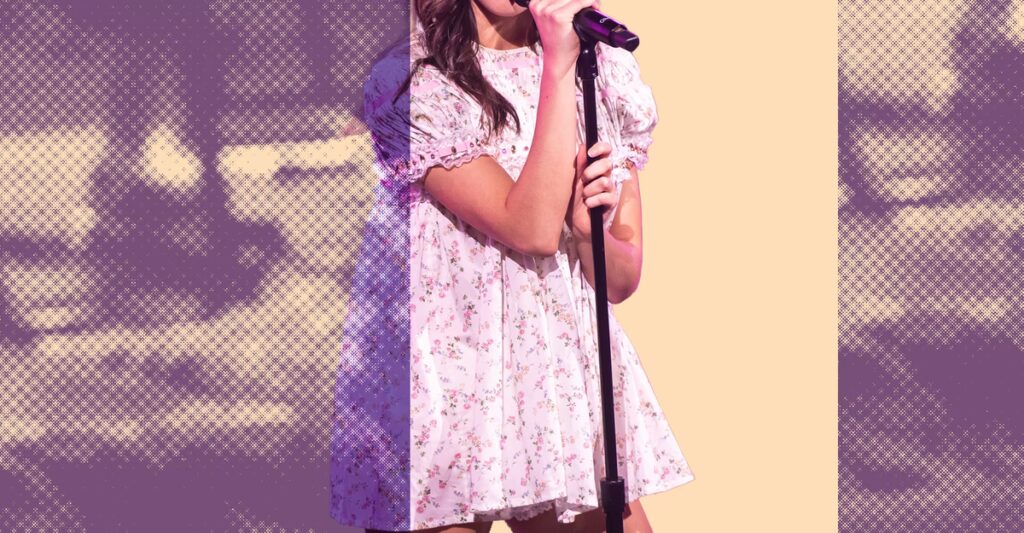
Earlier this month, to celebrate a Spotify-streaming milestone, the singer Olivia Rodrigo held an intimate concert in Barcelona while wearing a certain outfit: a floral baby-doll dress, pink bloomers, and knee-high leather boots. The getup almost immediately set off an online maelstrom. Some commenters accused her of dressing like a “sexy baby” and promoting “pedo core” (short for “pedophilia core”); others defended her right to dress however she pleases.
Rodrigo, though, appeared to have specific references in mind: In a recent interview, she noted that she’s currently inspired by artists such as Kat Bjelland and Courtney Love, who paired baby-doll dresses with punk rock in the ’90s to repudiate the fetishization of girlhood. But those artists, too, were disparaged for the look back then—one reviewer in 1994 called Love’s style that of a “raddled Baby Jane whose notion of clothes-shopping is to lie in a skip outside a paedophile brothel.” And criticisms of the style reached into the world of fashion more broadly. After Giorgio Armani and Anna Sui featured baby-doll dresses and pleated skirts in ’90s runway shows, one New York Times writer remarked, “Is there anything more perverse and weird than grown women wearing kiddie clothes?”
Baby-doll dresses have clearly been a magnet for moral panic for decades. But though some people might associate them squarely with girlhood, the history of the billowy dress is far more convoluted: It has traveled, over the centuries, between kid and adult closets. This fluidity reflects how “kiddie” and “grown” clothes have never had strictly differentiated styles, fashion historians told me, and how the line between the two has constantly shifted—even if the policing of how these garments are worn, especially by women, has remained constant.
[Read: Olivia Rodrigo’s big, bloody return]
For much of history, people mostly made kids’ clothes at home, and sometimes dressed their children like adults; in the Victorian era, some children wore corsets. Kids’ clothing as a separate, mass-produced consumer category didn’t even really take off in the U.S. until the early 20th century, thus launching fresh concerns about what was appropriate to wear at each age. In the 1920s, some people viewed the era’s adult shift dresses as childlike; when men wore shorts in public in the 1970s and ’80s, it was also sometimes deemed a kiddish regression.
Short, flowy garments—the classic baby-doll silhouette—actually started out as a practical choice that a child of any gender could play in: One American boy’s garment, from 1855, looks roughly like a baby-doll dress Rodrigo or Sabrina Carpenter might wear on tour. Adults started wearing a version of this garb around the 1860s, Aude Le Guennec, a design anthropologist at the Glasgow School of Art, told me. At the time, many women transitioned from riding horses sidesaddle to commuting by bicycle, and shorter dresses and bottoms were simply more functional. The outfit was highly controversial at the time, Le Guennec said, with people claiming it looked as if women were showing their underwear. (Eventually, many women switched to wearing culottes.)
Later in the 19th century, similar bottoms—varying in size from knee- to ankle-length—would be called “bloomers” after the suffragist Amelia Bloomer, who advocated for less-restrictive women’s clothing. Bloomers became a symbol within the women’s-rights movement—though even Bloomer eventually felt pressure to abandon the garment, after critics loudly accused her of trying to be too “masculine.”
In the 1950s and ’60s, short, loose-fitting dresses and bloomers were reconceptualized again, this time as lingerie. The designer Sylvia Pedlar, in response to World War II fabric shortages, had in the 1940s chopped nightgowns in half, creating dresses that people might now link with the baby-doll look. But the style gained its contemporary moniker after it became associated with the 1956 movie Baby Doll, about a 19-year-old girl forced to marry an older man. Old ideas about the silhouette’s functionality waned, and the dress started to be seen as a sexual symbol, a messy one that played into the oversexualization of young women.
Fashion tends to be a Rorschach test reflecting the concerns of its time. And the line between kid and adult clothes has been drawn largely based on ideas about which clothing was age-appropriate for girls to wear, Daniel Cook, a childhood-studies professor at Rutgers University at Camden, told me. After the rise of mass manufacturing, whole new vocabularies emerged to cater to different age groups (and to get people buying more clothes): “teenager,” “subteen,” “preteen,” “junior miss.” By the 1990s, the “tween” was a full-blown consumer category, catered to by new retailers such as Limited Too. And with each new demarcation, the clothing industry and the broader public seemed to negotiate the age at which it was okay for a girl’s body to be put on display. A “preteen” dress, for example, might be less revealing than a “teen” dress, or have a less “sophisticated” (read: tight) shape.
Nowadays, the distinction between child and adult fashion is largely disappearing again, especially as social media consolidates clothing into a more age-agnostic, algorithmic aesthetic. Stores such as Lululemon and Zara, associated with adult styles, are popular with girls; Limited Too recently released pleated skirts and polos in adult sizes.
Still, even as fashion evolves, the same cultural habit of scrutinizing women’s wardrobes persists. But so does a spirit of defiance. Amid the frenzy surrounding Rodrigo’s dress, Courtney Love reposted a series of reels to her Instagram Story, in support of the singer. “You can pry my babydoll dress,” one of the posts read, “from my cold dead hands.”
The post Olivia Rodrigo’s Babydoll Dress Was a Rorschach Test appeared first on The Atlantic.