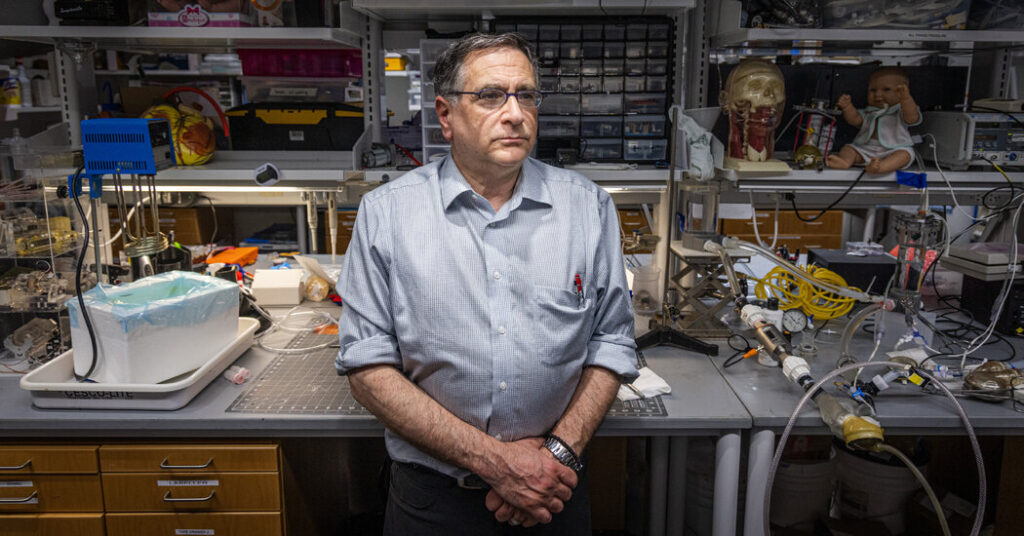
After the Trump Administration froze more than $1 billion in funding for Cornell last April, James Antaki set his sights on retirement.
For decades, Dr. Antaki, a biomedical engineer, had been building an artificial heart for babies and young children, a pump the size of a AA battery, and he was getting close. But with his research grants stopped, Dr. Antaki slowly drained his lab’s rainy day funds, and he was forced to lay off all his staff. After months of waning optimism, he saw no real path forward.
“I’m ready to pack up my bags, because what more can I do?” Dr. Antaki remembered thinking.
Then, right before Thanksgiving, the funding came back: “like by magic,” he said, adding, “it was unbelievable.” Dr. Antaki immediately called one of his former postdoctoral students, but the young scientist had already accepted a job elsewhere. Then came a university hiring freeze and a tangle of other problems that left Dr. Antaki trying to bring his laboratory back to life, before he could even think about resuming the research.
“I’m embarrassed that we’re not making any forward progress — or just baby steps,” he said.
Over the last year, the Trump administration has made deep cuts to the nation’s science infrastructure, forcing researchers to scale back their ambitions, delay critical work or abandon projects altogether. As universities have cut deals with the administration, Dr. Antaki is far from the only researcher whose funding was restored only after being forced to shut down for months.
While restored funding can revive a project, it cannot buy back the continuity and momentum that science depends on. The unraveling of Dr. Antaki’s laboratory illustrates not only how important public funding is for research but also how the damage from these cuts can endure long after the money returns.
Why building a heart for babies is so hard
Every year, there are about 14,000 children hospitalized with heart failure in the United States, but there are not many effective treatments.
For teenagers, surgeons can jury-rig an adult artificial heart, said Dr. Emile Bacha, the chair of surgery at Columbia University Vagelos College of Physicians and Surgeons. But for younger children with severe cardiac conditions, surgeons rely on the Berlin Heart, an external pump that moves blood in and out of the body. Although the device can help keep these children alive as they wait for a heart transplant, it leaves them tethered and confined to an intensive care unit.
Developed in the 1990s, the Berlin Heart also has a fairly high complication rate — most notably infections and strokes. These risks have only compounded with growing wait times for pediatric heart transplants, with fewer children dying in circumstances that allow organ donation and more patients surviving long enough to need them, Dr. Bacha said. So, some children die or become disabled before they can receive a new heart.
The promise of a pediatric artificial heart is that it could be implanted inside sick children, supporting them with fewer complications and more freedom, and potentially eliminate the need for a transplant. But making this device a reality is an extraordinarily difficult engineering problem, said Dr. Joseph Turek, the chief of pediatric cardiac surgery at Duke University Medical Center. The pump needs to be small enough to fit inside a baby’s chest, where the heart might be the size of a strawberry, and gentle enough to circulate blood without making it clot, since a newborn has about as much blood as a 12-ounce can of soda.
“This is really hard research, so it’s really been reserved for idealists,” Dr. Bacha said.
Because of the technical hurdles and the small market size, there is little financial incentive for private industry to get involved, Dr. Turek said. In an analysis of health technology companies, just 0.6 percent of seed funding went to products focused on pediatrics. In many cases, federal support is the only thing keeping such research alive.
“It won’t happen otherwise; the dollars just don’t add up,” Dr. Turek said.
What the funding cuts destroyed
So much of research comes down to timing. Before Dr. Antaki’s grants were frozen, he had the right team in place, time off from teaching, established partnerships and a 30-day animal study planned. But by the time the funding returned, all that momentum was gone.
With the animal study, for example, Dr. Antaki intended to test his devices in sheep of just the right size to model a baby’s circulatory system. When his funding disappeared, he needed to return these sheep to local farms, and in the fall, when the money returned, sheep of that size were no longer available. Similarly, Dr. Antaki needed a pediatric heart surgeon and anesthesiologist to find openings in their crowded schedules to make the two-hour drive to Ithaca and perform the operations — a process he would now have to start all over again. He was also counting on undergraduates to help monitor the animals after the operation, but now winter break was approaching, and most students were preparing to leave campus.
Because this research is so specialized, there are only so many scientists who can move it along, Dr. Antaki said, and his old employees were not sitting around waiting to come back. The postdoctoral student he needed had moved on, and a backup candidate wasn’t allowed to work in the United States because of the broad travel bans and restrictions issued by the Trump Administration.
“I’m struggling just to repopulate the team,” Dr. Antaki said.
In the meantime, Cornell imposed a hiring freeze, and he found himself buried in paperwork to get an exemption and restore agreements with outside partners, even as his teaching responsibilities had resumed. Before the funding pause, Dr. Antaki had secured a manufacturing partner to build his device, but after months of uncertainty, that company walked away. He has since had to search for a new manufacturer, reintroducing the project, working through the specifications and negotiating the contract.
Although his funding was frozen for seven months, Dr. Antaki estimates the ordeal set his research back by at least twice as long. Harder to measure was the loss of trust. For years he had been telling clinical partners that the artificial heart was close, but the freeze turned anticipation into skepticism. In medicine, adopting any new technology requires a leap of faith, Dr. Turek said, and once momentum is broken, it becomes harder to persuade people to buy in again.
With private industry largely uninterested in this kind of research, Dr. Antaki said he was grateful for government funding, despite the whiplash. “There’s no point in being bitter or being angry or getting even,” he said. “I really have no choice but to push forward.”
Simar Bajaj covers health and wellness for The Times.
The post How a Funding Pause Derailed an Artificial Heart for Babies appeared first on New York Times.