Back in my school days, William Golding’s “Lord of the Flies” was ubiquitous, an almost inescapable rite of passage, and while the novel is still on shelves, kept there as much by its Nobel pedigree as its length, Golding’s island has been on the wane for some time.
After all, few novels from the ’50s have aged well in a non-reading, present-obsessed conjuncture. This novel’s dystopic vision of human barbarity might have been stiff stuff in Ye Olden Times (1954), but in these days of school shootings and soaring teen suicide rates, the travails of Piggy and Company come off a little like John Bunyan — too hoary, schematic and, worst of all, too timid, especially if you grew up on “The Chocolate War” or “The Hunger Games” or Japanese bangers like “Battle Royale” or “The Drifting Classroom.”
Savagery, as we all know too well, sure ain’t what it used to be.
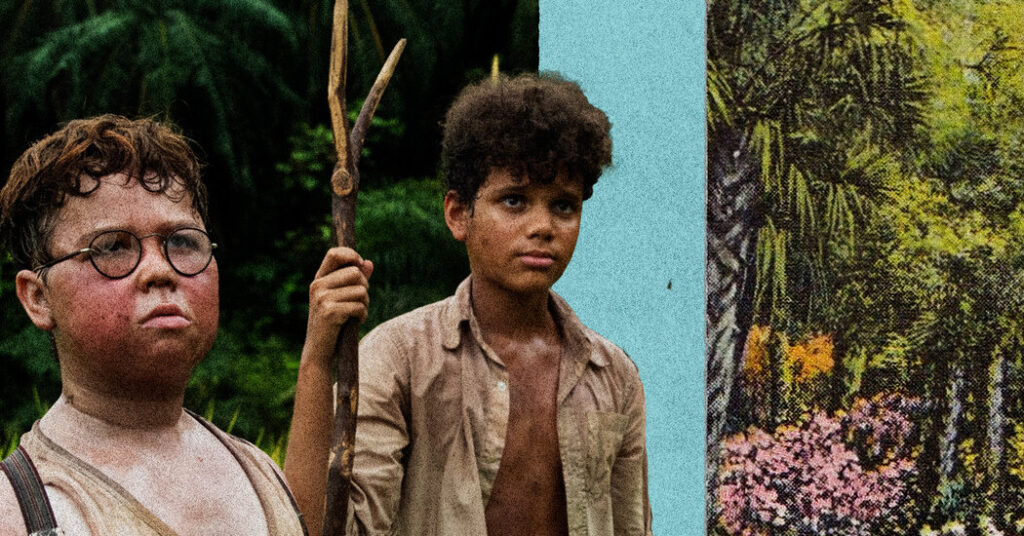
And it is into these carnivorous times that a supposedly faithful adaptation of “Lord of the Flies” has arrived from Jack Thorne, the writer of “Adolescence,” to Netflix, a return that prompts this brother, at least, to ask: Does Golding’s original severed-pig-head-on-the-stick have anything left to say to us?
With its savagery generation-gapped, Golding’s novel doesn’t have a lot to lean on, whittled down as it is to characterological minima. Even more demolishing: “Lord of the Flies” is a victim of its own success, a co-creational powerhouse that has inspired a lot, and I mean a lot, of contemporary takes in these past 70 years. If, as the writer Drew Basile notes, Robinson Crusoe “was the man responsible for a million islands,” Piggy and Company are responsible for an endless archipelago of darker, crazier islands. The text is one that inspires not an anxiety of influence but a voracity of influence, and it struggles as a consequence to interest the very present audiences it has had an incalculable role in shaping.
Not everyone has read “Lord of the Flies,” but thanks to the novel’s million descendants, everyone has encountered the novel’s core conceits and feral mythology, generic monuments that loom titanic over the psycho-oceanography of the zeitgeist.
At the cultural level, Golding’s island has become, in effect, a repeating island par excellence, our culture’s dark Brigadoon with fragments scattered across a dizzying variety of media: graphic novels (“Plutona”), video games (“DayZ,” “Rule of Rose”), television (“The 100,” “From,” “Yellowjackets”) and of course novels (Sarah Goodwin’s “Stranded,” Pierce Brown’s “Red Rising”). There’s so much “Lord of the Flies” in Stephen King’s gothics that I could write a dissertation on it. There are his obvious tributes like “The Long Walk” or the recurring fictional town Castle Rock, named after the fortified outcrop that one of the novel’s tribes inhabited. A reader need only squint at “The Stand” to discern a version of “Lord of the Flies.” Same with “Under the Dome.” Same with “The Mist.” Same with “The Shining.”
Golding’s novel might feel somewhat dated, but his delirious beast-haunted island, in shattered refracted form, sure as hell does not. And many of these newly risen Hispaniolas of depravity have kept up with our rising incivility, our deepening tribalism, our social media derangements.
So could a talent as massive as Mr. Thorne make Golding’s island haunt and disturb when we live in a society that isn’t just obsessed with brutality, it almost is brutality? In a society that has as much patience for historical objects as the show’s bully Jack has for the trappings of civilization? As he says: “An adventure island, what do we do on it? Nothing but boring things. Toilets. Water. Hut building. Boring.”
Spoiler alert: Mr. Thorne fumbles the pig’s head, producing a faithful adaptation that wouldn’t qualify to sit on the bench with far superior and eminently unfaithful adaptations like “Yellowjackets,” much less carry their water.
Mr. Thorne makes some halfhearted feints at updating our tale. Simon is maybe queer. Ralph is mixed-race Black. But both these diversities end up backfiring, doing both too little and too much. The show pitches Simon’s maybe-queerness and Ralph’s Blackness as anachronistically inconsequential in a society of boys that seems to lack much overt bias — diversities without difference, in other words — but then makes their otherness consequential in sneaky ways.
Maybe-queer Simon ends up mob-slain, a maybe-victim of the “bury your gays” trope. Similarly, Ralph suffers a massive agency demotion — reverse affirmative action — in comparison with book Ralph. In the novel, white Ralph helps organize the boys early on. In the show, Piggy does it all. In the novel, Ralph calls Simon’s death a murder, a judgment that novel Piggy outright rejects. In the series, white Piggy is the one with the moral clarity to call a maybe-homophobic slaughter murder, while mixed-race Ralph equivocates. A bizarre glow-up for Piggy when one recalls that in the original editions of the novel, he’s the only character to use the N-word.
You would think the Netflix show would at least do justice to the novel’s violence. But you would be wrong.
Here’s Piggy’s death in the original:
The rock struck Piggy a glancing blow from chin to knee; the conch exploded into a thousand white fragments and ceased to exist. Piggy, saying nothing, with no time for even a grunt … fell 40 feet and landed on his back across the square red rock in the sea. His head opened and stuff came out and turned red. Piggy’s arms and legs twitched a bit, like a pig’s after it has been killed.
In the series, Piggy is rocked in the head by one of the boy-savages, but he’s allowed to limp off to indulge in a long didactic exeunt, with no brain matter in sight.
No last words for Simon, alas. Maybe-queers, on this updated island, die in silence.
In an attempt to make ’50s intolerances palatable, Mr. Thorne has replaced them with occulted versions of our own intolerances and as a consequence makes Simon’s famous observation for him. There is no beast on the island; it’s only us.
Watching this timid, bloated show a third time, I keep trying to imagine what an “average boy” would make of it. The kind of boy whom Mr. Thorne essayed so piercingly in “Adolescence.”
Would he echo Jack — who in this iteration has become recognizably MAGA-coded, with manosphere tics — and denounce the whole four-hour affair boring? Would he see in the muddle a dim reflection of his own precarious life? Both are possibilities, but more likely than not this will be a flick viewed in meme form, something to run in the background as he scrolls on his phone and tries to survive a society far more demonic than the one that unraveled Piggy and his friends — a society that denies him education, housing, employment, medicine, even as it addicts his mind and heart to isolation, misinformation, gambling and porn — and where all sorts of very reasonable people take to social media to advocate their gender’s supremacy or another’s outright destruction.
It ain’t just savagery that ain’t what it used to be; civilization also ain’t what it used to be.
I wonder what might have been had the show, instead of stripping the characters of their historical granularity, heeded Fredric Jameson’s famous edict: Always historicize! If Mr. Thorne had filled in what the novel left unsaid with telling details about what life was like for a motley group of boys grappling with war, adolescence, societies’ relentless degradations in the declining days of Empire? Not an unfamiliar reality for many of us. You wish to add a mixed-race character and a queer protagonist into the mix — characters who plausibly could have been on the evacuation crash? Excellent! Just ground them in a faithful depiction of what life was like for such people in ’50s Britain.
Focus on the hypocritical homosociality of the era, on the small, vibrant early-Windrush Black presence, but don’t hurl characters like these into the present, stripped of the period lifeways that would make them meaningful.
Because ultimately when you deny the present the specific suffering, everyday banalities and subtle resilience of the past, you rob the past of its genius and its humanity, and you rob the present of the opportunity to meet itself in this strange genius and to be inspired by this immigrant humanity. Such a faithful adaptation could have become an opportunity for young people and the rest of us to, as Jameson wrote, “think the present historically in an age that has forgotten how to think historically in the first place” — to break us from the hammerlock of our present and its tyrants and put us into dialogue with our ancestors in all their flawed human dimension.
What Mr. Thorne’s adaptation wishes us to forget, and what a novel like “Lord of the Flies” could remind us of, in the hands of an apt teacher or showrunner, is not only the sameness of our savage islands but an even more urgent lesson: We were different once, really different, and by wrestling with those differences we could be different again, really.
Junot Díaz is a professor of creative writing at the Massachusetts Institute of Technology and the author, most recently, of “Islandborn.” He writes the StoryWorlds newsletter on Substack.
Source photograph by J Redza/Eleven/Sony Pictures Television and Nextrecord Archives via Getty Images
The Times is committed to publishing a diversity of letters to the editor. We’d like to hear what you think about this or any of our articles. Here are some tips. And here’s our email: [email protected].
Follow the New York Times Opinion section on Facebook, Instagram, TikTok, Bluesky, WhatsApp and Threads.
The post We’ve Become Too Savage for ‘Lord of the Flies’ appeared first on New York Times.