William Dean Howells, the editor of The Atlantic, wandered through Philadelphia’s Centennial Exhibition of 1876 trying to make sense of a spectacle that defied description. Two wheels, one small, one large, seemed to tell the story of the great transformation on display. The small one was made of wood—an old spinning wheel set up in a rude log cabin meant to conjure colonial Plymouth. As Howells related, a reenactor playing the Mayflower pilgrim Priscilla Alden paused in her work to give an old Quaker woman a turn. At first, the woman’s “long-unwonted fingers” seemed rusty. She struggled to splice the thread, then got it tangled while Howells and others watched in breathless silence. Finally, though, her dexterity revived, and the wheel came to life “with a soft triumphant burr, while the crowd heaved a sigh of relief.” It was, Howells reflected, “altogether the prettiest thing I saw at the Centennial.”
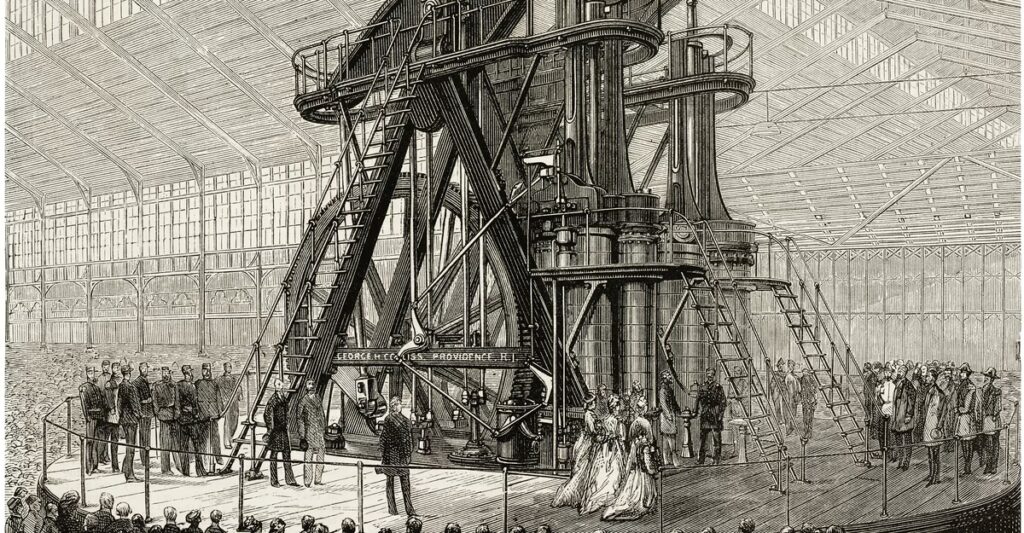
But Howells and millions of other Americans went to Philadelphia as much to look forward as to look back. Far more thrilling than the wooden spinning wheel was the huge cast-iron wheel—30 feet in diameter and 122,000 pounds—turning almost noiselessly at the center of the complex works of the Corliss Engine in Machinery Hall, driven by steam pumped in from a separate building. Howells sat, stunned, before the engine’s “infinitely varied machinery” working “with unerring intelligence.” No Priscilla Alden or old Quaker was necessary here—just a single, mostly idle attendant whose only job was to occasionally put down his newspaper and administer a few drops of oil.
[From the July 1876 issue: William Dean Howells on a sennight of the Centennial]
In Centennial: The Great Fair of 1876 and the Invention of America’s Future, the historian Fergus M. Bordewich takes a tour of the exhibition—and, venturing beyond it, takes the measure of America on its 100th birthday. At not quite 200 pages of text, the book is brisk and tightly constructed, filled with vivid characters and finely wrought, often-wrenching scenes. Along the way, Bordewich finds a country caught between the marvel of its material progress—what he calls a “phantasmagorical theater of national glory”—and the fragility of its ideals and institutions. While the fair celebrated a confident industrial future, the nation outside its gates seethed with violence, corruption, and social inequality.
Writing in our own anniversary moment, when historical narratives are themselves the stuff of cultural and political conflict, Bordewich largely lets the discord speak for itself. But taken together, the dizzying disorientations of 1876 can’t help fueling grim conclusions. Bordewich, who has written forceful histories of the Underground Railroad, the radicalism of the Republican Congress during the Civil War, and Reconstruction-era Ku Klux Klan violence, presents a country turning its back on two revolutions—those of 1776 and 1865. In their place, Americans embraced a third: an industrial revolution that rendered the spinning wheel a quaint relic of the past and the iron wheel an object of faith for the future.
The centennial commenced on the morning of May 10, 1876, with a seemingly providential break in the rain. The program—which included lengthy speeches on the marvels of American growth, and an orchestra playing an array of national anthems from around the world in addition to Richard Wagner’s made-to-order “American Centennial March”—had swelled to fit the exhibition’s hybrid nature. What had originally been intended as a national birthday celebration had been joined to a World’s Fair displaying the material wonders of the Industrial Age. The ensuing event, which ran for the next six months, was designed to show how happily material progress and national glory could be made to blend. Financed through a mix of public and private money and enabled in no small part by the backroom maneuvering of the Pennsylvania Railroad boss Thomas Scott—whose lines stood to benefit from the traffic—it was a perfect Gilded Age confection.
The massive glass-and-iron main building was the largest man-made structure on the planet at the time, encompassing more than 21 acres of floor space. It was just one of some 200 buildings across the site, many of them sparkling architectural showpieces dedicated to, among other things, pomology, photography, brewing, dairy processing, and glassmaking. Nations and states commissioned their own buildings—a Tudor mansion for England, a residence and “bazaar” for Japan, a “cottage” for Connecticut, a Spanish-moss-fringed log cabin for Mississippi. Fairgoers could see some of the first mechanical typewriters in action, sample Charles E. Hires’s root beer, hear the ear-splitting “annunciator” of Western Electric’s new heat-sensitive fire alarm.
When the exhibition closed in November, at least 9,799,392 people—about 20 percent of the U.S. population—had visited, including a 79‑year‑old man who walked from New Albany, Indiana, with the aid of a stick cut and carved in the 1810s. Most of those who went were delightfully overwhelmed. In a letter home, a young woman from Providence, Rhode Island, struggled to find words for what she saw: “Dear Mother, Oh! Oh!! Oh!!! Oh!!!! Oh!!!!! O-o-o-o o-o-o-h!!!!!! Your affectionate daughter, Mary.” Even Alexander Graham Bell, whose newly invented telephone was one of the fair’s sensations, said that it was all “so prodigious and wonderful that it absolutely staggers one.”
Behind the unspeakable wonders of Machinery Hall stood a world of labor—dirty, dangerous, and low-paid—that constituted a grave threat to the values of the republic. Such toil clashed with Jeffersonian ideals that equated independent proprietorship of farms and shops with the moral virtue necessary for honest citizenship. Just before the Civil War, Abraham Lincoln had said that men performing wage labor for more than a short stint suffered from “either a dependent nature which prefers it, or improvidence, folly, or singular misfortune.”
By 1876, industrial wage labor was the permanent misfortune of a growing class of people. Their absence from the spectacle in Machinery Hall was telling. The ingenuity of those who’d designed and displayed the machines fit easily on the trajectory of national greatness; the drudgery of those who did the grunt work off-site did not. The old ethos that Lincoln had believed in still had enough purchase that workers themselves bore the blame for their own miseries. “Had an unfortunate accident this morning,” a Pittsburgh plant manager working for Andrew Carnegie reported (one of Bordewich’s many well-chosen quotes).
Rope on cupola hoist broke and cage fell catching the Hoist Boy in the act of crossing under, crushing him to a jelly. It was caused by the boy’s carelessness, and disobedience of order and the poor fellow paid the penalty with his life. Delayed works slightly.
Events unfolding that summer in Pennsylvania coal country, about 100 miles away from the exhibition, showed how little hope there was to at least improve working conditions through unions and other forms of labor organizing. As Bordewich narrates in an astonishing set piece, the Philadelphia and Reading Coal and Iron Company had seen to that. When it sought retribution against Irish miners who had gone on strike the previous year, it didn’t merely have the backing of public authority in Schuylkill County; it was the public authority. With the help of a private police force, the company’s president took on the powers of a district attorney and personally prosecuted a set of cases against the miners, most of whom were labor activists. In a series of show trials, the men were charged with murder and assorted acts of terror, and 20 were sent to the gallows.
If industrial workers were largely absent from the centennial, Bordewich shows how Native Americans turned into a different kind of disappearing act. Assumed for decades to be “vanishing” before the tide of Anglo-American civilization, they had become objects of ethnological interest, their “primitive” cultures underscoring the marvels of the present age. Taking the lead on the event’s many Native American exhibits, the Smithsonian’s director, Joseph Henry, first planned to stage a living display of several hundred Native Americans—a Museum of Natural History diorama brought to life. But ongoing hostilities in the West got in the way. Instead, Henry sent expeditions to gather as many Native American artifacts as possible, in order to “present savage life and conditions in all grades and places.” For fairgoers, the juxtaposition with mechanical developments was powerful.
Beyond the exhibition, of course, the “vanishing” of Native Americans was not an abstraction but a policy. Writing on “the Indian question” in 1873, Commissioner of Indian Affairs Francis A. Walker had asked, “What shall be done with the Indian as an obstacle to the national progress?” The answer, he hoped, would involve peaceful means, albeit with extant Western Indians coerced onto reservations, where they would be subject to a “rigid reformatory control” while learning to adopt Anglo-American culture and practices. More often, the putative “Peace Policy” devolved into war, as was the case with the American campaign against the Lakotas happening during the centennial.
That campaign—provoked by America’s violation of an existing treaty after the discovery of gold in the Black Hills—produced a great shock at the fair. Just three days after the triumphant Fourth of July celebrations in Philadelphia, news arrived that the Lakotas had routed American forces under the command of General George Armstrong Custer near the Little Bighorn River, in the Montana territory. Custer, who was killed along with more than 260 of his men, had confidently predicted that “civilization in its advancing tread” would “roll mercilessly over” the Plains Indians. Only weeks before, he’d been at the centennial—to take in the wonders of civilization in its advancing tread.
For Black Americans, the centennial posed a pressing question: What place would they have in the national future it claimed to celebrate? Some, such as Representative Josiah Walls of Florida, anticipated that the fair would blot out “all questions of minor differences and all hurtful recollections of past disagreements.” Walls was mostly right, just not in the way he hoped. Bordewich describes how, at a moment when political support for Reconstruction was ebbing, the exhibition staged a reconciliation not between races, but between regions. White northerners and white southerners restored their old bonds of friendship through symbolic gestures—Union and Confederate generals seated together; a relative of Robert E. Lee reading the Declaration of Independence on the Fourth of July.
[Read: Jake Lundberg on an unsettling anti-slavery memorial]
Still, claiming their place in both the exhibition and the nation at large remained a goal of Black Americans. Members of the African Methodist Episcopal Church commissioned a monument to Richard Allen, a prominent Black Philadelphian of the early republic and the founder of the denomination. “We intend to leave Philadelphia in 1876 as did the heroes in 1776, with a fixed resolve to achieve noble results,” the group announced. “And in 1976, we expect our progeny to gather around the Monument in question, shed tears of gratitude for the example we have left them, and call us blessed.” Delayed first by a missed deadline and then by a train accident, the monument was installed just a week before the exhibition closed.
In Allen’s absence, the most prominent “memorialization” for Black Americans was a restaurant, not a monument or a pavilion. When a white Atlanta businessman proposed to open a “Restaurant of the South,” centennial commissioners welcomed the prospect. The waitstaff would be among the only Black employees on the fairgrounds (Black workers were mostly excluded from the centennial), and their job would include playing enslaved people on a plantation, singing “quaint melodies,” and strumming the banjo. Northern fetishization of southern slavery was nothing new; the minstrel show had become popular in northern cities in the decades before the Civil War. But the success of the restaurant and its apparent nostalgia for slavery seemed to complete a notable shift in national sentiment since Appomattox.
[From the November 2025 issue: Clint Smith on telling the full story of Colonial Williamsburg]
Many northerners (Republicans, at least) had linked Black freedom to national progress immediately after the Civil War. That connection had all but faded by 1876, amid violent campaigns to “redeem” southern states from Republican rule and Black voters. As Bordewich relates in a harrowing account, those efforts had turned to South Carolina in the summer of 1876. Well aware that they were in the minority in their state, South Carolina’s redeemers had been waiting for a chance to “provoke a riot and teach the negroes a lesson,” as the future governor and senator Ben Tillman recalled. “It was generally believed,” Tillman wrote, “that nothing but bloodshed and a good deal of it could so well answer the purpose of redeeming the state from negro and carpetbag rule.”
The redeemers had their opening when two white men in a carriage confronted a Black militia marching in a Fourth of July parade in the town of Hamburg. When the two men returned for a court date four days later, they came with a mob and a cannon. The militiamen did not appear at the courthouse, but took shelter instead in a nearby building that housed their weapons and ammunition. In the ensuing standoff, the mob (including Tillman and his rifle club) began shelling the building. When the militiamen were driven from the building, the mob killed six of the men, as well as the town’s Black marshal, cutting out his tongue. The massacre was just a piece of what became a successful campaign to oust the Republican governor and legislature. The following month, a Black South Carolina Republican wrote to President Ulysses S. Grant begging for federal protection after another armed white group attacked a party meeting and demanded that the men “give up the flag” or be shot.
At the centennial’s closing, on November 10, 1876, there was no providential break in the rain. Those on hand for the ceremonies packed into Judges’ Hall for valedictory reflections and final rounds of Handel’s “Hallelujah” chorus, Wagner’s march, and a rendition of “America.” Grant declared the exhibition over, and a telegrapher tapped out instructions to the Corliss Engine’s operator to halt the great machine.
Three days earlier, on Election Day, the great machine of American self-government had also come to a halt. That year’s presidential contest pitted New York’s Democratic governor, Samuel J. Tilden, against Ohio’s Republican governor, Rutherford B. Hayes. Neither was a man of great charisma—Tilden shy; Hayes upright, teetotal, and vague—but everyone knew what was at least nominally at stake in the election. In addition to taking on the widespread corruption with which the Republicans had become associated, Tilden promised an end to Reconstruction. Hayes paid lip service to the rights of former slaves, while also voicing his commitment to reconciliation between the North and the South.
[From the April 1877 issue: James A. Garfield on a century of Congress]
Though the choice was not exactly stark, the outcome was opaque. Bordewich offers a concise account of the tangled mess that followed. Tilden won the popular vote and stood on the precipice of claiming the Electoral College, but given rampant problems and irregularities, the nation “teetered on the edge of a constitutional abyss,” as Bordewich writes. The result came down to three southern states—Florida, South Carolina, and Louisiana—in which both parties claimed victories in state and national races.
Absent the violence and intimidation visited upon Black voters, the Republicans would likely have won each state, but winners were impossible to determine. Florida ended up with three separate vote counts. In South Carolina, where the number of votes exceeded the number of eligible voters, two legislatures and two governors vied for control and haggled over the presidency. Louisiana’s electoral commissioner put the state’s returns up for sale to the highest bidder, while a monitoring commission tossed out the results from 15 parishes in which the fraud and violence had been particularly egregious.
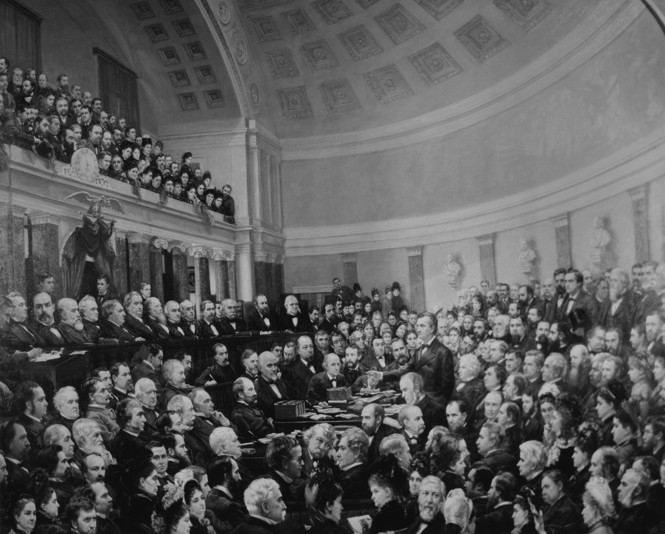
Another civil war loomed. While the White League in Louisiana threatened to attack the statehouse, and representatives of rival governments, all heavily armed, faced off in South Carolina, former Union General George B. McClellan, a Tilden supporter, talked of marching on Washington at the head of an army. Resolution came only through shadowy negotiations and political compromises. Congress created a special Electoral Commission—composed of senators, representatives, and Supreme Court justices—to determine the outcome, but its deliberations quickly broke along partisan lines. In a series of backroom dealings, Democrats agreed to accept Hayes’s election if federal troops were withdrawn from the South. Reconstruction, already heading toward a violent end in places like Hamburg, came to an official close as Hayes removed the last federal troops from the South, seven weeks after his inauguration.
Not long before the Centennial Exhibition ended, a Massachusetts man published a poem in a Washington, D.C., newspaper telling “The Story of Hamburg,” just a few columns over from a grim run of headlines leading an article on continuing violence associated with the election. The poem isn’t in Bordewich’s book, but, like the stark contrasts in its pages, the lines speak to our moment. “Let others tell of the nation’s glory,” the poet began; his attention would be elsewhere:
I sound no paeans of valor and fame— My song is shadowed by strains of sadness; I tell the tale of the nation’s shame.
On the 250th anniversary, we are no less caught between the glory and the shame than our forebears were on the 100th. Since the 1960s, the writing of American history has largely been a project of recovering and reckoning with conquest and its legacies, racism and the limits of democratic practice, and horrific events like the Hamburg Massacre. The aim of the official anniversary proceedings embodied in President Trump’s 2025 executive order has been to “restore truth and sanity to American history”—and, in the process, to recover the glory and forget the shame. That effort was vividly realized in Philadelphia earlier this year, when the National Park Service removed a slavery exhibit from the President’s House in Independence National Historical Park. A federal judge’s order to restore the exhibit is now being appealed, and the fight over where to look—and how to look—at our past remains the crux of our commemorations.
Though we’ll mostly be looking back at 1776 this year, Bordewich has done a great service in calling our attention to 1876. The soundness of our democratic machinery is again in doubt; we, too, wonder at the power of new technology, and what it means for work; race remains a source of conflict and a tool of power. Bordewich is as cautious in drawing such parallels as he is in spelling out the lessons that might lie in the juxtapositions of fairground and background. It’s up to us to hear the echoes, and to make sense of the glory and the shame.
This article appears in the June 2026 print edition with the headline “How America Celebrated Its 100th Birthday.”
The post How America Celebrated Its 100th Birthday appeared first on The Atlantic.