The U.S. job market is fairly stable. But it certainly doesn’t feel that way to most job seekers.
The job market is slow — or as many would say, “stuck” — especially compared to the rocketing growth that followed coronavirus pandemic shutdowns.
Now, hiring is stagnant, the labor force is shrinking and workers who would like to find a new position are nervous to quit their jobs. Yet the job market is not in a crisis. It’s just staid. And that feels bad for the millions who are trying to advance their careers or keep paychecks rolling in.
“It’s not weak; we’re just kind of sitting there,” said Ron Hetrick, principal economist at labor market intelligence company Lightcast.
Here’s what the frozen job market looks like.
A dip from the boom times
Right now there is roughly one job opening for each unemployed person searching for work, a steep drop from four years ago. And that doesn’t include all the people who have jobs and are hunting for new ones.
“The labor market is quite slow right now, but it is relatively balanced,” said Kory Kantenga, LinkedIn’s head of economics for the Americas. “It’s not getting more competitive, but it’s certainly much more competitive than two or three years ago.”
The hiring rate is lower than it was in 2019 and 2020, in the lead-up to the pandemic — and significantly lower than immediately following the pandemic recession.
Businesses have slowed hiring, in large part because global uncertainty has made them wary to expand too much when things could change dramatically at any moment. The labor market showed some signs of warming in April, but economists caution that the weight of the Iran war could show up in the data this summer.
The Trump administration’s tariff policies made it more expensive for American businesses to get materials and products. And now the war in Iran is causing energy prices to skyrocket, making it riskier for companies to take on significantly more employees.
Throughout the tumult, borrowing rates have remained elevated, making it more expensive to carry out expansions. Interest rates are not expected to budge for a while. The Federal Reserve said last month it would leave the baseline rate unchanged for the third month in a row.
“We’re in a labor market that has cooled and has a lot fewer job opportunities,” said Cory Stahle, senior economist at Indeed. “It’s a low-hire, low-fire market.”
That stuck environment has led to lower churn than in recent years; people are staying in jobs rather than looking for new opportunities and risking a prolonged job hunt.
This lack of churn can weigh on workers in the long term. Generally, people can significantly boost their incomes by switching jobs. If they’re wary to do so, they can get saddled with lower salaries.
“Now with inflation rising, you would expect people to try to leverage and get more wage increases or try to get better offers,” said Elise Gould, senior economist at the Economic Policy Institute. But workers aren’t quitting at high rates.
Unemployment holds steady
Despite widespread slow hiring, the unemployment rate has remained at a healthy rate, holding at 4.3 percent in April.
A big reason that unemployment has not jumped is because fewer people are working or even looking for work, meaning the labor force participation rate is shrinking.
“We don’t need as many jobs to keep the unemployment in check,” said Nicole Bachaud, labor economist at ZipRecruiter.
Boomers are retiring, and fewer young people are entering the force. At the same time, some people are opting out of the labor force after long searches for jobs have yielded no fruit.
Immigration has slowed into the U.S., meaning fewer workers are coming in. And, economists note, immigrant workers are also getting swept up in the Trump administration’s enforcement actions, while others are leaving voluntarily. More immigrants left the United States than entered last year, according to Brookings estimates, the first time that’s happened in at least 50 years.
“There’s a slowdown in supply, a slowdown in demand, a slowdown in amount of churn,” LinkedIn’s Kantenga said.
Health care is hiring
The slow hiring rate doesn’t tell the full story of how hard it is to find jobs in many industries. Hiring boomed in tech, food service, finance and other areas after the pandemic slump. But now, many industries are hiring less than they were before the pandemic.
The notable exceptions are in health care and the transportation and warehousing sectors, which are still growing at strong rates. But those jobs don’t always match what job seekers, especially recent college graduates, are searching for.
Many new grads are looking for jobs in finance or tech or professional services, where jobs are relatively scarce. Workers are having to make compromises to get into the workforce.
“It used to be easier to get a job than it is now,” Bachaud said. “And people are getting jobs, but they might be making trade-offs.”
Long hunts for jobs
The number of people who have been unemployed for six months or more has crept up over the past year, and now make up about 1 in 4 of total unemployed people.
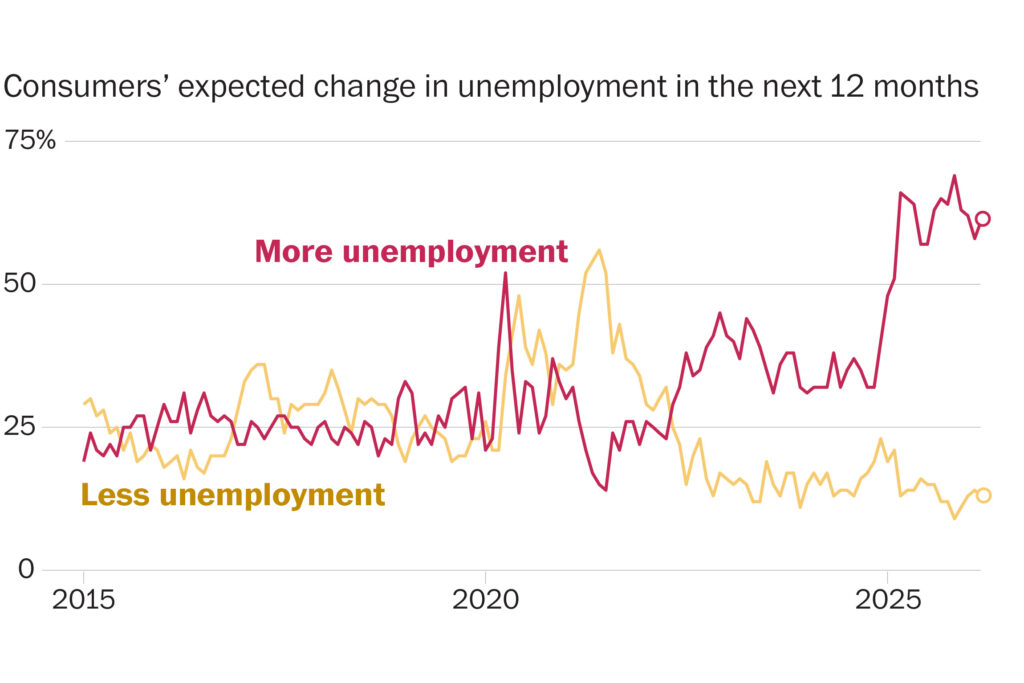
Some people are going without a job for longer as hiring slows. And the longer you’re unemployed, the harder it can be to find a job, labor economists say, souring people’s overall impression of the economy.
The long-term slog of looking for a job can affect seekers’ mental health and confidence, and also can create a stigma for hiring managers. They think ‘Why hasn’t someone else hired this person?’
That thinking can leave a candidate on the market even longer and the cycle “kind of becomes a self-fulfilling prophecy. No one is actually looking at the merits of the applicant,” said Ofer Sharone, a professor of sociology at University of Massachusetts at Amherst, who studies career transitions.
The feel-bad job market
Even though the frozen job market is not a dire situation, it still feels disappointing and frustrating for many workers. It’s especially draining in contrast with the few years that followed the pandemic, a time of rampant hiring and worker power.
It’s a “peak to valley” moment, Bachaud said.
Though many indicators still show the economy is strong, or at least stable, persistent inflation, high interest rates and now rising gas prices are taking their toll. Plus, uncertainty, from geopolitical conflicts to changing economic policies, means the rest of the year could be rocky.
The post 7 charts that explain why the job market is so tough right now appeared first on Washington Post.