TROY, N.Y. — The civic uproar began quietly, when a mom walking her newborn spotted a strange black contraption at the end of her block: a camera topped with a solar panel.
Dierdre Shea researched the camera and learned that it was an artificial-intelligence-assisted license plate reader — the type that have caused privacy concerns across the country in recent months, leading to laws limiting their use in more than a dozen states.
She emailed her neighbors, sparking fierce debate in this town of 52,000 overlooking the Hudson River. Citizens called for the devices to be taken off the streets, and the Republican mayor, who supports the cameras, clashed with the Democratic city council, which tried to halt funding for them.
Last month, Mayor Carmella Mantello, flanked by officers in blue, accused the city council of “defunding” the police and declared a state of emergency to keep the cameras running, a designation usually reserved for floods and blizzards.
“I will not put our city in jeopardy and take these cameras away,” she said.
The cameras at the heart of the debate are run by Flock Safety, a technology company that has built a network of automatic license plate readers in more than 6,000 communities across the country in recent years.
Flock’s system uses AI-enabled cameras to snap photos of every vehicle that passes, creating a digital “fingerprint” that includes data as personal as bumper stickers or gun racks.
Flock cameras are beloved by police because officers can use the company’s national database to track vehicle movements to recover drugs and stolen automobiles, and to solve even more serious crimes. A company spokesman said in a statement that the devices support “communities across the country in addressing crime and locating missing people.”
“At Flock, we believe safety and privacy should go hand in hand, which is why our technology is built around transparency, accountability, and local control,” Chris Castaldo, Flock Safety’s chief information security officer, said in a statement. “Our platform includes safeguards like audit trails to help ensure accountability at every step.”
Yet the company’s rapid expansion has given rise to citizen concerns about intrusive surveillance, worries that have intensified amid reports that federal immigration enforcement officials used the system to target immigrants.
A national mapping project for the license plate readers, DeFlock, estimates that there are more than 90,000 in use in the United States and that over 60 communities have canceled or rejected contracts with Flock and other companies. “Get the Flock Out” is the mantra.
The cameras are not just unpopular in blue states: In tiny Bandera, Texas, the city council voted to terminate its contract with Flock after the public raised concerns and someone vandalized one of the cameras, a move one local news outlet dubbed “extrajudicial Wild West ‘cowboy justice.’”
Here in Troy, City Council President Sue Steele said police installed 26 cameras without council approval or citizen input, a move that has people on edge. The council is reviewing why no one other than the police department signed off on the contracts; anything over $35,000 typically requires the mayor’s signature.
The council has sued the mayor over the emergency declaration and is now considering a law that would limit the cameras’ use.
“I think it was done secretly, and when you aren’t transparent that angers people,” Steele said. “It touches on the nerve of ’1984,’ and ‘Big Brother is watching you.’”
‘Network of surveillance’
Shea, who lives in Troy, was initially perplexed when she first noticed the camera at an intersection about a block from her canal-side home.
She’d heard about Flock cameras but had never seen one, and it quickly became clear that was the device she’d encountered on her walk. She and her partner joked about splattering the camera with a paint-filled water balloon or taking it down with a slingshot.
Flock Safety is one of the largest companies in the rapidly expanding field of AI-powered license plate readers, marketing the systems to police, private companies and homeowner associations as 24-hour surveillance tools.
Proponents say the cameras are a cheap and effective tool to aid police, and they dismiss arguments by the American Civil Liberties Union and others that the surveillance violates Fourth Amendment rights. Flock noted in its statement that courts have ruled that there is no reasonable expectation of privacy in public roadways.
But the cameras also enable law enforcement to monitor public spaces with little accountability and track driver whereabouts that could reveal personal movements, such as attending an Alcoholics Anonymous meeting or visiting an immigration lawyer, said Andrew Guthrie Ferguson, a law professor at George Washington University and the author of the book “Your Data Will Be Used Against You: Policing in the Age of Self-Surveillance.”
“This inescapable network of surveillance gives police a new power that they didn’t have,” Ferguson said.
Some communities have discontinued or rejected contracts with Flock Safety over concerns about data security and privacy, and fears that the technology could be used to target immigrants.
Last year, Flock canceled pilot programs with Customs and Border Protection and Immigration and Custom Enforcement’s investigative arm to combat fentanyl and human trafficking.
However, privacy experts said federal immigration officers are still able to access Flock’s database through local law enforcement partners. In a study last fall, the University of Washington’s Center for Human Rights showed that several agencies in that state shared Flock data with the U.S. Border Patrol last year. The Ohio community of Shaker Heights this month limited searches on its Flock camera systems after activists uncovered documents showing that law enforcement had conducted more than 200 immigration searches.
And there have been other high-profile incidents of misuse, such as the Kansas police chief who was forced to resign after he used Flock camera data to stalk his ex-girlfriend.
Shea, 39, an industrial designer, moved to Troy from the San Francisco Bay Area during the pandemic, part of wave of transplants who have driven the city’s transformation from a fading industrial town to a vibrant hub for tech companies and other businesses. She said she is “not a super political activist type person,” but in February she sent an email to neighbors and friends with the subject line “Flock Cameras in Troy — Please Share.”
“There are multiple ways that our personhood is being taken from us by tech companies,” she said. “I know you can’t do something about it a lot of times, but this is a time we can do something about it.”
A group of activists coalesced to write letters, testify and show up outside City Hall to chant “It’s surveillance, not safety!” Much of their ire has been directed at Mantello, a Troy native whose father was a police detective and who has been an enthusiastic — if blustery — booster of her hometown during her first term.
Steele said that until Shea and the others drew attention to it, the city council was not aware of Troy’s more than two dozen Flock cameras, which had been up for years, first installed as a pilot in 2021 and later expanded.
Troy’s deputy police chief, Steven Barker, said the department signed up for the program after a spate of drive-by shootings and followed the normal procurement procedure for the contract, now $156,000 for two years.
“The cameras are used in almost every investigation our detective bureau pursues,” Barker said, noting that they provided information to solve major crimes, including two homicides. The data is deleted after 30 days, and the police “paused” the town’s participation in the national database in March after outcry.
Shikole Struber, a council member who works in cybersecurity, said she has questions about Flock’s methods of securing data. She said the company hasn’t provided any compliance reports or documentation to the council showing how it is protecting data, after repeated requests, and the police have released only partial audits of the material.
“I am absolutely concerned with the security of Flock still,” she said.
More than 150 people showed up to a city council meeting on March 19 to protest the cameras, crowding into the tiny chamber and spilling down the hall. The mood was raucous. Steele repeatedly pounded her gavel at protesters, who shouted “You’re lying!” at one point when Mantello tried to speak.
The council directed city staff to pause payments to Flock, prompting Mantello to declare the state of emergency to pay the company the $78,000 owed to keep the cameras on.
She accused the council of overstepping its legislative authority. “We are not going to jeopardize public safety here in the city,” she said in an interview.
‘A dramatic escalation’
This month, the council released a proposal for a new law that would limit use of the cameras, requiring most data to be deleted after two days. The mayor has already called it “dangerous, misguided and a gift to criminals.”
It could take weeks to approve. Meanwhile, the city remains under a state of emergency. On Tuesday, the council sued the mayor, demanding that she vacate her “illegal” action.
“The city of Troy is now under a perpetual state of emergency over Flock, which is ridiculous,” Steele said.
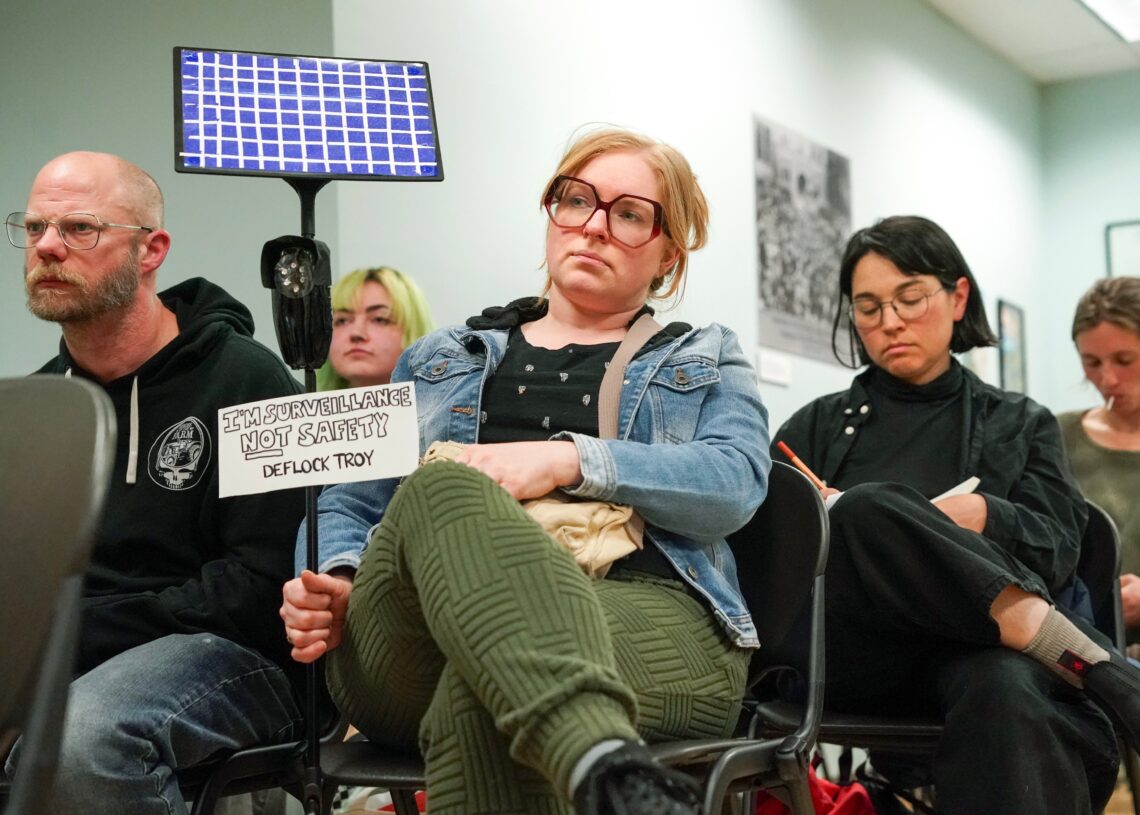
At one recent council meeting, Shea and other activists also urged the mayor to rescind the emergency declaration, suggesting that Mantello is making Troy seem like a dangerous place. One carried a mock Flock camera and a sign that said “I’m Surveillance Not Safety.” Another read a list of past emergency declarations Mantello had made during her time as mayor, including for the demolition of a decrepit hotdog restaurant.
Mantello, who has defended the declarations, stood in the back with her aides, smiling, seemingly unbothered by the criticism.
“It just feels like such a dramatic escalation of events,” Shea said from the lectern when it was her turn to speak. “I don’t think the mayor and the police department really understand how these cameras work — and they have not provided any concrete data as to why they are deserving of emergency funding.”
After she was finished, she darted up to the mayor and whispered, “I really mean it, I think we should meet.”
“Sure, sure, sure,” the mayor said, still smiling.
Despite the activists’ pleas, however, the mayor’s position has not changed. The state of emergency will remain in force, she said. And, she added, the cameras are never coming down.
The post AI license plate cameras tore this town apart and led to a state of emergency appeared first on Washington Post.