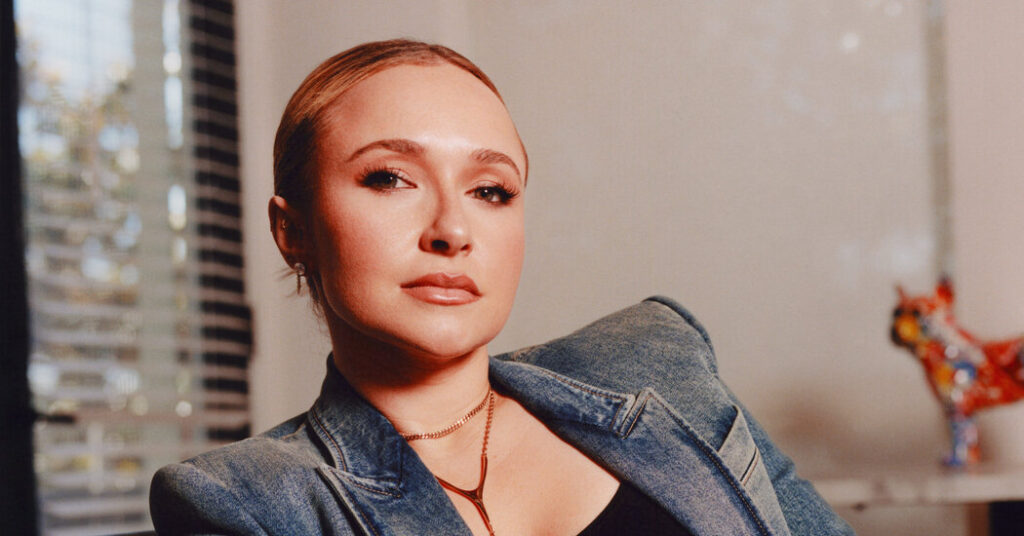
Hayden Panettiere did not want to sit still. Moments after she said hello via Zoom from her Los Angeles condo, she asked if she could walk back and forth while we talked. The movement helped her process her thoughts. And so, clad in a black hoodie, her blonde hair pulled back tight, Panettiere, a two-time Golden Globe-nominated actress who has lived her life in front of cameras since she was 11 months old, started to pace.
After a tumultuous decade that involved crippling postpartum depression, addictions to alcohol and Klonopin, losing custody of her daughter, stints in and out of rehab and, finally, sobriety, she’s gearing up for the release of her memoir, “This Is Me: A Reckoning,” out on Tuesday.
Along with returning to acting and becoming a published author, Panettiere, 36, said she has a “laundry list of aspirations” for this new phase of life. She’d love to produce and direct, maybe create a jewelry or makeup line and — what the hell — perhaps she’ll launch a lifestyle brand. But first, she’s focusing all her energy on the release of the book.
“This Is Me” chronicles her early years as a child star in soap operas and her breakout role, alongside Denzel Washington, in “Remember the Titans.” Her turn as the Texas cheerleader Claire Bennet in the hit NBC series “Heroes” had Teen Vogue calling her an “all-American beauty” on its cover, and tabloids printing photos with captions calling out her cellulite.
Panettiere writes that she suffered from body dysmorphia as a result. This was the early 2000s, an era when the paparazzi were ruthless, especially when it came to young female celebrities like Panettiere, Lindsay Lohan and Paris Hilton.
“It blows my mind that people could be so cruel,” Panettiere said when I asked her about that time. “Looking back as an adult and a mother of a daughter, it’s hard to believe that grown adults were OK with ripping you apart at such a tender age. At any age, really.”
If you ask a celebrity why they finally decided to write a memoir now, they’ll tell you they’re tired of their story being told, often incorrectly, by other people. They’ll explain that they want to reveal their truth, in their words, on their terms. They’ll say it’s time to get honest and raw about the gossip, the past traumas, about whom they did and did not date.
For millennial women like Hilton, Keke Palmer, Lena Dunham or Jennette McCurdy, those truths often involve revelations of abuse, body image issues and addiction. Panettiere is no exception, and her story also involves grieving the death of her younger brother, Jansen, who dealt with substance abuse. He died in 2023, at 28, due to heart complications.
Panettiere, who worked closely with a collaborator and with Suzanne O’Neill, the executive editor at Grand Central, which is publishing the book, said that writing about her brother was the hardest part of the process.
“It’s been three years, and I wish that time healed that kind of loss,” she said. “I hope it keeps his memory alive. He always wanted to be famous, and maybe now he will be.”
The memoir isn’t all grief and struggle. There are stories about her idyllic childhood in the secluded Hudson Valley enclave of Snedens Landing, where she meets famous neighbors like Bill Murray and Björk. She writes lovingly of her father, an N.Y.P.D. officer and later firefighter who took her to a few auditions but who mostly watched her career from the sidelines.
Later, when Panettiere was 16, she discovered that her father cheated on her mother. She was distraught, but they eventually repaired the relationship.
It was her mother, Lesley Vogel, an actress, who got their 11-month-old into modeling and shuttled her to auditions over the years. Panettiere writes that she appeared in about 50 commercials by the time she was 5.
Her mom wasn’t cruel, but she did push her young daughter to succeed.
“‘Don’t phone it in’ was her favorite line,” Panettiere writes. “It was my signal to get my act together and reach the top of my game — stage fright or not.”
When I spoke to Panettiere, she said that neither of her parents had read the book, and that mining those early memories was difficult.
“You always want to think the best of your parents and see them in the brightest light,” she said. “But there were a lot of things done with an approach that was not about my mental health or what was emotionally or mentally safe for me to do. That’s a tough realization.”
(Responding to unflattering prepublication reports, her mother told the New York Post that “the present drama is partially to sell books.”)
To access sadness for the camera, Panettiere would imagine the death of a pet. As she got older, the images became darker.
“It was almost like I became numb to those small sadnesses, and I had to up the ante every time,” she said. “I could connect crying and feeling that kind of emotional pain as something that was going to make people happy with me.”
In the book, she explains that those early connections likely set her on the path to anxiety, depression and substance abuse, writing, “Is it any wonder why I’ve faced so many real struggles in my life?”
Those struggles, and Panettiere’s eventual recovery, were what intrigued Grand Central’s O’Neill, who described her story as “riveting.” They spent about two years on the book, looking to find a tone that was confessional and entertaining, but never self-pitying.
“One thing that makes a good memoir is when the author is willing to make herself really vulnerable,” said O’Neill, who has edited memoirs by celebrities like Flea, Mindy Kaling and Abbi Jacobson. “Hayden was willing to go there, and show readers how to come back from a dark situation and be stronger for it. It was important to her that she never come across like a victim, or woe is me, and that’s a fine line to walk.”
Panettiere became famous during a time when Harvey Weinstein was still producing movies, and before laws were enforced to punish hackers who posted nude photos of celebrities online.
Her Hollywood is depicted as incredibly dangerous, for young women especially. When she was still a teenager, she writes, an older representative on her team handed her a “happy pill” on the red carpet to pep her up. She found herself at parties with predatory men, fending off sexual advances and inappropriate comments. Yet she felt like she had to keep those encounters to herself.
“It was terrifying, and I know I am speaking for many young women in my industry who have gone through the same thing,” she said. “Some have chosen to be vocal about it and some are not ready yet or never will be ready to share it. I’m hoping I can open people’s eyes.”
In 2009, Panettiere met and fell in love with the champion boxer Wladimir Klitschko. They got engaged, and she gave birth to their daughter, Kaya, in 2014, during her six-season run as country music star Juliette Barnes on “Nashville.” Postpartum depression led her to alcohol and pills as a way to mask the anxiety she was experiencing.
When Kaya was 3, Klitschko asked Panettiere to sign papers granting him sole custody of their daughter. The tabloids, of course, jumped all over the news. Panettiere’s struggle to find sobriety also got these outlets plenty of clicks. According to Panettiere, the writers and producers on “Nashville” used what she was experiencing to inform their story lines. If she was pregnant or battling addiction in real life, then Juliette Barnes was, too.
She never thought to tell them to stop, or to ask for help. Just like when she was a little kid, imagining a pet’s death to force a cry, she fell in line.
“That was ingrained in me from a very young age. I was a soldier. Never for a second did I think to say, ‘Hey I’m not comfortable with this.’ I was much more terrified of making them upset and of them not wanting to work with me or hire me again, because I was seen as a difficult actor.” (Series executives did not respond to requests for comment.)
Before she got sober after an eight-month stay in rehab, Panettiere was in an abusive relationship with Brian Hickerson. In 2021, he served time in jail after pleading no contest to two felony counts of injuring the actress.
She writes that in working the Twelve Steps of Alcoholics Anonymous, she came to forgive Hickerson. “He also had a big heart full of pain, just like mine, and I had love for him — despite what he’d done to me,” she writes. “Those were feelings I knew I’d probably spend my whole life working through.” (In a recent interview with TMZ.com, Hickerson didn’t dispute the portrait of their relationship, saying, “It speaks for itself.”)
Memoirs are about choices. What you choose to reveal, and what you keep close. Panettiere said she “dove into the book headfirst” and wanted to be as honest as possible. As they worked through the memories, O’Neill said she was struck by “the sheer volume” of incidents in Panettiere’s young life.
“It’s shocking to read it all,” the editor said, “and see how she came back from that.”
Panettiere has appeared in a few movies over the years and hopes to continue acting. She said she now has “an incredible bond” with Kaya, who is 11 and lives in Europe. Kaya is getting to the age where she seeks out her mom’s advice and opinions, about fashion or friends or the future. “I dare say we even have a friendship,” Panettiere said.
She hopes her story will help anyone who has experienced loss, like she has, or who battles addiction. When the book is out in the world, Panettiere knows headlines will be written, comments will be made, and readers will share their own stories with her. It’ll be both healing and, at times, hard to hold. But she’s ready.
Before we said goodbye, I asked Panettiere how she feels today, having relived her past triumphs and traumas, and put them on paper for the world to witness.
“I just can’t believe I made it through alive,” she said. She was still pacing.
The post Hayden Panettiere Can’t Escape the Drama appeared first on New York Times.