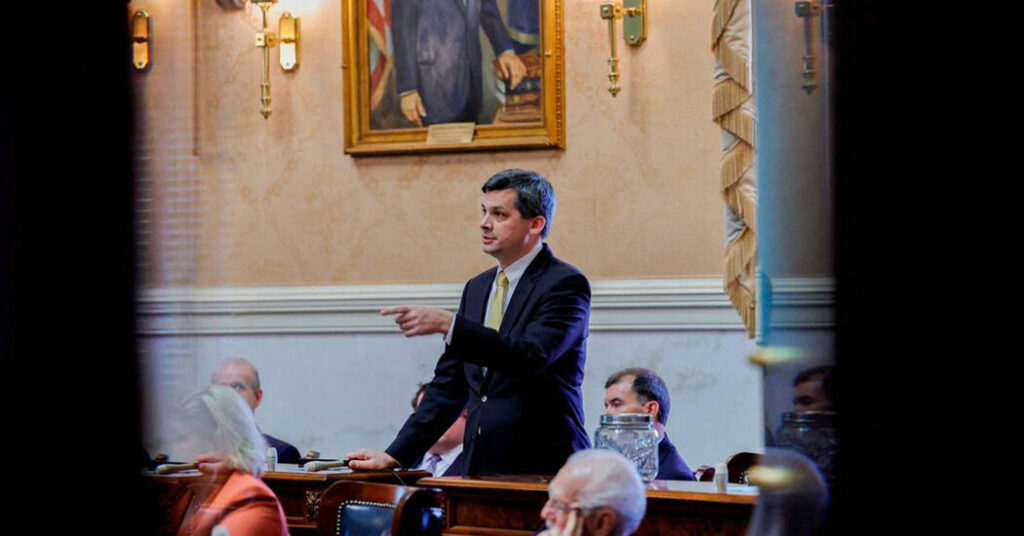
Last Tuesday, the Republican majority leader of the South Carolina Senate, Shane Massey, stood before his colleagues and gave a speech that exemplified two virtues that can seem almost extinct in the Trump Republican Party: wisdom and courage.
Days before, he had received a call from President Trump asking for his support for a midterm gerrymander in South Carolina. Trump wants South Carolina to follow the lead of Texas, Tennessee and other Republican-led states to try to wipe out as many Democratic districts as possible.
But Senator Massey said no. He would not agree to gerrymander Democrats out of existence in South Carolina. Specifically, he vowed — and voted — to protect James Clyburn’s district. Clyburn is the only Black member of the House from South Carolina.
And when Massey said no, he didn’t just defy a president; he defied many of his Republican colleagues and he undoubtedly defied many of his own constituents. He made his speech one week after Indiana primary voters defeated at least five Republican state senators who’d refused to gerrymander their state further.
South Carolina is already heavily gerrymandered. Democrats usually get roughly 40 percent of the statewide vote in presidential elections, but the state has six Republican districts and one Democratic district.
Massey’s speech is notable not just for its defiance, but for its depth. Using the plain, populist language of a Southern politician (there are lots of y’alls in there), he made both a principled and a pragmatic case for American pluralism.
Before we get rolling on the speech itself, I should mention that Massey is no Republican squish. In the speech, he calls himself a “rabid partisan.” He agreed that Washington Democrats are “crazy.” He said some Democratic ideas are “wacky.” He included a flattering reference to one of South Carolina’s favorite sons, John C. Calhoun.
For those who aren’t familiar with Calhoun, he was one of America’s most reprehensible politicians. He almost split the Union before the Civil War, and he referred to slavery as a “positive good.” Massey also said: “I’ve got too much Southern in my blood. I’ve got too much resistance in my heritage” to capitulate to pressure. This is not a man who’s about to switch parties.
At the same time, however, Massey recognizes that there are issues that transcend partisan politics and that legislators don’t just exist to exercise power. They should also, well, safeguard the Republic, including by upholding the letter and spirit of the Constitution. If any American faction tries to crush its opponents through the use of raw power rather than debating and defeating its opponents in the marketplace of ideas, then it places the American system under intolerable strain.
It’s worth watching the entire speech, but you can also boil it down to a few simple points.
First, our system wasn’t designed only to divide power between the different branches of the federal government, but also between the federal government and the sovereign states. Trump should not dominate the federal government, and he should not dominate the state of South Carolina.
“The separation of powers may actually be the most important governmental doctrine that has been created in the history of man,” Massey said. “It is that important. And what the Congress has done to relinquish their authority to the executive is terrible. And we all see the results of that.”
As for South Carolina, there is “another brilliant creation, and that is of federalism and the sovereignty of the states. I don’t want to be a participant in further eroding federalism and further diminishing the essential role of states.”
Second, Republicans in South Carolina should not try to destroy the Democratic Party in their home state. In fact, Massey made an argument that we rarely hear any politician make. “I will tell my Republican friends: Republicans are stronger when the Democrat Party is vibrant and viable,” Massey said, “We are. Competition makes you better, y’all.”
People often say that America needs two healthy parties. This is a matter of common sense. In a two-party system, power will change hands regularly, and if power is lurching between the competent and the incompetent, between the honest and the corrupt, then the system will not just tip out of balance sometimes, but will be inherently unstable.
We don’t often think, however, that healthy political parties can make each other better. Yet this also makes sense. To defeat a viable opponent, a party has to rise to the challenge. It has to fix its failures. It has to innovate. Defeating a sclerotic rump of a party is no achievement. Instead, one-party rule enables corruption. It fosters stagnation.
This is human nature. If you take a test that you know you’re going to pass, how hard do you study? If you run a race that you’re guaranteed to win, how hard do you push yourself?
Third, Massey dealt directly with one of the most pernicious arguments in politics: You should try to crush your opponents because if the roles were reversed, then they would surely try to crush you. You should, in other words, engage in pre-emptive retaliation for an imagined offense.
What was Massey’s response to the claim that the Democrats in South Carolina would do the same thing to Republicans if they had the chance? “I would hope that wouldn’t be the case, but I’m not naïve. My larger question, though: Is that the way it should happen? ‘They do it to you, so you should do it to them?’ Do unto others as you believe they would do unto you? Is that it?”
“I don’t remember that being the context in the Gospel of Matthew,” he said, “and I don’t think the Messiah meant it only as something to apply to children, but how we interact with each other.”
Fourth, he made a point that every American leader should remember. This nation — the most powerful in the world — cannot be conquered by an outside foe, but it can destroy itself. And it will destroy itself if it abandons its founding principles and its founding values. “Maybe we become convinced that the only way to preserve the Republic is to implement policies that are contrary to the founding ideas of the Republic,” he worried. “Maybe we turn on ourselves. Maybe 250 years in,” we will no longer be able to keep our Republic.
I know that I disagree with Senator Massey on many things, not least on his regard for Calhoun, much less on being a rabid partisan, but if we’re going to get through this terrible national moment, we cannot rely only on our own political allies or a single political party. Our Republic will have to be rescued by people who voted for Trump three times, alongside people who resisted him from Day 1.
I also know that Massey is engaged in an almost certainly doomed struggle. His vote — along with those of four of his Republican colleagues — denied Republicans the two-thirds majority they needed to continue the legislative session and move forward with redistricting.
On Thursday, however, the Republican governor, Henry McMaster, called a special session, and a new congressional map can pass with a simple majority vote.
When I speak in public, I’m often asked what gives me hope. My answer comes from unexpected people in unexpected places who demonstrate uncommon virtue.
At the grand scale, I think of the Ukrainian comedian who has defied the Russian bear. I think of the vice president who found his voice when an angry mob came for his head. I think of a Canadian prime minister who stood up to a president and articulated a compelling vision for preserving the free world.
But the smaller battles matter as well. And now I think of a Republican state senator who knew he would probably lose (and might lose his seat as well), but made his stand nonetheless.
And he made a statement that I’ve longed to hear in the age of Trump: “If we’re going to lose this radical idea of a nation conceived in liberty and dedicated to the proposition that all men are created equal, a nation that in its Constitution guarantees to each state a republican form of government to ensure the debate of ideas — if that’s going to happen, Mr. President, by God, it’s not going to be because I surrendered it.”
“I’m voting no.”
The Times is committed to publishing a diversity of letters to the editor. We’d like to hear what you think about this or any of our articles. Here are some tips. And here’s our email: [email protected].
Follow the New York Times Opinion section on Facebook, Instagram, TikTok, Bluesky, WhatsApp and Threads.
The post We Need More ‘Rabid Partisans’ Like Shane Massey appeared first on New York Times.